Jev 1.14 adds images, a box type and an update timeline
- Source
- typesafe.ai
- Publisher
- TypeSafe AI
- Author
- OpenRouter
- Date
Context
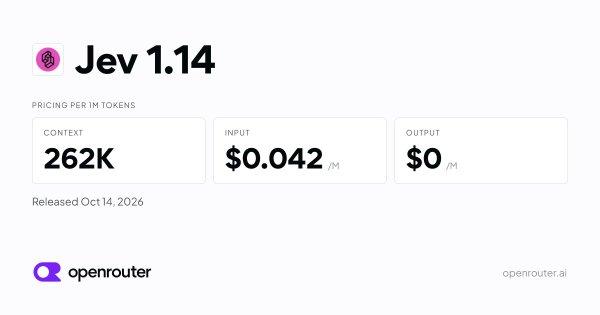
Jev is TypeSafe AI's model for decisions inside software. Instead of writing prose, it returns typed answers such as categories, yes/no judgments and ratings with confidence scores, as Simon Willison explained at launch. OpenRouter has added version 1.14 at the same price as before, $0.042 per million input with no charge for output. TypeSafe's release post splits the release into two parts: a modest default upgrade and a set of experimental features kept behind explicit flags.
The upgrade itself is meant to be dull. TypeSafe says most things in jev-1.14.0 should be a tiny bit better, with the largest gain expected in multilingual support. The timeline matters more than the gains for anyone already using Jev. The new version first ships under the jev-preview name, and the floating jev-latest alias will point to it after a week, so code that calls jev-latest changes model automatically, while code pinned to jev-1.13.0 keeps the old one for a while. TypeSafe says it intends to give 60 days' warning before 1.13.0 is formally deprecated and 30 days for 1.14.0, and to publish a deprecation policy before then.
The new capabilities sit in what TypeSafe calls the danger zone: features switched on with request headers that the company says are still too uneven, or jagged, for it to vouch for in production. Image input is enabled with TypeSafe-Danger-Zone-Images and works in the existing 1.13.0 as well, which TypeSafe says was all along. Images can go anywhere the JSON interface accepts input, including the , the instructions and the decision criteria, though the company warns that all models, Jev included, do worse on images than on text. A new box type returns a single bounding box around something in an image; it is TypeSafe's first output type not aimed purely at if-style decisions, and it works only on 1.14.0. A third header lifts Jev's production limit. TypeSafe says Jev supports longer inputs than it has enabled but is less reliable on them, and it still recommends keeping inputs short. Separately, users can opt in to let TypeSafe inspect their queries to help it find weak spots; the company says it still will not train on them.
- Token — A piece of text, such as a word, part of a word or a punctuation mark, that a language model represents as numbers and handles as a unit.
- multimodal — A model that works with more than text — reading images, audio, or video, and sometimes generating them too.
- State — Information describing a system at a particular moment, such as its current text, settings or saved records.
- Context and context window — Context is the information available for a generation; the context window is the capacity available to hold it.