As a test of our progress to advance the frontier of AI research, in June we entered the next generation of our autonomous AI research system, AIRA₃, in a live Kaggle competition run by NVIDIA to fine-tune a 30B Nemotron model. The challenge was to teach the model to reason better — all competitors had access to the same information and were graded externally on a private test set.
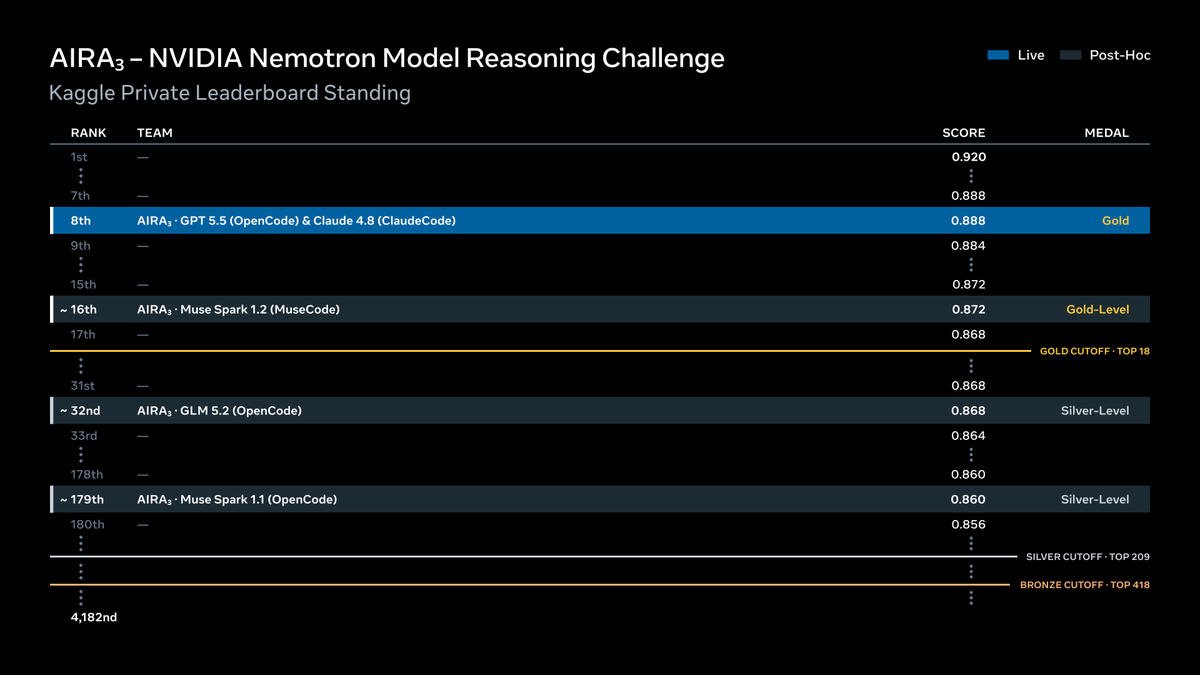
AIRA₃ placed 8th out of ~4,000 teams to win Gold, outperforming human competitors who had access to the same frontier tools.
We believe this is a reliable signal that AIRA₃ can improve a targeted capability of an AI model at a level similar to human experts.
We entered AIRA₃ with an ensemble of models in the live competition, and also assessed it with several others post-hoc. The 8th ranked gold medal entry ensemble was a combination of GPT 5.5 (w/ OpenCode) + Claude 4.8 (w/ ClaudeCode).
Post-hoc we assessed with Muse Spark 1.2 (w/ MuseCode), which also performed at a Gold Medal level, as well as Muse Spark 1.1 (w/ OpenCode) and GLM 5.2 (w/ OpenCode), both of which achieved Silver Medal level performance. The post-hoc submissions were also graded externally on the same private test set as those made during the live competition.
Rather than relying on a central controller, AIRA₃ runs many long-running agents (pairs of models + coding harnesses) in their own isolated environments and coordinates asynchronously through two shared substrates:
1️⃣ a forum for sharing hypotheses and findings
2️⃣ a shared filesystem for solution artifacts
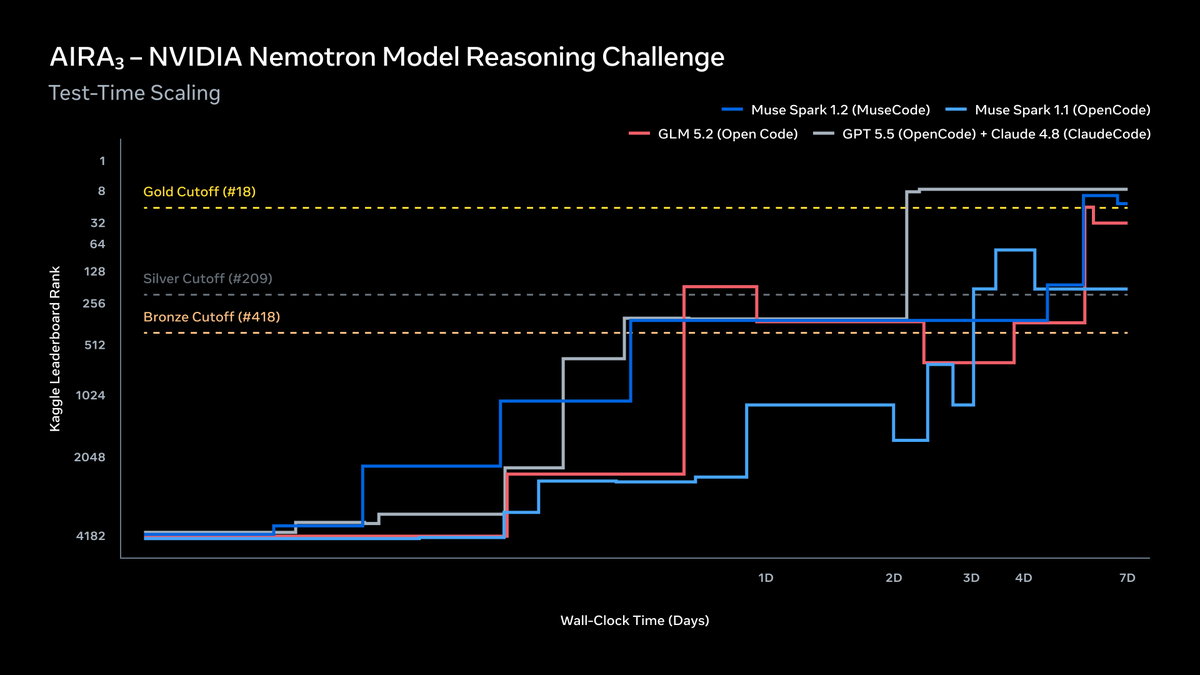
The individual agents collaborate, share discoveries, and build on each other’s work. As the graph below demonstrates, the system uses compute to compound knowledge and drive performance gains over time. Search strategies emerge dynamically as each agent decides which discoveries to build upon.
While the Kaggle competition demonstrated AIRA₃’s capabilities in a specific domain, the system itself can generalize across distinct domains: changing only the task specification. In an internal benchmark, AIRA₃ achieved a 27% latency reduction on production GPU kernels, and gold-level performance in another Kaggle competition translating 4,000-year-old Akkadian clay tablets into English.
We're early, and hard problems are still ahead of us. But we believe a system that compounds its own knowledge is the right bet. As we continue to develop and scale, we’re excited about its potential to accelerate AI research and unlock recursive self-improvement.
AIRA₃'s 8th-place gold-medal entry was an ensemble of GPT-5.5 running inside OpenCode plus Claude 4.8 running inside Claude Code, not a single model.
Post-hoc, outside the live competition, Meta also assessed Muse Spark 1.2 with MuseCode at gold-medal level, and Muse Spark 1.1 plus GLM-5.2 (both with OpenCode) at silver-medal level, graded on the same private test set.
Rather than a central controller, AIRA₃ runs many long-running agents in isolated environments that coordinate asynchronously through two shared substrates: a forum for hypotheses/findings and a shared filesystem for solution artifacts.
Meta says the same system generalizes across domains by changing only the task spec: internally it cut production GPU kernel latency by 27% and separately reached gold-level performance translating 4,000-year-old Akkadian clay tablets.
Terms in this piece · Glossary
fine-tuning — Taking a trained model and training it a bit more on your own examples so it gets better at one specific job.
Why it matters
Meta's AIRA₃ won Gold in a live Kaggle fine-tuningTaking a trained model and training it a bit more on your own examples so it gets better at one specific job.Full definition → competition against human teams using the same tools, coordinating many isolated agents through a shared forum and filesystem instead of a central controller.


 articleNVIDIA AVO Reaches 100% on ARC-AGI-3, Demonstrating a Frontier-Level General-Purpose Architecture for Long-Horizon Autonomous AgentsTanya Lenz
 podcastAjeya Cotra – Inside the OpenAI agent swarm that hacked Hugging FaceDwarkesh Patel