Meta's Muse Glimmer: A 30B Open-Weight Agent Model for Consumer GPUs
- Source
- scontent-phl2-1.xx.fbcdn.net
- Author
- AI at Meta
- Date
Context
Meta released Muse Glimmer in August as an Apache 2.0 open-weight model for agents that run locally. The technical report it published in October explains how that works: its primary design constraint was fitting within 32 GB of memory, which the authors call the practical ceiling for consumer hardware. The model has about 30 billion parameters, takes text and images and returns text. Meta's announcement says it runs at practical speeds on a Mac or PC with one consumer GPU at 4-bit precision, and the report's conclusion names a single RTX 5090.
The first choice was between a dense model and a model, which activates only some of its parameters for each token. Meta trained scaled-up series of both kinds while holding the memory used at inference fixed, and reports that at this size the dense model gave 2 to 2.5 times better compute efficiency, so it chose dense. Because memory use in long agent sessions is dominated by the , the stored attention state for earlier tokens, three of every four layers only attend to the last 2,048 tokens, and each layer keeps just two key-value heads. A compressed-attention alternative was tested and dropped because it did worse on long-context benchmarks. Much of the model's capability is inherited from Muse Spark, Meta's frontier model. Glimmer was pretrained to match Spark's output probabilities, and in post-training it generated its own attempts while Spark scored each step, which the authors say worked better than going straight from fine-tuning to reinforcement learning.
, meaning storing the weights at lower precision, closes the remaining gap. At full BF16 precision the weights take 55.7 GB, so Meta targeted under 20 GB to leave room for the KV cache, the image encoder and a draft model. Of the schemes tested, a search-based mix of 4-, 5- and 6-bit tensors called EvoPress (19.65 GB) was picked for 32 GB machines, and llama.cpp's smaller Q4_K_M profile for 24 GB. Across 15 benchmarks, Meta reports average accuracy of 75.7% at full precision, 75.6% for EvoPress and 74.8% for Q4_K_M. For speed, the report pairs quantization with : a small DFlash drafter guesses blocks of upcoming tokens and the main model checks them. The report gives no tokens-per-second figures in its main text.
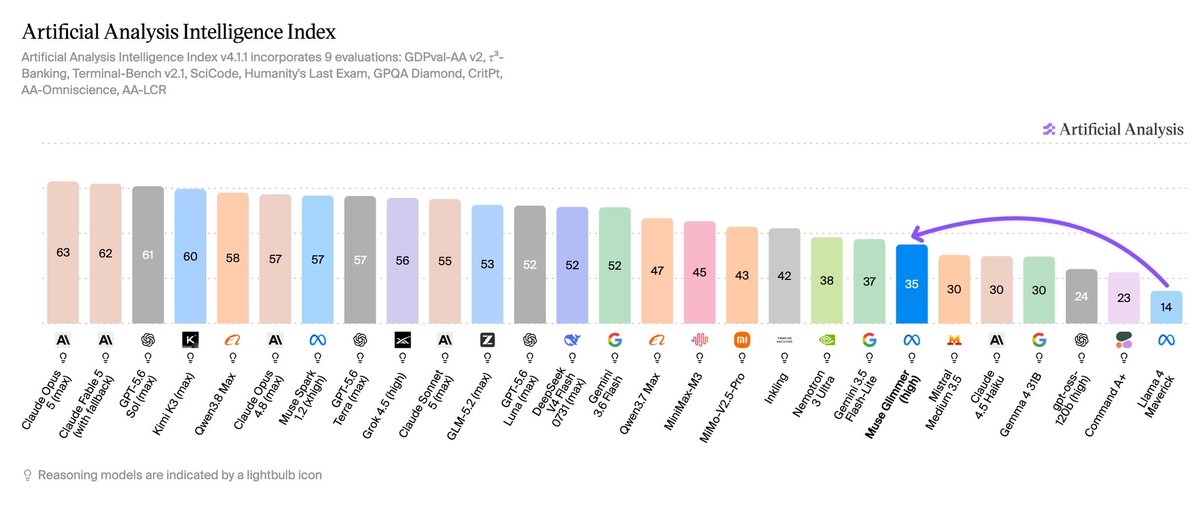
The claim that Glimmer leads comparably sized open models, Google's Gemma4-31B and Qwen's Qwen3.6-27B, comes from Meta's own scorecard. When the model launched, Artificial Analysis scored it 35 on its Intelligence Index, just behind Qwen3.6 27B at 38. In a follow-up, it reported that Glimmer's gaps against its class concentrate in agentic evaluations, where it trailed Qwen3.6 27B on GDPval-AA and Terminal-Bench, while Gemma 4 31B did worse than Glimmer on those measures. The report also describes training the model to resist prompt injections hidden in tool results and to avoid oversharing private information when acting on a user's behalf.
- mixture-of-experts — A model built from many specialist sub-networks where only a few activate per token, giving big-model capability at small-model running cost.
- KV cache — The memory a model keeps about text it has already read, so generating each new token doesn't require reprocessing the whole conversation.
- quantization — Shrinking a model by storing its numbers less precisely — like rounding — so it runs faster and fits on smaller hardware, at a small quality cost.
- speculative decoding — A speed trick where a small model drafts several tokens ahead and the big model verifies them in one pass, often doubling generation speed.





Checking sign-in…
Loading comments…