Have Ai Capabilities Accelerated
- Source
- epoch.ai
- Author
- Epoch AI publications
- Date
Context
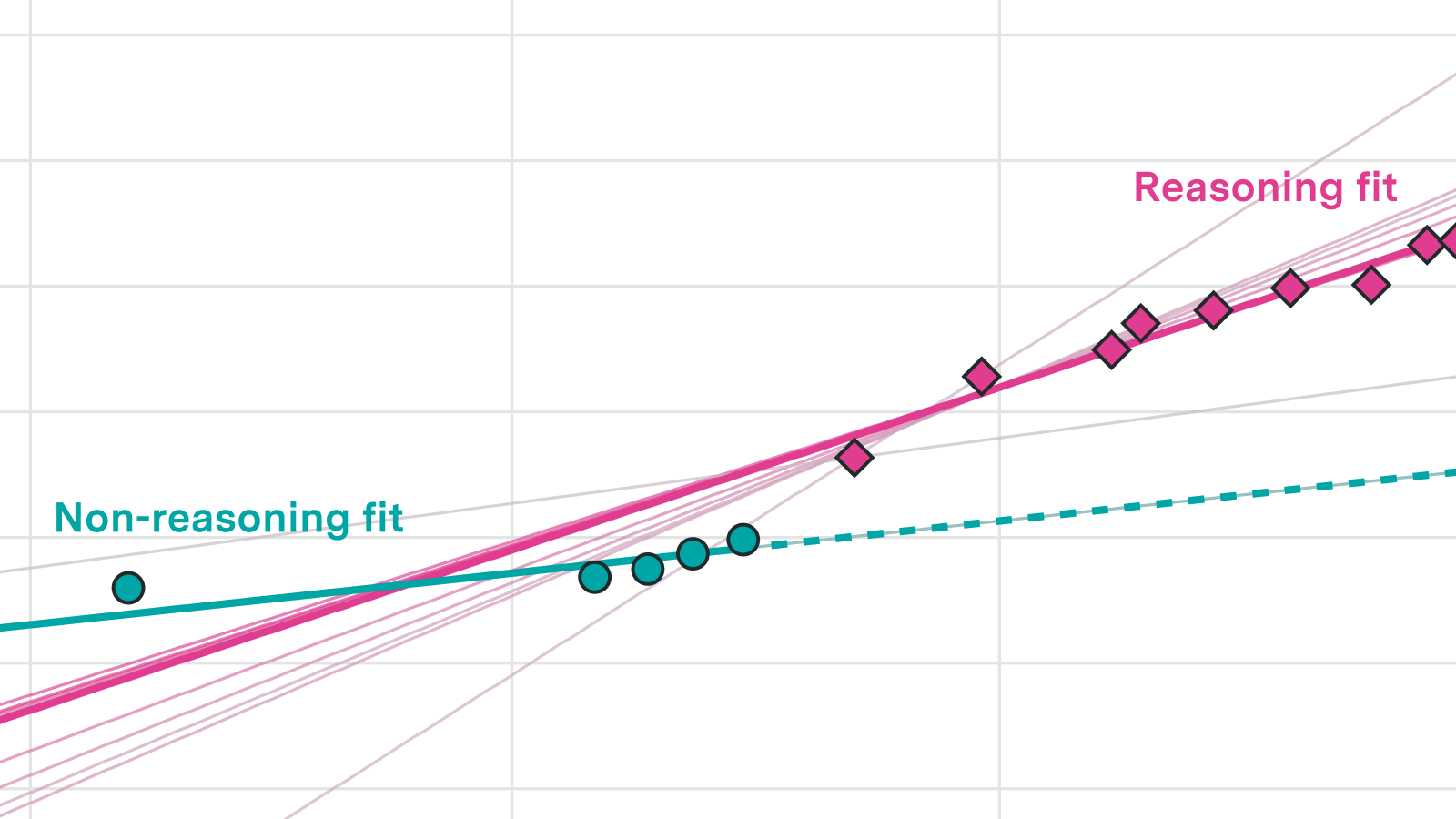
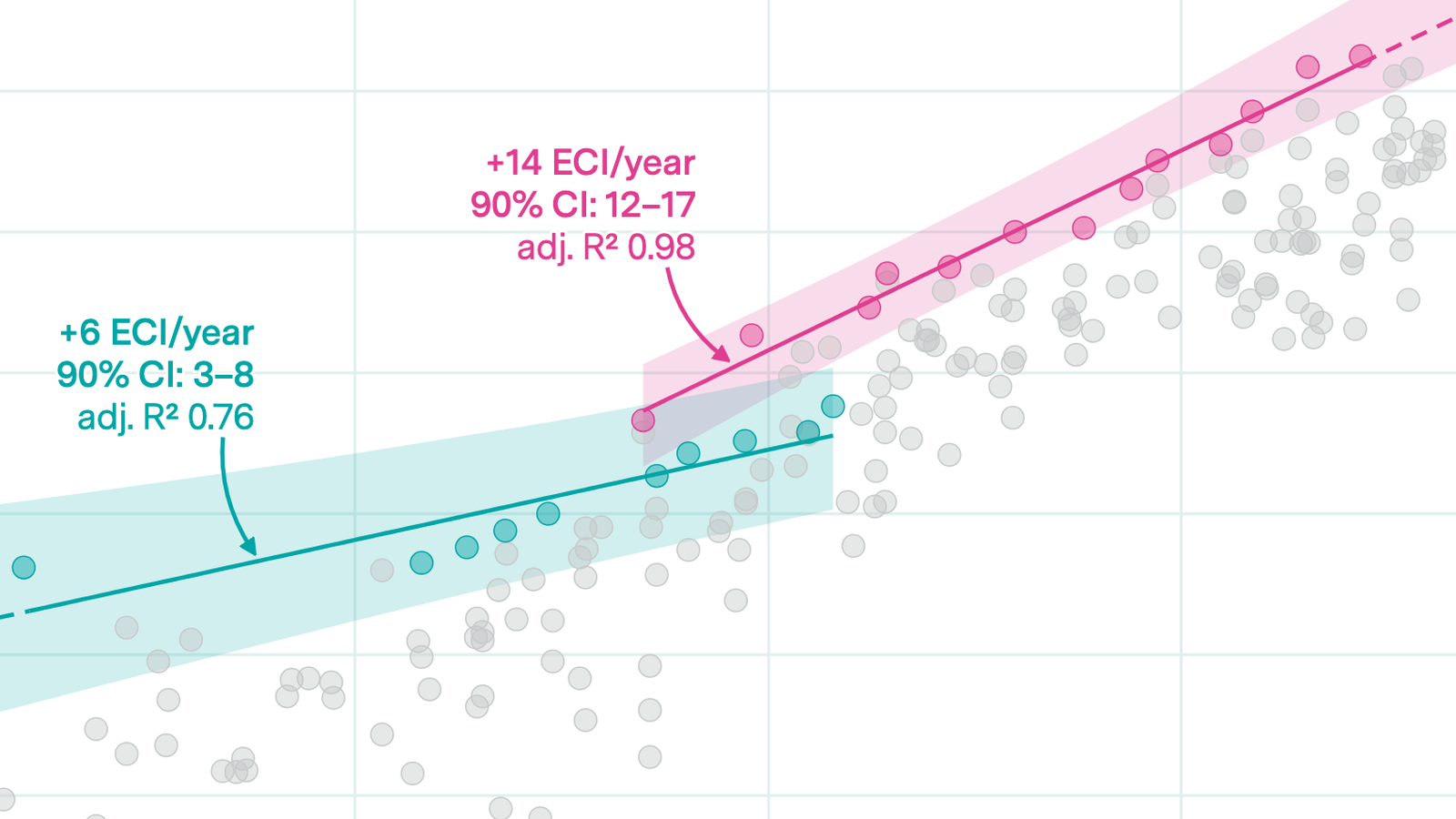
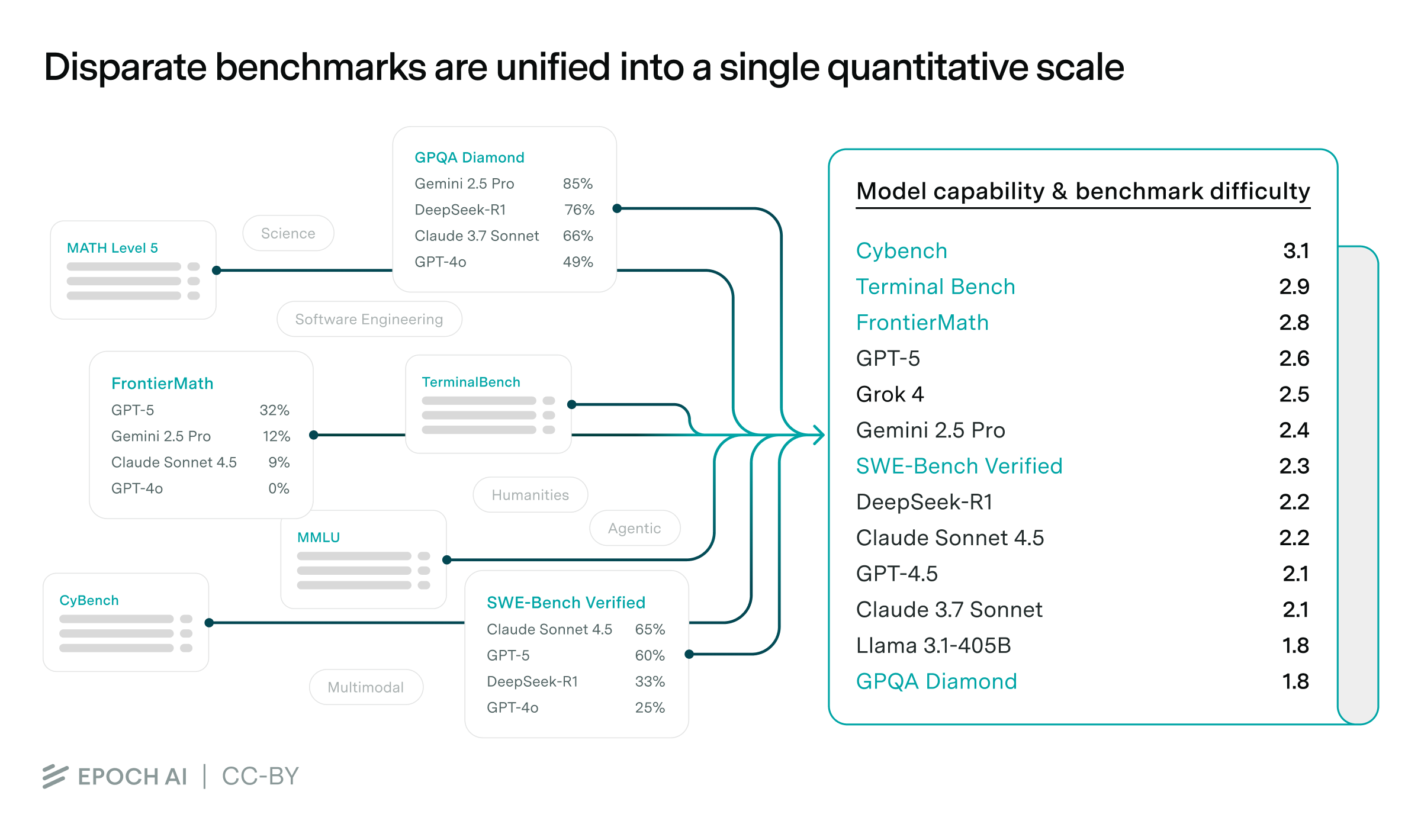
Yes on three of the four measures Epoch AI examined: progress on its Epoch Capabilities Index, on METR's 50% time horizon and on a combined math index has sped up relative to a straight-line trend fit to data from 2023 onward, seemingly driven by the arrival of reasoning models (epoch.ai). The authors, Jean-Stanislas Denain and Alexander Barry, fit eight candidate curves to each metric, from a constant linear trend through quadratic, exponential and a hyperbolic "singularity" curve. They judged them not by how well they fit the past but by how well a curve trained on earlier data predicted later data, mainly at a six-month horizon chosen in advance.
Across the three accelerating metrics, the best performer was two separate straight lines, one for reasoning models and one for non-reasoning models. Reasoning models show a one-off jump in performance and then a trend roughly 2 to 3 times faster. The authors note this is not a perfectly clean split, since scaling up compute at time, heavier reinforcement learning after and models writing out reasoning all arrived over the same few months. Several other accelerating curves also performed well on individual metrics, so they say they cannot pin down a precise growth rate. The time horizon data is METR's version 1.1, the larger task suite METR released in January 2026 (earlier coverage).
The fourth metric, an index built from the WeirdML V2 , showed no acceleration; a single linear trend fit best. The authors suggest two reasons: WeirdML gives models only five attempts to submit working code with no external tools, a setting recent reinforcement-learning training has not targeted, and it has only about a year of data from before reasoning models, which limits the power to detect a break. They also point out that the accelerating metrics are concentrated in programming and mathematics, where answers are easy to verify automatically and therefore natural targets for reinforcement learning, so the speedup may be less general than the headline suggests.
- Comparing candidate curves by how well they predict held-out data, Epoch found strong evidence of acceleration since 2023 on three of four metrics: ECI, log METR 50% time horizon, and a math index.
- The best fit was two separate linear trends: reasoning models show a one-off jump plus a roughly 2-3x faster trend than non-reasoning models, though several superlinear fits also perform well, so no precise rate is pinned down.
- The 'reasoning' label bundles correlated changes from the same months: more inference compute, heavier RL post-training, and models emitting reasoning tokens.
- A WeirdML V2 index showed no acceleration; Epoch notes its five-attempt, no-tools setup is not a recent RL target, that the data has limited power, and that gains concentrate in easily verified coding and math.
- inference — Running a trained model to get answers — the phase where AI is actually used, as opposed to trained.
- pretraining — The first, biggest phase of building a model: training it on enormous amounts of text so it learns language, facts, and reasoning in general.
- token — The chunk of text a model reads and writes in — roughly three-quarters of a word — and the unit AI usage is billed in.
- benchmark — A standard public test set for comparing AI models — the shared scoreboards behind every "model X beats model Y" claim.

Checking sign-in…
Loading comments…