MiniMax Details Training-Free Low-Bit Attention Speedup for Video Models
- Source
- x.com
- Date
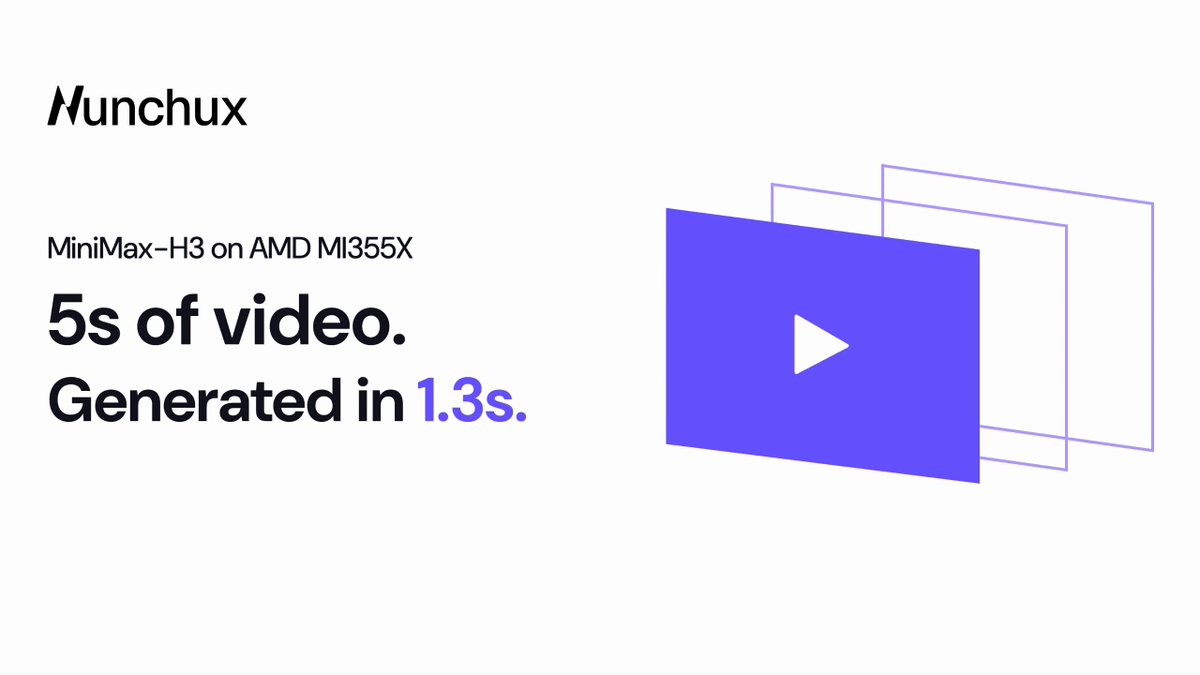
Three paths to faster video attention: compute the same interactions more efficiently, compute fewer in full, or change how information is mixed. Here’s a visual guide. 👇 Thanks to Nunchux AI and collaborators for VC-Attention, bringing training-free low-bit acceleration to MiniMax-H3, with better fidelity than SageAttention2 in the B200 evaluation. The approach balances speed and fidelity: V-Smooth reduces value quantization error, while ExpCast-FP8 makes softmax faster through approximation. Excited to see the community keep building on H3. Could combining low-bit computation with sparse methods like Sol-Attn push efficiency further? We’re looking forward to seeing that explored.

Context
MiniMax shared work from partner Nunchux AI applying VC-, a technique for speeding up the attention computation inside its MiniMax-H3 video model without retraining the model itself. Attention is the step where a model compares many pieces of the input against each other; running that comparison in lower-precision numbers makes it faster but can introduce rounding error. MiniMax's post describes two adjustments meant to control that error: V-Smooth, which reduces the error introduced when quantizing one part of the calculation, and ExpCast-FP8, which speeds up the softmax step, the part of attention that turns comparisons into weights, through approximation. MiniMax says Nunchux AI's own on NVIDIA B200 GPUs found better output fidelity than SageAttention2, an existing low-bit attention method, though this comparison is the partner's self-reported rather than an independently verified result. MiniMax previously detailed a separate NVIDIA-built speedup for the same H3 model, splitting generation into a low-resolution draft and a refinement pass.
- attention — The mechanism that lets a model weigh which earlier words matter for the word it's currently processing — the core operation of a transformer.
- eval — A repeatable test for AI quality — a set of tasks plus scoring — used the way software teams use test suites, because model output is too variable to judge by eyeballing.
- benchmark — A standard public test set for comparing AI models — the shared scoreboards behind every "model X beats model Y" claim.

Checking sign-in…
Loading comments…