MiniMax H3 Video Generation Hits 2x Real-Time via SGLang VDN-H3
- Source
- x.com
- Date
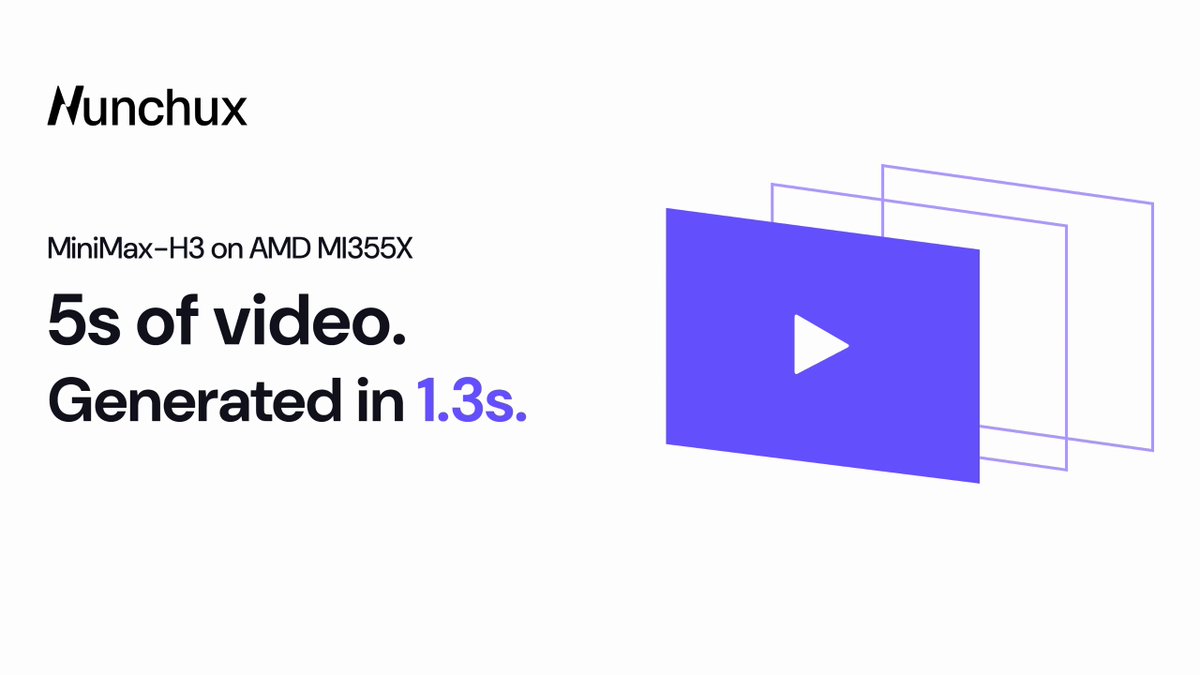
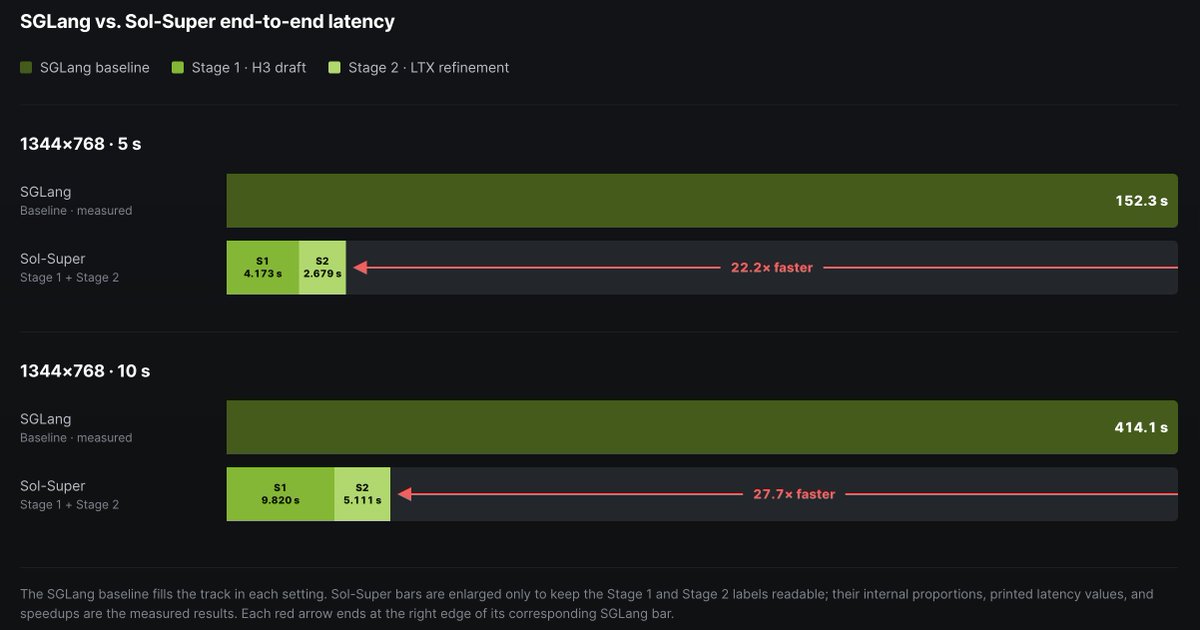
MiniMax reports that its SGLang-Diffusion sampler, VDN-H3, now generates 14.4 seconds of 768p video in 9.0 seconds end to end on eight B200 GPUs, more than twice real time. The company says the speedup comes with no measured quality regression against the 50-step dense baseline it was tested against, meaning the gain is from a better sampling schedule rather than a smaller or cheaper model. Faster inference changes the economics of video generation directly, since compute time per clip is most of the cost at scale. It also demonstrates that open inference stacks and open model weights are compounding gains together rather than independently, since the sampler improvement applies on top of whatever model efficiency MiniMax already had. Teams running video generation in production get a concrete lever to cut GPU hours per video without waiting for a new model release.

H3 keeps getting faster. ⚡️ @sgl_project + VDN-H3 now push MiniMax H3 beyond 2× real-time denoising on 8× B200 - generating 14.4s of 768p video in 9.0s end-to-end after warmup, with no measured quality regression. Open models compound through open ecosystems. 🚀
Context
MiniMax's H3 is an open video-generation model. Generating video is normally much slower than the clip itself, because the model runs many rounds of a noise-removing process called denoising to build each frame.
MiniMax says a collaboration between the open-source SGLang project and a technique called VDN-H3 now pushes H3 past twice real-time speed: generating 14.4 seconds of 768p video in 9.0 seconds end to end after warmup, on a cluster of 8 NVIDIA B200 GPUs, with no quality drop that MiniMax says it measured. MiniMax frames this as evidence that open model weights and open inference tooling improve together faster than either would alone.
- inference — Running a trained model to get answers — the phase where AI is actually used, as opposed to trained.


Checking sign-in…
Loading comments…