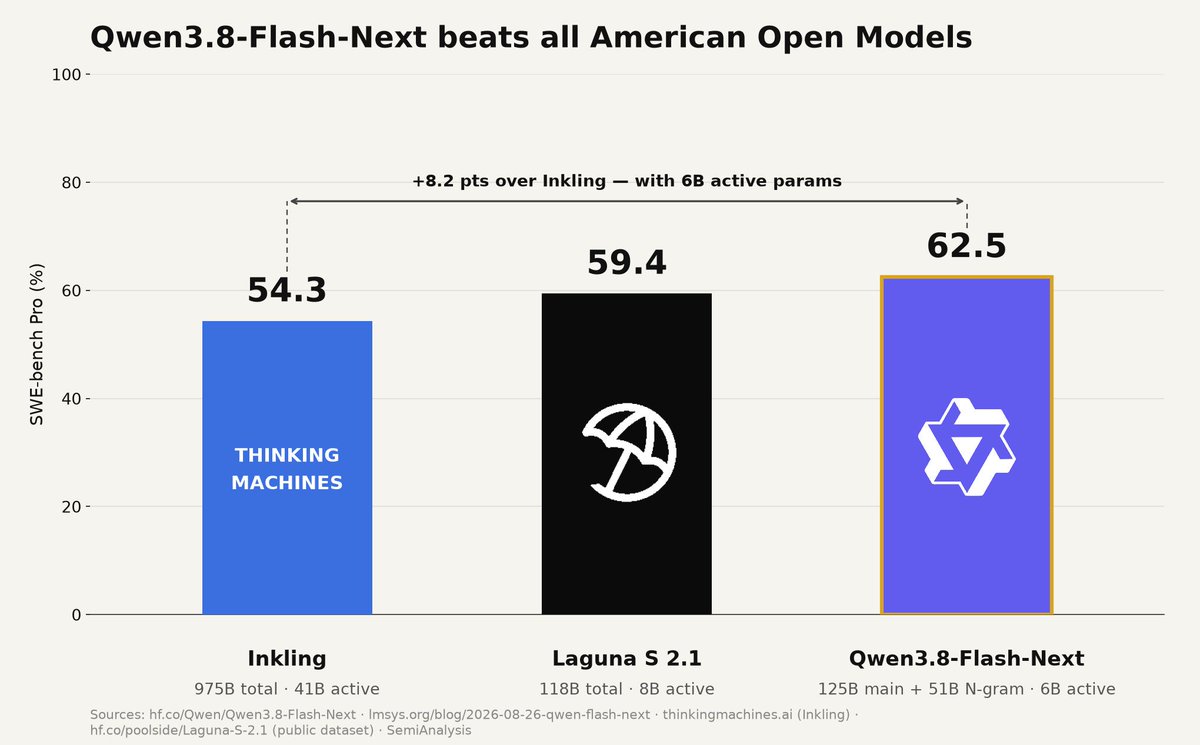
Qwen3.8-Flash-Next open-sources a Qwen4 architecture preview at 6B active
- Source
- x.com
- Date

⚡Meet Qwen3.8-Flash, a multimodal MoE and an early preview of the Qwen4 architecture, now open-weight! The production version Qwen3.8-Flash will be available soon via QwenCloud API at just $ 0.16/1M input tokens and $ 0.47/1M output tokens. 125B parameters + 51B N-gram embeddings, with just 6B activated per token. Unmatched cost-efficiency. What's new: 🥳 - Next architecture: GDN + QSA hybrid attention, Gated Residual, N-gram Embedding & Muon optimizer, serving as a precursor to the architecture used in Qwen4. - Dramatically lower training and inference costs: trained at just 1/9 the cost of Qwen3.7-Plus, while outperforming it across the board with especially strong gains in coding and office tasks. - Strong performance: scoring 58.7 on DeepSWE 1.1, 62.5 on SWE-bench Pro, 73.9 on CoWorkBench, 84.5 on AndroidWorld, and 95.7 on MathVision (with CI). - 262K native context, extensible to 1M with YaRN. We’re also releasing the weights for Qwen3.8-Flash-Next, giving the community an early look at the new architecture we’re exploring for Qwen4.🚀 We can't wait to see what you build with Qwen3.8-Flash!👀👇 - Blog: https://t.co/M5hYypFLgJ - Technical Report: https://t.co/IF0gObIkQO -…

Context
Qwen released two related things here. Qwen3.8-Flash-Next is a set of open weights that its model card calls an experimental preview of the architecture that will underpin Qwen4. Qwen3.8-Flash is the production version built on it and sold through Qwen Cloud, with extras the open release lacks, such as a 1M-token by default and official built-in tools. The open model's own native context is 262,144 tokens, which the card says can be stretched to about 1M with a RoPE scaling method called YaRN. The headline of 6B active parameters needs unpacking. The card lists a 125B-parameter language model with 6B activated, plus 51B of n-gram embeddings and 4B for multi-token prediction. Those add up to the 180B model size shown on the Hugging Face page, so the download is much larger than the per-token compute figure suggests.
The n-gram embedding is the unusual part. Besides the normal table that gives each token a learned vector, the model keeps a separate table of 20 million entries indexed by short bigrams and trigrams and used at layer 2. The card argues that embeddings offer a way to add parameters with less computation than adding experts, and that they are easier to offload, which suits accelerators short on memory. In a follow-up analysis, SemiAnalysis drew the practical consequence: the table could sit in slower, cheaper tiers of DRAM. The other architectural changes are Qwen Sparse Attention, which picks context in micro-blocks rather than token by token to cut long-context latency, and a Gated Residual design that controls how information flows between layers.
The benchmark results are Qwen's own, and the footnotes matter for comparisons. For DeepSWE 1.1, the 58.7 is the better of two agent harnesses, and the card notes the model did best on mini-SWE-agent. For Pro, Qwen ran every model in the Claude Code on a version of the benchmark with problematic tasks corrected, except Claude Opus 4.6, whose score is the officially published one. CoWorkBench, where the model scores 73.9, is an in-house benchmark. The announcement also says the model was trained at one-ninth the cost of Qwen3.7-Plus and quotes API prices of $0.16 per million input tokens and $0.47 per million output tokens. The cost figure can't be checked against the technical report, which wasn't readable, and Qwen's later API post lists input at $0.15.
- context window — The maximum amount of text a model can consider at once — its working memory for the current conversation or task.
- mixture-of-experts — A model built from many specialist sub-networks where only a few activate per token, giving big-model capability at small-model running cost.
- SWE-bench — The standard benchmark for AI coding agents: real GitHub issues from real repositories, scored by whether the agent's patch passes the project's own tests.
- agent harness — The scaffolding around a model that turns it into a working agent — the loop, the tools it can call, and the rules for when to stop.

Checking sign-in…
Loading comments…