Open Weight Vs Closed Weight Models
- Source
- openrouter.ai
- Author
- OpenRouter editorial sitemap
- Date
OpenRouter published routing data showing open-weight models rising from 27% to 72% of the tokens served by its top 50 models over one year. Per token, those open models cost about a quarter of what closed models cost. Closed models still lead by about 11 points on an intelligence index. Read together, the numbers say most traffic on the platform has moved to models that score lower but cost roughly four times less, and that the move happened within twelve months. OpenRouter frames this as support for starting agent steps on open models and escalating to closed ones when a step needs it. The data comes from a single router's traffic, so it describes OpenRouter's customers, who already chose a multi-provider gateway, rather than the whole market.
Context
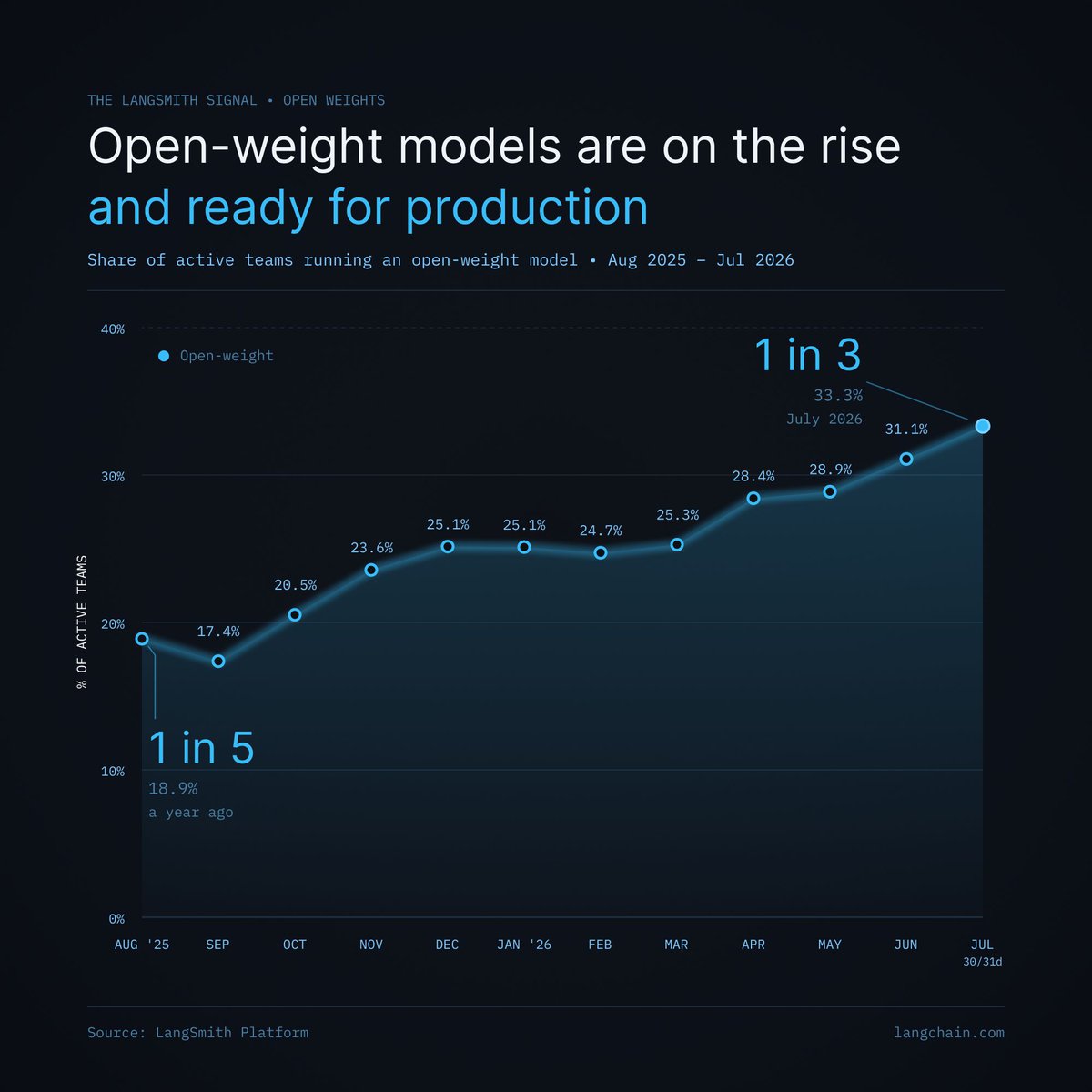
An model is one whose trained weights, the numbers it learned in training, are published so anyone can run it, it or serve it to others. A closed-weight model is available only from its maker and the clouds it licenses. OpenRouter, which routes requests to both kinds through one API, notes in this explainer that open weight is not the same as open source: the Open Source Initiative's definition also covers training data or detailed information about it, which most open-weight releases leave out, and licenses vary, from MIT to terms that require written permission for larger commercial products.
OpenRouter's usage figures show open-weight models taking over most of its traffic. Among the 50 most-used models on the platform, their share of weekly rose from 26.8% in the week of October 6, 2025 to 71.7% in the week of September 28, 2026, after peaking at 77.5% in July. Closed-weight volume also grew almost tenfold, so the shift reflects faster growth rather than a fall in closed-weight use. OpenRouter credits price: over four weeks, the token-weighted list price was $0.28 per million input tokens and $1.62 per million output tokens for open-weight models, against $1.27 and $6.36 for closed ones, because many providers compete to serve the same open model. DeepSeek V4.1 Flash, for example, had 31 providers charging between $0.03 and $0.60 per million input tokens.
The trade-off is quality. On the Artificial Analysis Intelligence Index, a composite benchmark score, the best closed model, Claude Opus 5.5, scored 57.6 and the best open one, Xiaomi's MiMo-V2.6-Pro, scored 46.3. OpenRouter's advice is to start on an open-weight model, test it on your own tasks, and pay for a closed model only on the steps where it changes the result, such as planning in an . The numbers carry limits the post states itself. They cover OpenRouter traffic only, exclude unclassifiable stealth models that reached 38.7 trillion tokens in the latest week, and compare token counts from different tokenizers. The quality gap was about five points in its June roundup on an earlier version of the index. The categories also overlap on price: GPT-6 Luna lists below every Kimi K3 provider, so the comparison that matters is between specific models, not the two camps.
- Both kinds of model grew: closed-weight volume in OpenRouter's top 50 rose from 3.4T to 33T tokens a week between October 2025 and September 2026, while open-weight volume rose more than 60-fold to 83.5T. The open share peaked at 77.5% in July.
- OpenRouter attributes the roughly 4x price gap mainly to competition: DeepSeek V4.1 Flash had 31 providers and GLM-5.3 Flash 30, versus 2 to 5 for the closed models it sampled. Input prices for one open model spanned $0.03 to $0.60 per million tokens.
- The categories overlap at the model level. Kimi K3's endpoints ranged from cheaper than Claude Sonnet 5.5 to about twice its price, while GPT-6 Luna listed at $0.10 per million input tokens, below any Kimi K3 provider.
- The shares exclude stealth models, which reached 38.7T tokens in the latest week, and token counts come from each provider's own tokenizer. OpenRouter's June roundup put the quality gap at about five points on an earlier index version.
- open weights — A model whose trained parameters are published for anyone to download and run — unlike API-only models you can access but never possess.
- fine-tuning — Taking a trained model and training it a bit more on your own examples so it gets better at one specific job.
- token — The chunk of text a model reads and writes in — roughly three-quarters of a word — and the unit AI usage is billed in.
- AI agent — An AI system that doesn't just answer once but works toward a goal in a loop — taking actions, reading the results, and deciding what to do next.




Checking sign-in…
Loading comments…