Meta ships Muse Spark 1.3 with leaner tool use for agent runs
- Source
- x.com
- Date

We’re excited to release Muse Spark 1.3 with improved performance on agentic and coding tasks, and a focus on real-world usability. Key capabilities: → Sustains longer-horizon work across multiple workflows in a single thread → More actively collaborates with users: it asks clarifying questions, flags when it's stuck, confirms before consequential actions → Better calibrated on its own limits instead of hallucinating outcomes → ~20% fewer tool calls and ~25% fewer tokens vs. Muse Spark 1.2 in internal comparisons

Context
Meta released Muse Spark 1.3, the newest model in its Muse Spark line, aimed at agent and coding tasks, and described the change mostly as behavior rather than raw capability. Meta says the model keeps longer pieces of work going across several workflows in one conversation thread, asks clarifying questions, says when it is stuck, confirms before taking consequential actions, and is better about its own limits instead of hallucinating outcomes. It also says that in internal comparisons, 1.3 makes about 20% fewer tool calls and uses about 25% fewer tokens than Muse Spark 1.2.
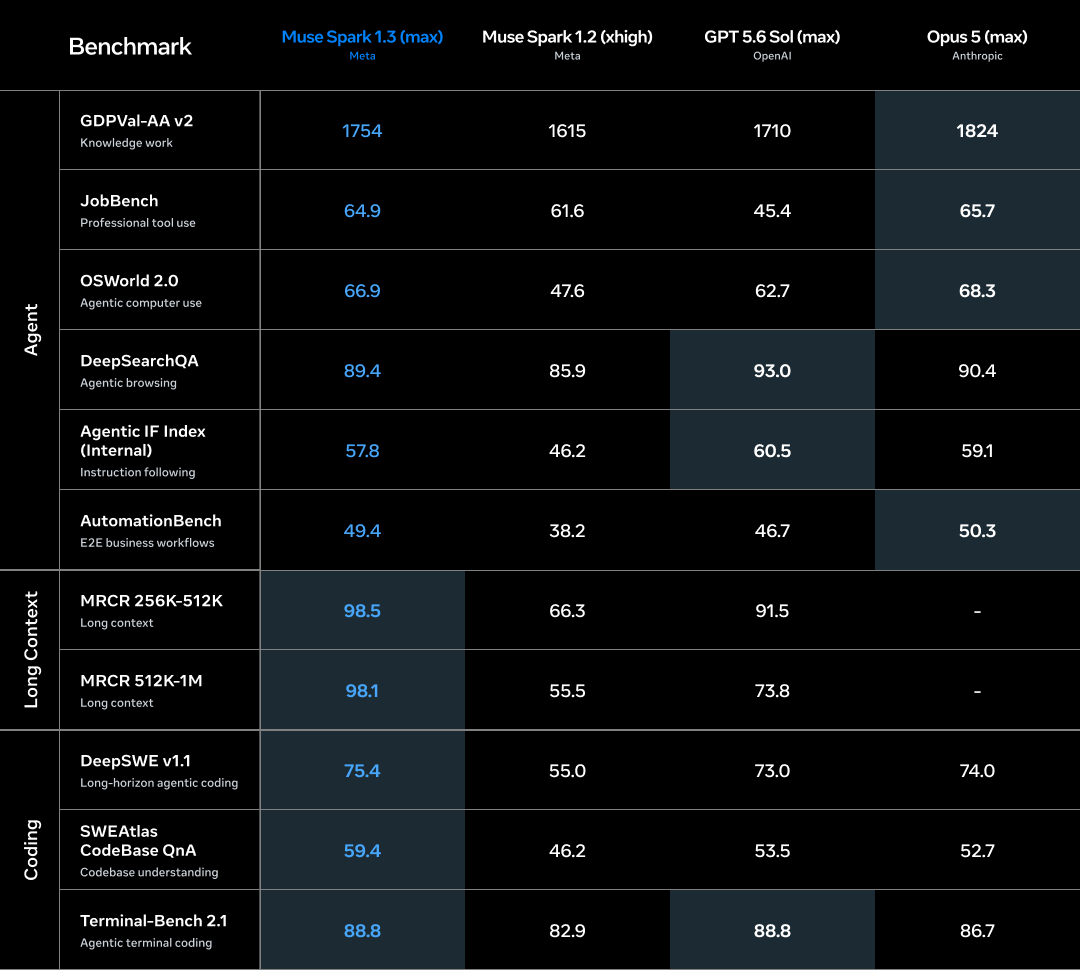
The benchmark table attached to the post is Meta's own and compares the max variant of 1.3, which Artificial Analysis reported was then in limited preview for Meta's partners, with Muse Spark 1.2 (xhigh), GPT-5.6 Sol (max) and Claude Opus 5 (max). Among the largest jumps over 1.2 in that table are those on long- retrieval, where MRCR at 512K to 1M tokens rises from 55.5 to 98.1, and on OSWorld 2.0, a test of operating a computer, which rises from 47.6 to 66.9. Opus 5 (max) still scores highest on four of the six agent rows, including GDPval-AA v2 knowledge work at 1,824 against 1,754. Meta made the max reasoning mode available in Muse Code and the Meta Model API two days later.
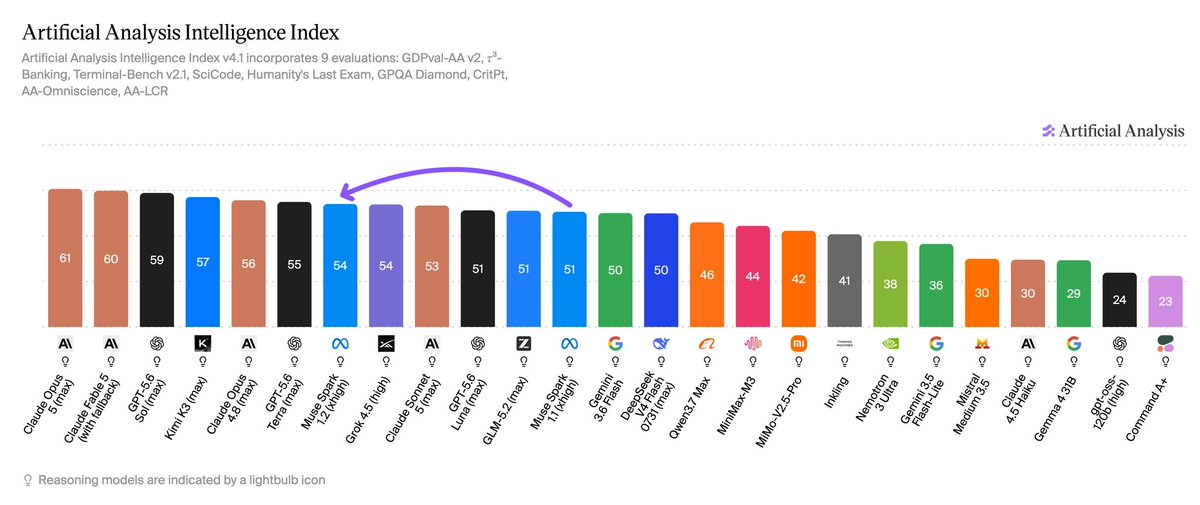
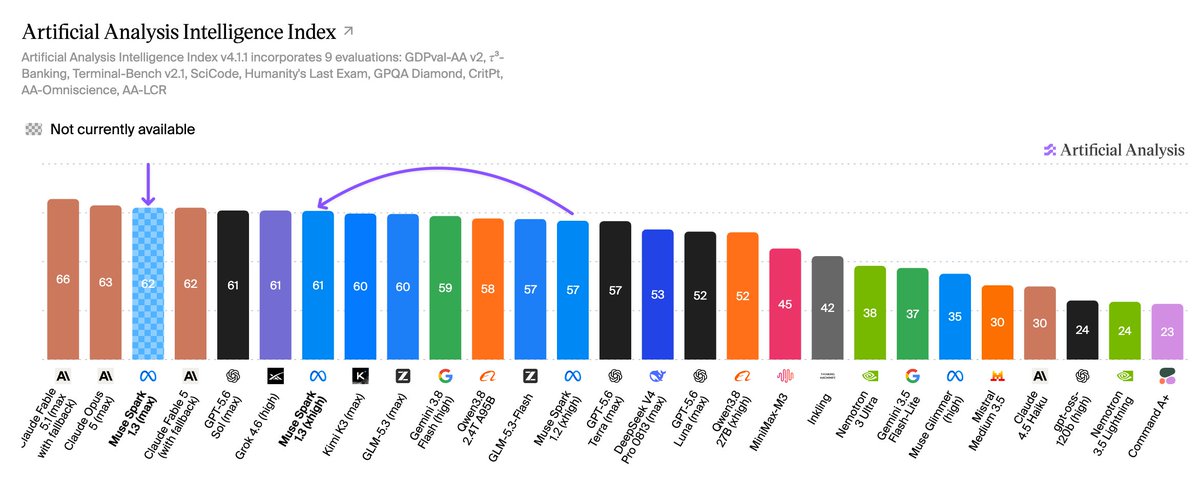
Outside measurement supports part of this and complicates another part. Artificial Analysis's independent testing found the generally available xhigh variant abstained more often when unsure, which lowered its rate, consistent with Meta's calibration claim. But on Artificial Analysis's agentic evaluations the same variant used about 57% more input tokens per task than 1.2, and its cost per task rose from $0.40 to $0.55. Meta has not said which tasks its 25% token reduction was measured on, so the efficiency gain should be read as true for Meta's internal comparisons and not assumed for every workload.
- calibration — How well a model's confidence matches reality — a calibrated model saying "90% sure" is right about 90% of the time.
- context window — The maximum amount of text a model can consider at once — its working memory for the current conversation or task.
- hallucination — When a model states something false with full confidence — inventing facts, citations, or APIs that don't exist.
- open weights — A model whose trained parameters are published for anyone to download and run — unlike API-only models you can access but never possess.


Checking sign-in…
Loading comments…