Google TPUv7 posts first agentic inference benchmark result
- Source
- x.com
- Date
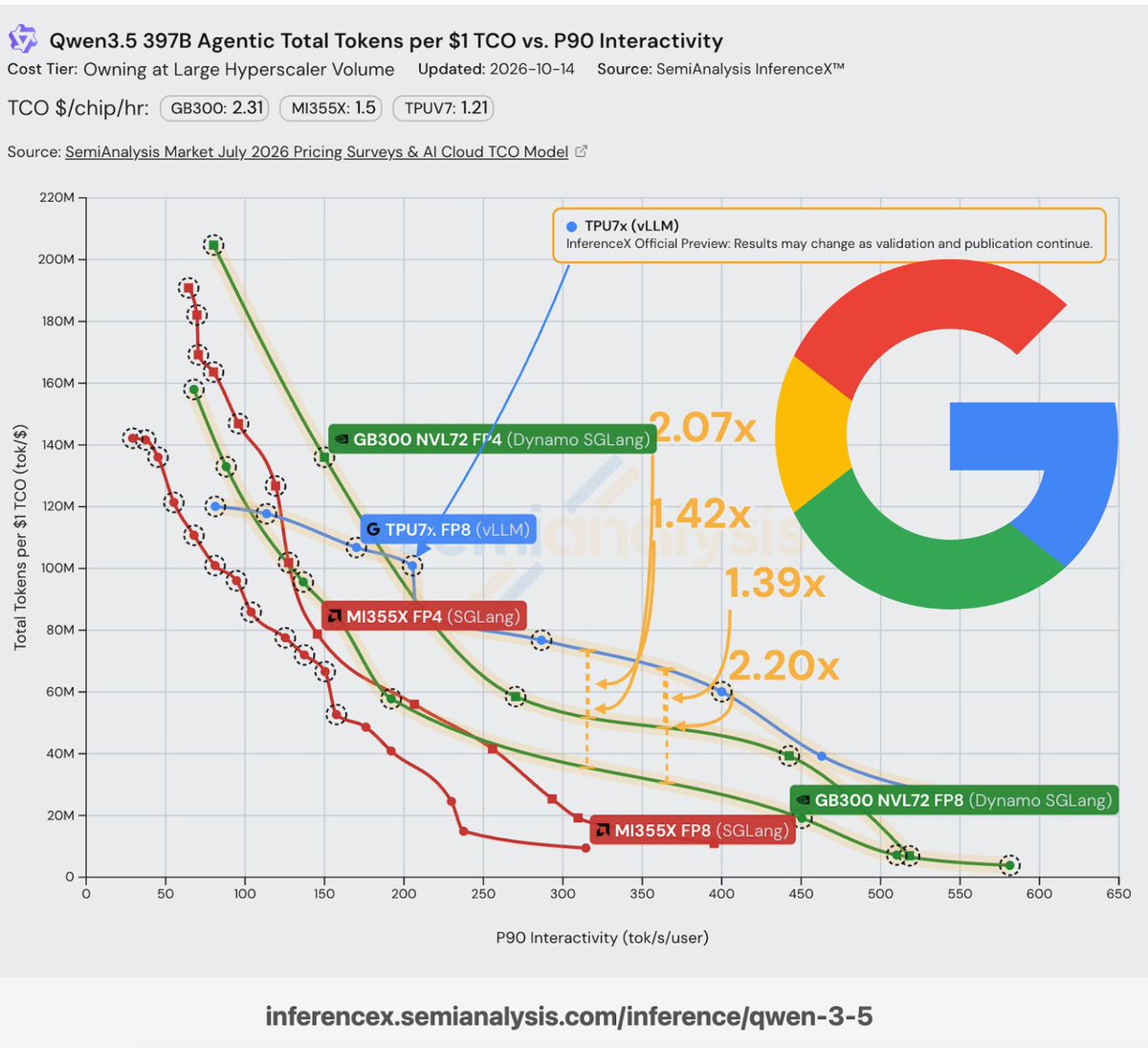
Google has submitted its first TPUv7 results to SemiAnalysis's Agentic Inference Benchmark, running vLLM at FP8. SemiAnalysis reports 1.67x better performance per dollar than NVIDIA's GB300 NVL72 running FP4, and reads the submission as a sign that TPUs are moving beyond Google's internal workloads. The figure is vendor-submitted and has not been independently reproduced, so it is a claim to check rather than a settled ranking. The same day, Artificial Analysis added AMD's MI355X to AA-AgentPerf, which replays real coding-agent sessions with caching and tool delays, and reported up to 40% more throughput per megawatt than NVIDIA Blackwell on DeepSeek V4 Pro. Two non-NVIDIA accelerators now have published numbers on agent-shaped inference traffic rather than synthetic token throughput. For teams pricing large agent workloads, these benchmarks are worth tracking as they mature, because hardware competition is what eventually moves per-token prices.

BREAKING NEWS🚨: Google has submitted its FIRST TPUv7 FP8 vLLM results to our Agentic Inference Benchmark and has demonstrated 1.67x better perf per dollar than even GB300 NVL72 FP4. 🚀 It is amazing to see Google go full steam ahead with externalizing the power of TPUs outside of Google.👇️ (1/4)🧵

AgentX captures the four elements of an agentic workload: 🟠 Multi-turn: A session includes many user/assistant interactions (tens or hundreds) compared to a handful in a chatbot scenario. 🟠 Long context: System prompts, tool definitions, and the large number of turns make context accumulate quickly. 🟠 High prefix reuse: Since the conversation progresses linearly, the output from turn n-1 is concatenated to turn n. 🟠 Sub-agent bursts: A session launches multiple short-lived sub-agents with fresh context, which create bursty KVCache patterns. TPU has been able to demonstrate that its upcoming TorchTPU vLLM stack was able to successfully handle agentic workloads. (2/4)

What is surprising is that Google TorchTPU vLLM on TPUv7 FP8 with just 4 chips was able to beat GB300 NVL72 FP4 on performance per TCO across most of the pareto frontier. At low interactivity, gb300 fp4 still wins but at low interactivity tpuv7 fp8 still beats gb300 fp8. (3/4)

Great work by the Google TPU, TorchTPU, @Inferact, @RedHat, and vLLM teams on their first amazing AgentX result. We are excited to see Google submit many more models soon to demonstrate the full power of the TPU software and hardware. Stay tuned for the full article with many, many more models! Link to dashboard (4/4) https://t.co/QCV3l3h23l
Context
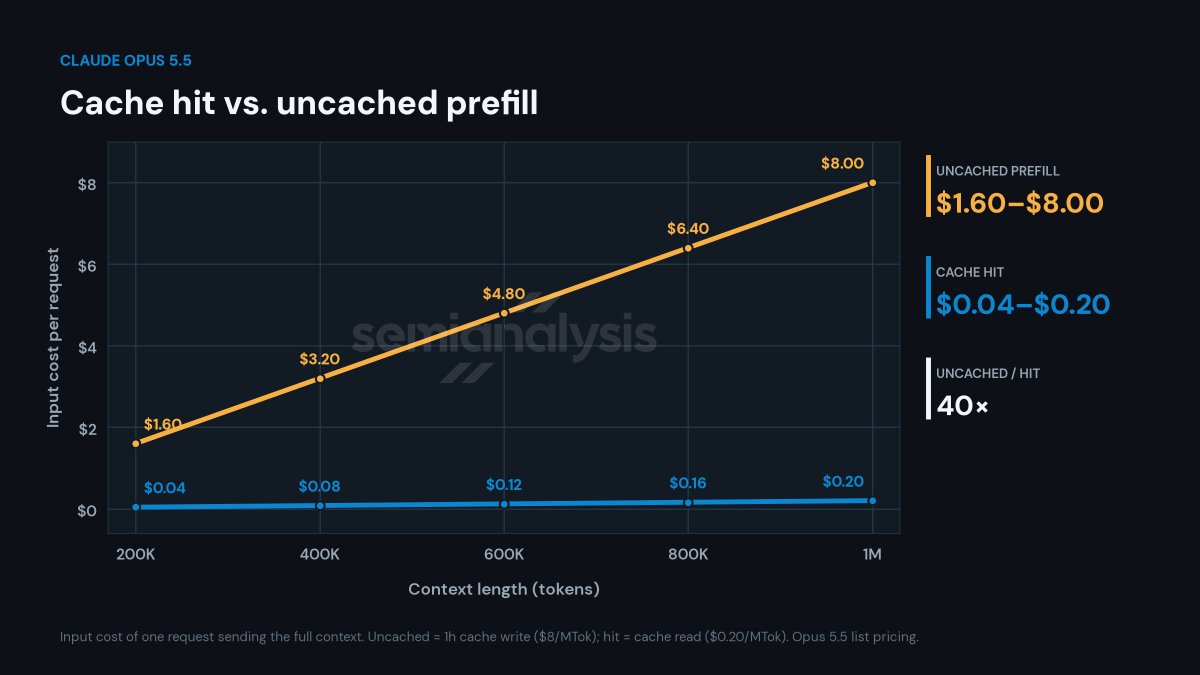
SemiAnalysis says Google has submitted its first results for TPUv7, its seventh-generation AI chip, to AgentX, the agentic benchmark SemiAnalysis launched in August, and that they show 1.67 times better performance per dollar than Nvidia's GB300 NVL72 rack (thread). AgentX imitates the traffic a coding creates: sessions with tens or hundreds of turns, contexts that grow quickly from system prompts, tool definitions and history, heavy reuse of earlier because each turn resends everything before it, and bursts of short-lived sub-agents with fresh context. A diagram in the thread shows the server caching the shared earlier portion from one turn to the next, which is why SemiAnalysis treats cache behavior as part of the test.
The test served one open model, Qwen3.5 397B. Google ran it on TPUv7 in FP8, an 8-bit number format, using its TorchTPU build of the vLLM serving engine; the Nvidia system ran in FP4, a 4-bit format, using Dynamo with SGLang. The chart does not give a single score. It plots total tokens served per dollar of total cost of ownership against interactivity, the output speed each user sees at the 90th percentile. Packing more users onto the hardware lowers the cost per token but slows each user down, so every system traces a curve, and the 1.67x label marks the gap at one point on it. SemiAnalysis says TPUv7 FP8, with just four chips, beat GB300 FP4 across most of that curve. At low interactivity GB300 FP4 still wins, peaking on the chart at about 205 million tokens per dollar against about 141 million for TPUv7, although TPUv7 FP8 still beats GB300 running FP8 there.
The dollar side is SemiAnalysis's own estimate, not a market price. The chart's cost tier is owning the hardware at large hyperscaler volume, at $1.03 per TPUv7 chip-hour against $2.31 for GB300, taken from its July 2026 pricing surveys and cloud cost model. The next day SemiAnalysis posted a follow-up putting the advantage at 1.42x on what it called an external, non-Google cost basis, a smaller figure than the 1.67x here. The chart labels the TPU curve an official preview whose results may change as validation and publication continue.
SemiAnalysis frames the result as evidence that Google is pushing TPUs to outside users, a theme of its earlier article on TPU inference, which asked whether an model served through a familiar inference engine could beat Nvidia on cost. The thread credits Google's TPU and TorchTPU teams along with Inferact, Red Hat and the vLLM project, and says Google will submit many more models and that a full article is coming.
- inference — Running a trained model to get answers — the phase where AI is actually used, as opposed to trained.
- AI agent — An AI system that doesn't just answer once but works toward a goal in a loop — taking actions, reading the results, and deciding what to do next.
- context window — The maximum amount of text a model can consider at once — its working memory for the current conversation or task.
- open weights — A model whose trained parameters are published for anyone to download and run — unlike API-only models you can access but never possess.


Checking sign-in…
Loading comments…