AgentX: Benchmarking Inference on Real Agentic Coding Traffic
- Source
- newsletter.semianalysis.com
- Author
- SemiAnalysis
- Date

Context
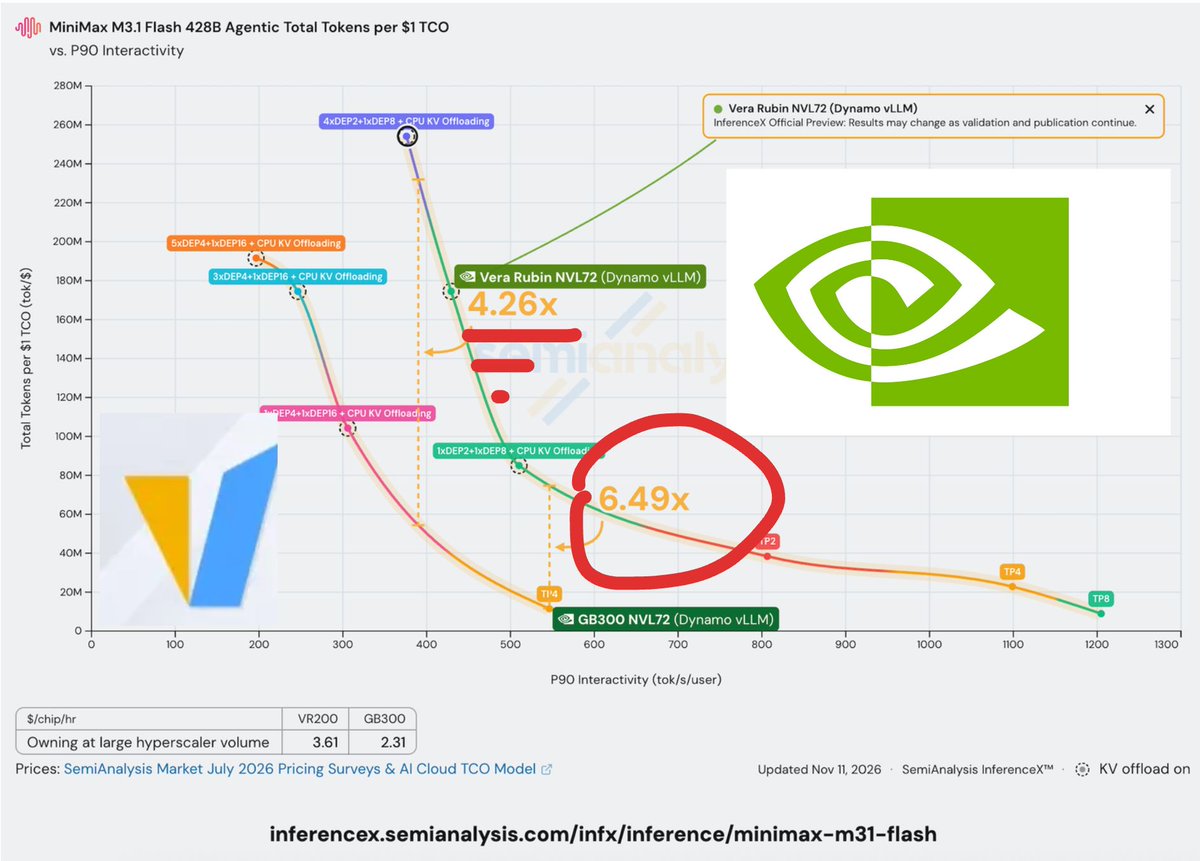
In the first results from AgentX, SemiAnalysis's new benchmark for serving coding-agent traffic, NVIDIA leads on most models, and the authors locate that lead mainly in serving software rather than silicon. AgentX, released on August 24, 2026 as part of InferenceX v3, replays long agent sessions in which the whole growing conversation is re-sent on every turn and subagents arrive in bursts. On that workload SemiAnalysis reports Nvidia more than 20 times ahead on Qwen3.5 397B at 90 tokens per second per user, with both vendors running the SGLang engine, and up to 5 times more cost-efficient on GLM 5.3 at 150 tokens per second per user. DeepSeek V4 Pro was tighter: AMD's MI355X running SGLang matched Nvidia's B200 running vLLM on performance per dollar, though B300 on vLLM and B200 on SGLang stayed ahead, and after August 21 vLLM optimizations from Inferact and Nvidia put the B200 in front, a race the authors call close.
The software explanation follows from what agent traffic demands. Because most of each request repeats earlier , a server keeps the attention state it already computed (the ) and reuses it. When GPU memory fills, that cache has to spill to CPU memory, and each session has to be routed back to the GPU holding its history. SemiAnalysis ties AMD's weaker results to exactly this layer. On MiniMax M3, none of AMD's best configurations used CPU offload, because GPU-to-CPU copies were inefficient in AMD's vLLM until a batching API arrived in ROCm 7.14. For context parallelism, which splits a very long context across GPUs, every AMD backend is listed as unsupported in vLLM, and the authors count it as part of the CUDA moat. AMD's strongest numbers came from ATOM, its own engine. ATOM on MI355X beat a GB300 NVL72 rack running vLLM on Kimi K3 performance per dollar between 40 and 60 seconds of end-to-end latency. SemiAnalysis adds that few labs use ATOM in production and asks AMD to move those gains into vLLM.
Two limits shape the answer. The figures are a snapshot taken around August 21, and SemiAnalysis promised updated AMD and Nvidia results within three to four weeks. The traffic is also one organization's: 393 anonymized sessions, mostly Claude Code (the from Anthropic) used by SemiAnalysis staff. A companion explanation covers how those sessions are replayed and what the dashboard exposes. The article is marked paid, but the stored copy holds the full AgentX results and methodology. The paywall begins at the section on historical single-turn tests, which the free text says include several fixed-length configurations where MI355X leads. So the verdict here applies to agent-style traffic: AMD hardware can compete, but on the upstream open-source stacks most customers run, SemiAnalysis's data shows Nvidia ahead until AMD's offload and distributed-serving software catches up.
- Context and context window — Context is the information available for a generation; the context window is the capacity available to hold it.
- KV cache — The memory a model keeps about text it has already read, so generating each new token doesn't require reprocessing the whole conversation.
- Agent mode — A mode in which one agent can inspect, edit, run commands, and iterate toward an outcome.
- Large language model — A model trained on large amounts of data to process and generate language.
Checking sign-in…
Loading comments…