Meta's Muse Voice Transcribe adapts latency word by word
- Source
- x.com
- Date

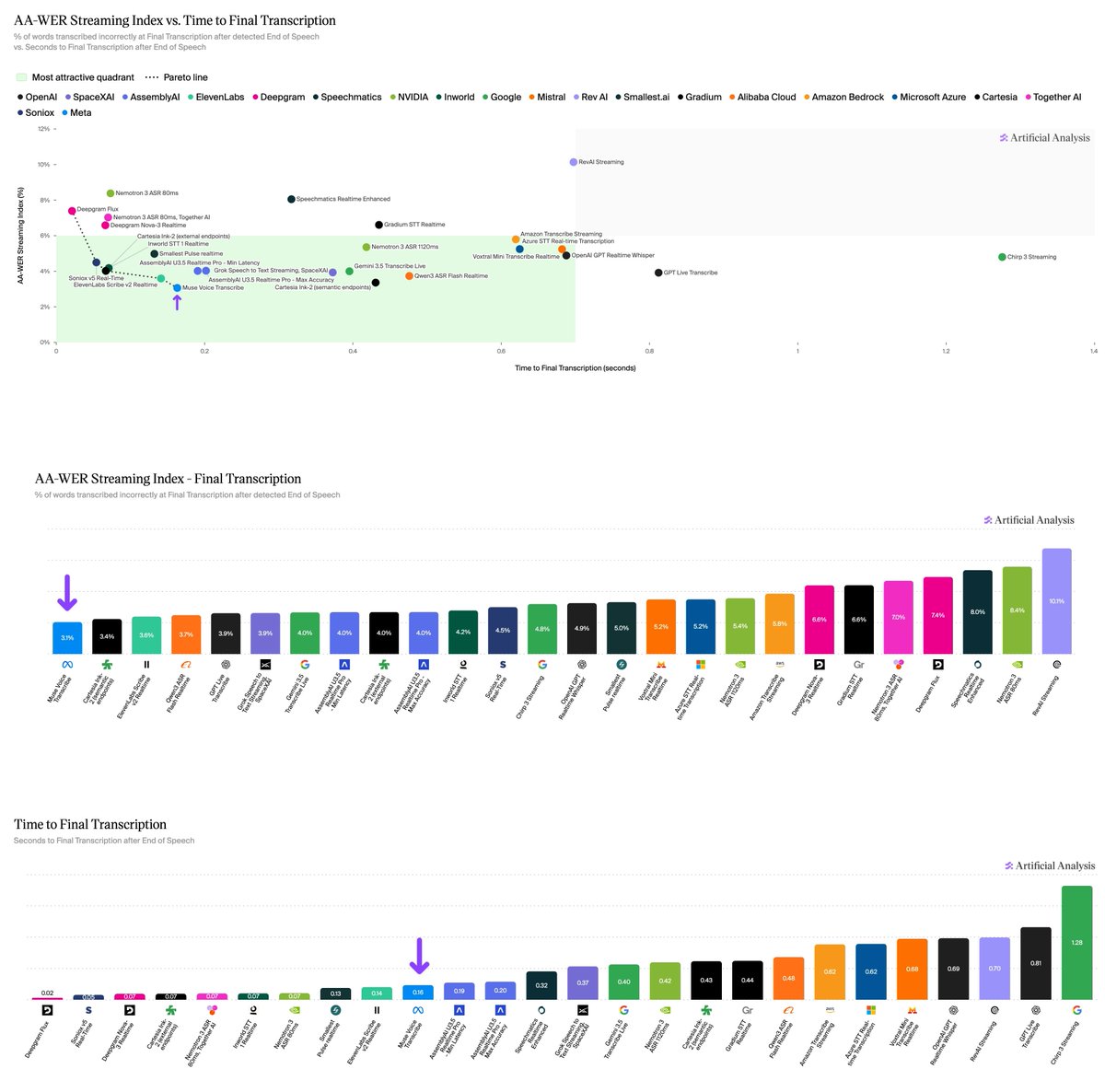
Introducing Muse Voice Transcribe, the first real-time audio perception model from Meta Superintelligence Labs. Muse Voice Transcribe delivers real-time streaming ASR, diarization with 20+ speakers, and endpointing. It’s multilingual with seamless code-switching and improves accuracy with language, keyword, and context biasing. The model ranks first on @ArtificialAnlys streaming speech-to-text and on public diarization benchmarks.


Context
Meta's Muse Voice Transcribe is a speech-to-text model for live audio: it writes the transcript while someone is still talking instead of waiting for a finished recording. Meta's launch post says the model, built by Meta Superintelligence Labs, also handles diarization, which labels who is speaking and works with more than 20 speakers, and endpointing, which detects when a speaker has finished. Developers can bias it toward an expected language, keywords or ; Meta's example is getting names such as Menlo Park right.
The hard decision in live transcription is when to commit a word. Meta's technical blog explains that audio arrives in 80-millisecond chunks, and after each chunk the model either keeps listening or writes text. Waiting gives it more context and a more accurate transcript, but adds delay. Instead of fixing one waiting time, Meta trained the model with reinforcement learning on a reward that combines word accuracy and delay, so it waits longer on difficult words and commits sooner on easy ones. Speaker changes and the start and end of speech come out as special markers in the same text stream, so one model produces all three outputs.
Meta says the model ranks first on the Artificial Analysis speech-to-text leaderboard and on public diarization benchmarks. The first claim has outside support: Artificial Analysis reported a 3.1% word error rate on final transcripts, returned 0.16 seconds after speech ended, which put it ahead of Cartesia Ink-2 and ElevenLabs Scribe v2 Realtime on final accuracy. The diarization claim rests on Meta's own chart, which shows a 17.5% error rate averaged across the AMI and VoxConverse test sets against 21.1% or higher for five other systems that the blog does not name.
- context window — The maximum amount of text a model can consider at once — its working memory for the current conversation or task.
- streaming — Sending a model's response token by token as it is generated, so the reader sees text immediately instead of waiting for the whole answer.




Checking sign-in…
Loading comments…