Progress Index: quantifying frontier pace and the open-weights lag
- Source
- x.com
- Date

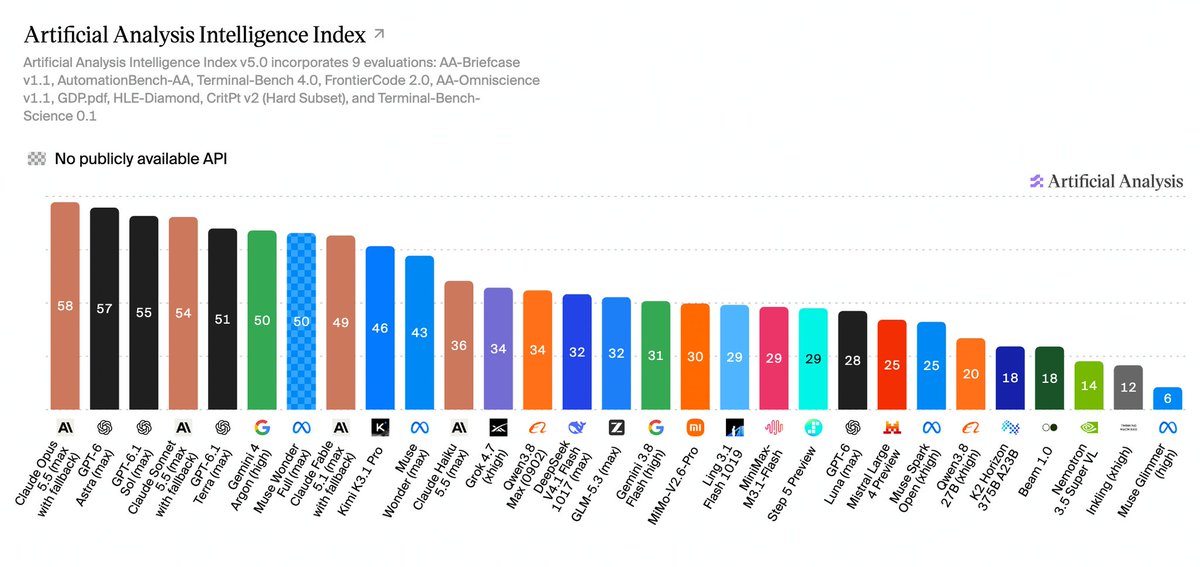
We’ve announced the Artificial Analysis Progress Index: a single capability scale for every language model since 2022, launched alongside Intelligence Index v5 The Intelligence Index is still our primary measure of current model intelligence. It uses the evaluations most relevant to developers today, so its mix changes as evaluations are added and retired, and scores from different versions can’t be compared. The Progress Index is built for comparisons across time. It uses item response theory, a statistical method used to score standardized tests, to estimate one general capability score for each model from the underlying tasks in all our evaluations, including those that are retired or excluded from the Intelligence Index. Use the Intelligence Index to choose a model today. Use the Progress Index to see how capability has changed over time. The Progress Index builds on prior work placing models on a single capability scale, in particular @EpochAIResearch's Epoch Capabilities Index and the capability scale @AnthropicAI published in its Claude Mythos Preview system card. Key takeaways: ➤ Since reasoning models arrived, the frontier has risen ~65 to 70 points a year, about…

Context
Artificial Analysis built the Progress Index because its main score cannot track change over time. Its Intelligence Index uses whichever evaluations matter most to developers today, so the mix changes as tests are added and retired, and scores from different versions cannot be compared. The Progress Index thread describes a single scale for every since 2022. It uses item response theory, a statistical method used to score standardized tests, to estimate one general capability score per model from the individual tasks in all of Artificial Analysis's evaluations, including ones since retired. Artificial Analysis credits earlier work by Epoch AI on its Epoch Capabilities Index and a capability scale Anthropic published in the Claude Mythos Preview system card. Its advice is to use the Intelligence Index to choose a model today and the Progress Index to see how capability has changed.
On this scale, the top score among released models has risen about 65 to 70 points a year since reasoning models arrived, roughly twice the 2023 pace. The leading score went from GPT-3.5 Turbo at 125 to GPT-4 Turbo at 160 in 2023, a rise of 35 points. It then rose 67 points in 2024, to o1 at 228, and 68 in 2025, to GPT-5.2 at 296. In 2026 it has risen 56 points so far, to Gemini 4 Carbon at 352. Records are also being broken more often: the top score was raised on 2 release dates in 2023, 4 in 2024, 9 in 2025 and 11 so far in 2026, about once every four weeks this year. OpenAI held the top spot for the first 27 months measured, but in 2026 the lead has changed hands quickly among OpenAI, Anthropic and, most recently, Google.
The scale also measures the open-weights lag in time instead of points. Since January 2025, each new best open-weights score arrived 2 to 8 months after a proprietary model first reached it, with a median of about 4. The highest-scoring model with released weights, DeepSeek V4.1 Flash 1017 at 324, sits at the level Claude Fable 5 reached in June 2026. Kimi K3.1 Pro scores 341, about two months behind the closed frontier, but its weights have not been released yet.
These findings depend on the scale's construction, and the thread does not explain what a point represents in practical terms. The methodology page was not part of the material reviewed here, so the pace and lag figures are best read as Artificial Analysis's measurements on its own set.
- LLM — A large language model — the neural network behind tools like Claude and ChatGPT, trained on huge amounts of text to predict what comes next.
- eval — A repeatable test for AI quality — a set of tasks plus scoring — used the way software teams use test suites, because model output is too variable to judge by eyeballing.
- open weights — A model whose trained parameters are published for anyone to download and run — unlike API-only models you can access but never possess.

Checking sign-in…
Loading comments…