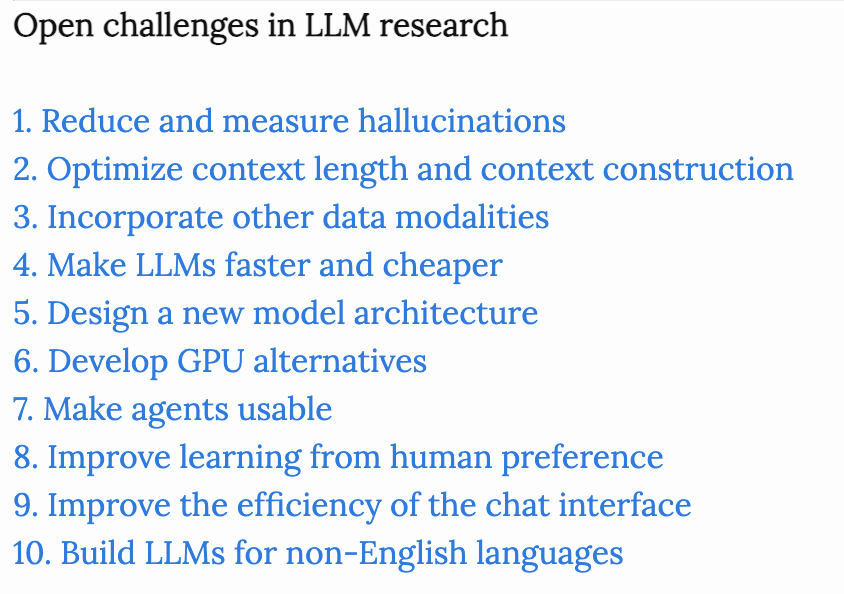
Open challenges in LLM research
- Source
- huyenchip.com
- Author
- Chip Huyen
- Date
Context
A model's capacity to accept more text does not tell you how well it will use that text. Chip Huyen's 2023 research agenda separates from context construction: choosing the information a model receives when answering a question.
For a customer-support assistant, that information might include product documentation and the customer's history. A retrieval system selects relevant passages to supply with the question. A larger input allowance permits more passages, but selecting useful material and checking whether the model uses it remain separate problems. This distinction explains why increasing the context window alone cannot establish better answers.
- On a panel with Dropbox, Langchain, Elastic and Anthropic, the number one roadblock named for putting LLMs into production was . Not cost, not latency.
- About 16.5% of questions in the NQ-Open dataset have answers that shift with context like time or place, per the SituatedQA paper. Enterprise questions skew further that way, since the answer often depends on which customer is asking.
- Fine-tuning GPT-3.5's 175B parameters at 16-bit needed roughly 375GB and many machines in Nov 2022. By May 2023 a 4-bit Guanaco 7B needed 6GB and fit on a MacBook. Build something good enough and the community makes it cheap.
- The four compression levers, by mechanism: spends fewer bits per parameter, trains a small student to mimic a big teacher, low-rank factorization splits a 3x3 tensor into a 3x1 and a 1x3 (9 params to 6), and pruning removes weights.
- The inefficiency in a Transformer is specific: attention cost grows with the square of sequence length, and the MLP with the square of model dimension. Subquadratic designs like Monarch Mixer aim at exactly those two terms.
- context window — The maximum amount of text a model can consider at once — its working memory for the current conversation or task.
- hallucination — When a model states something false with full confidence — inventing facts, citations, or APIs that don't exist.
- quantization — Shrinking a model by storing its numbers less precisely — like rounding — so it runs faster and fits on smaller hardware, at a small quality cost.
- distillation — Training a small, cheap model to imitate a big one's outputs, keeping much of the capability at a fraction of the cost.
“My takeaway: if you create something good enough, people will figure out a way to make it fast and cheap.”
“Number 1, reducing hallucination, will be much harder, since hallucination is just LLMs doing their probabilistic thing.”
“Text-based models require so much text that there’s a realistic concern that we’ll soon run out of Internet data to train text-based models .”
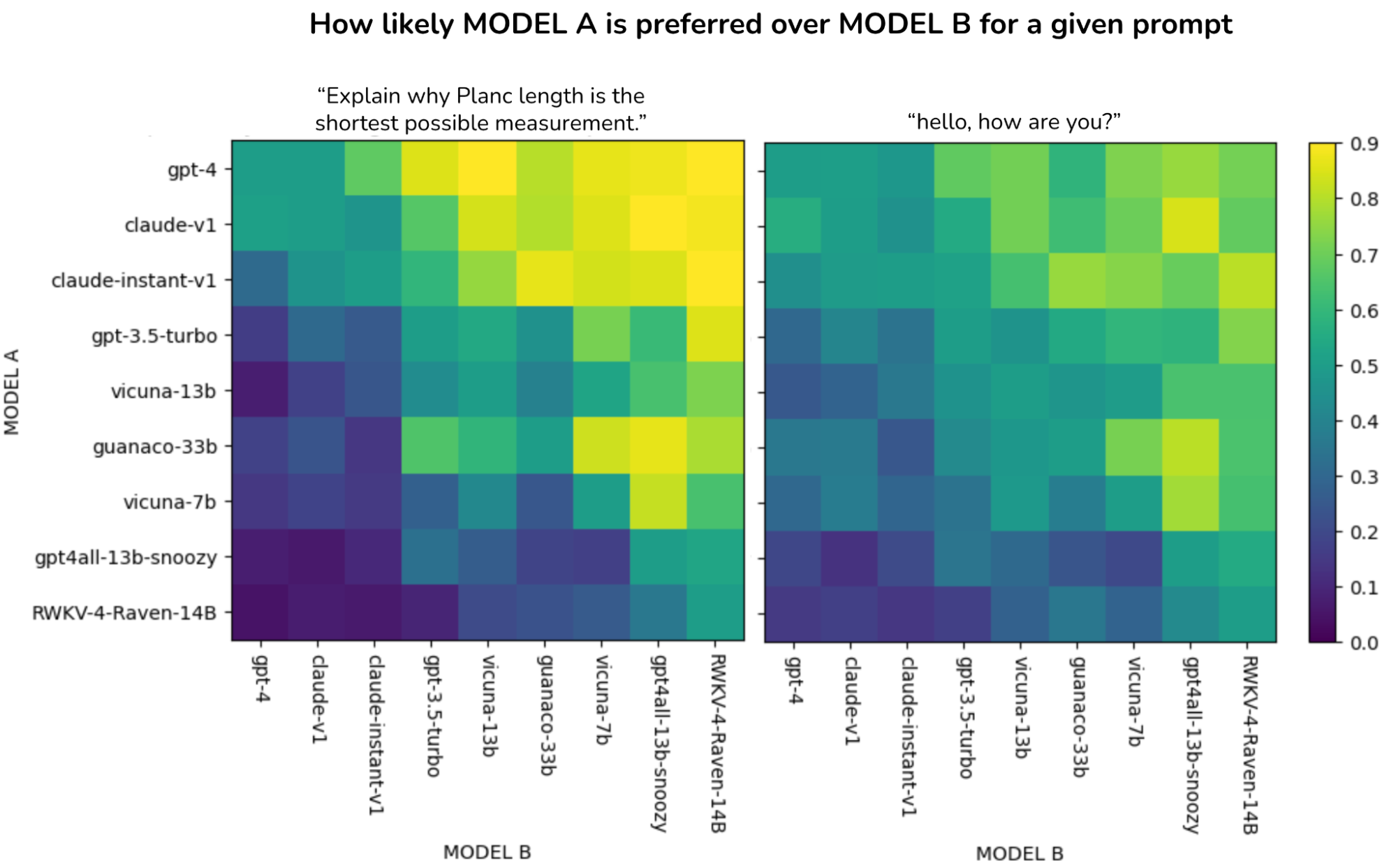
“RLHF, Reinforcement Learning from Human Preference , is cool but kinda hacky.”
 articleExtrinsic Hallucinations in LLMsLilian Weng
 articleUnified Hallucination Fuzzing for Multimodal Large Language ModelsPengfei Zhou, Jiajun Song, Zhiwei Tang, Yixing Ma, Xiaopeng Peng, Donghui Si, Yuhang Xu, Huiqi Song, Yiyuan Miao, Yichen Qian, Weihua Chen, Wangbo Zhao, Bohan Zhuang, Jiasheng Tang, Yang You
 articleClosed-World Resolution Against Tool Hallucination in LLM AgentsLaxmipriya Ganesh Iyer
Checking sign-in…
Loading comments…