hallucination — When a model states something false with full confidence — inventing facts, citations, or APIs that don't exist.
multimodal — A model that works with more than text — reading images, audio, or video, and sometimes generating them too.
benchmark — A standard public test set for comparing AI models — the shared scoreboards behind every "model X beats model Y" claim.
agent harness — The scaffolding around a model that turns it into a working agent — the loop, the tools it can call, and the rules for when to stop.
Why it matters
Anyone relying on static hallucinationWhen a model states something false with full confidence — inventing facts, citations, or APIs that don't exist.Full definition → benchmarks gets evidence those scores overstate robustness, plus an open fuzzing agent harnessThe scaffolding around a model that turns it into a working agent — the loop, the tools it can call, and the rules for when to stop.Full definition → for stress-testing their own multimodalA model that works with more than text — reading images, audio, or video, and sometimes generating them too.Full definition → stack.

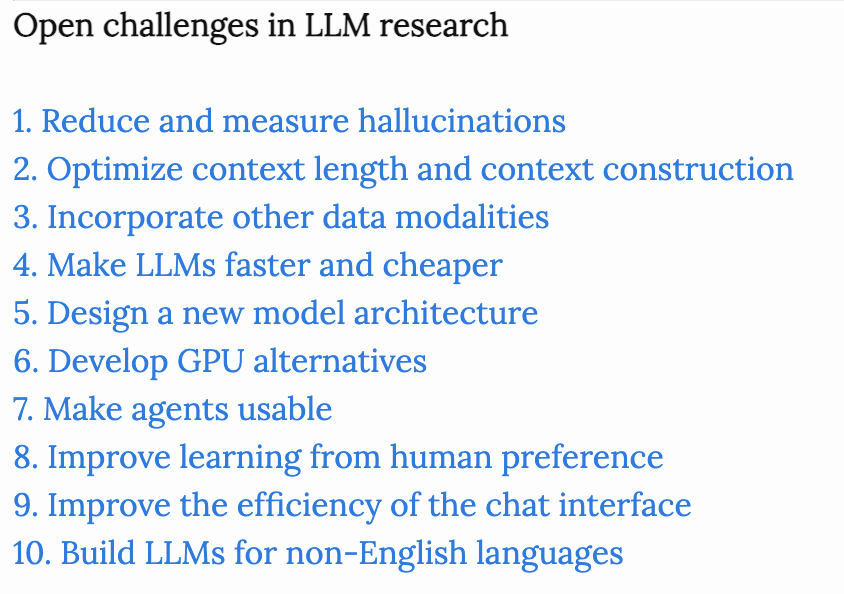 articleOpen challenges in LLM researchChip Huyen
 articleClosed-World Resolution Against Tool Hallucination in LLM AgentsLaxmipriya Ganesh Iyer
 articleDEEPO: Dual-Entropy Enhanced Policy Optimization for Hallucination in MLLMsYingxuan Zhuang, Miao Pan, Wangjie Gan, Jingxiao Yang, Fan Wang, Weiming Liu, Cheng Tan, Xuhong Zhang, Jintao Chen