How NVIDIA DSX MaxLPS Maximizes AI Factory Throughput and Efficiency
- Source
- developer.nvidia.com
- Author
- Sarah McKenney
- Date
Context
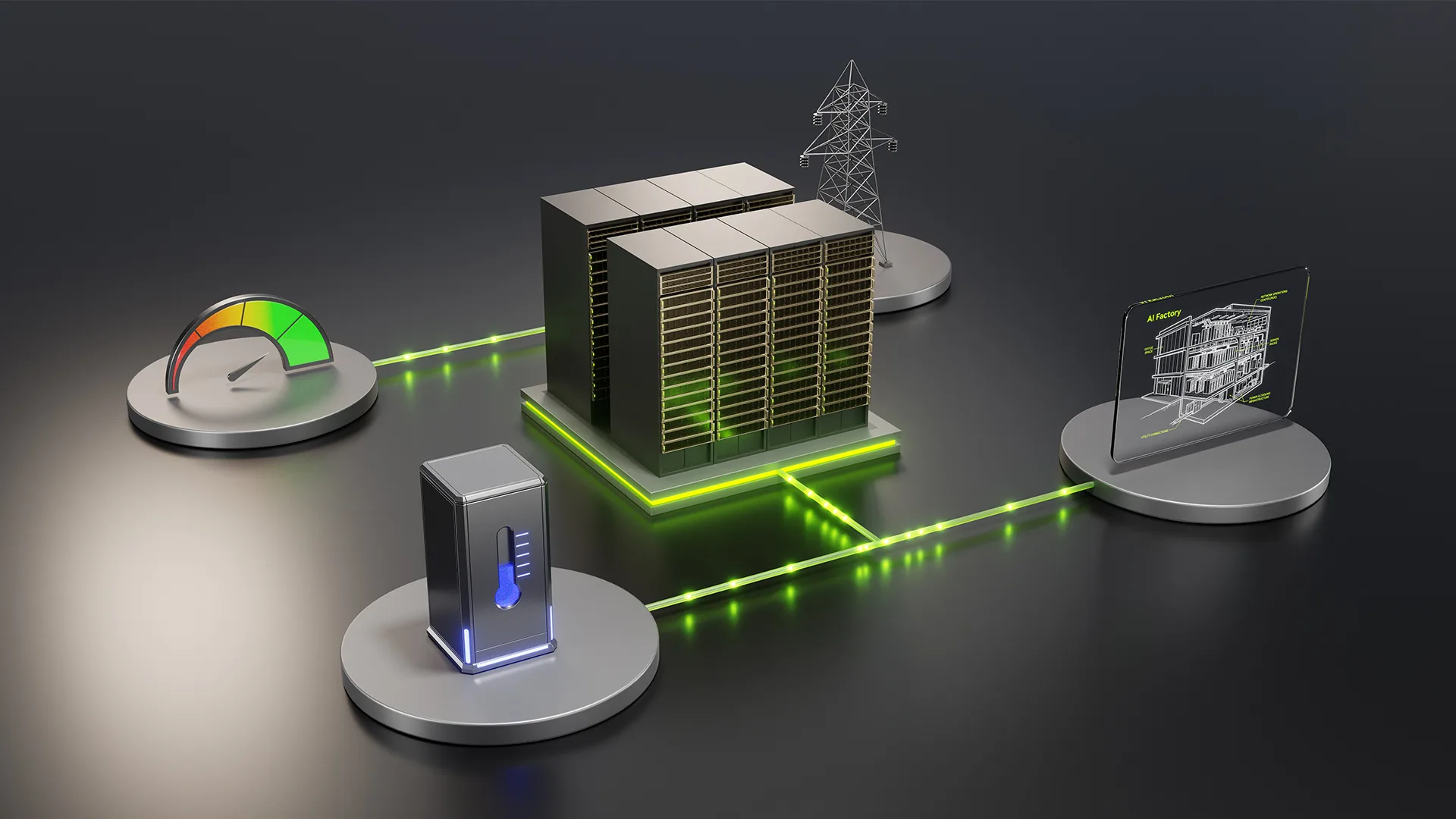
NVIDIA's DSX MaxLPS shares available power across participating machines as their workloads fluctuate. This can fit additional GPUs within an existing electrical budget because every machine need not reserve its peak allocation continuously. In a joint NVIDIA and Nscale evaluation running Kimi K2.5 on GB300 NVL72 systems, the configuration grew from 140 to 192 GPUs under the same 264.4-kilowatt budget, increasing normalized aggregate throughput by 49.2%.
The larger fleet consumed 19.7% more measured power. Its efficiency claim therefore concerns output per provisioned watt, with the budget as the denominator. Typical response latency stayed close to baseline, but the 99th-percentile wait for the first output increased 17%. The result shows additional capacity within an electrical limit, accompanied by a worse wait at the slow end of requests.
- Static planning reserves peak power for every node at once, but training cycles through compute, communication and checkpointing and inference through prefill, decode and idle gaps, so headroom inside one node's reservation stays stranded while the site sits below its limit.
- NVIDIA stresses MaxLPS adds no site power: operator policy sets node and group limits, reserves and priorities, and the software shifts participating GPU power caps from telemetry so the aggregate stays under the approved budget.
- In the NVIDIA and Nscale test, the extra 52 GPUs ran one more high-throughput Kimi K2.5 instance while per-instance output held flat (59,153 vs 59,220 tokens/s); measured power rose 19.7% and budget utilization went from 62.9% to 75.2%.
- Usable headroom depends on the workload mix: workloads with complementary power profiles free more capacity than ones that peak together, so NVIDIA advises testing a representative production mix against the aggregate limit rather than a single model.
- The recommended rollout is staged: map the enforceable power boundary, baseline under static provisioning, start with limits near that baseline, add nodes in steps while testing peak demand and telemetry failure, then set production limits.
- eval — A repeatable test for AI quality — a set of tasks plus scoring — used the way software teams use test suites, because model output is too variable to judge by eyeballing.
- inference — Running a trained model to get answers — the phase where AI is actually used, as opposed to trained.
- token — The chunk of text a model reads and writes in — roughly three-quarters of a word — and the unit AI usage is billed in.
- benchmark — A standard public test set for comparing AI models — the shared scoreboards behind every "model X beats model Y" claim.
 articleHow NVIDIA Groq 3 LPX Deterministic Execution Drives Power-Efficient High-Interactivity Inference on NVIDIA Vera RubinTanya Lenz
 articleNVIDIA Vera Rubin and Blackwell Set a New Standard for Agentic AI Performance per WattElizabeth Goodman
 articleHow NVIDIA NVLink 6 Delivers Multi-Layer Resiliency for AI FactoriesElizabeth Goodman
Checking sign-in…
Loading comments…