Thinking Machines Has Released Inkling The New Leading U S Open Weights Model
- Source
- artificialanalysis.ai
- Author
- Artificial Analysis articles
- Date
Context
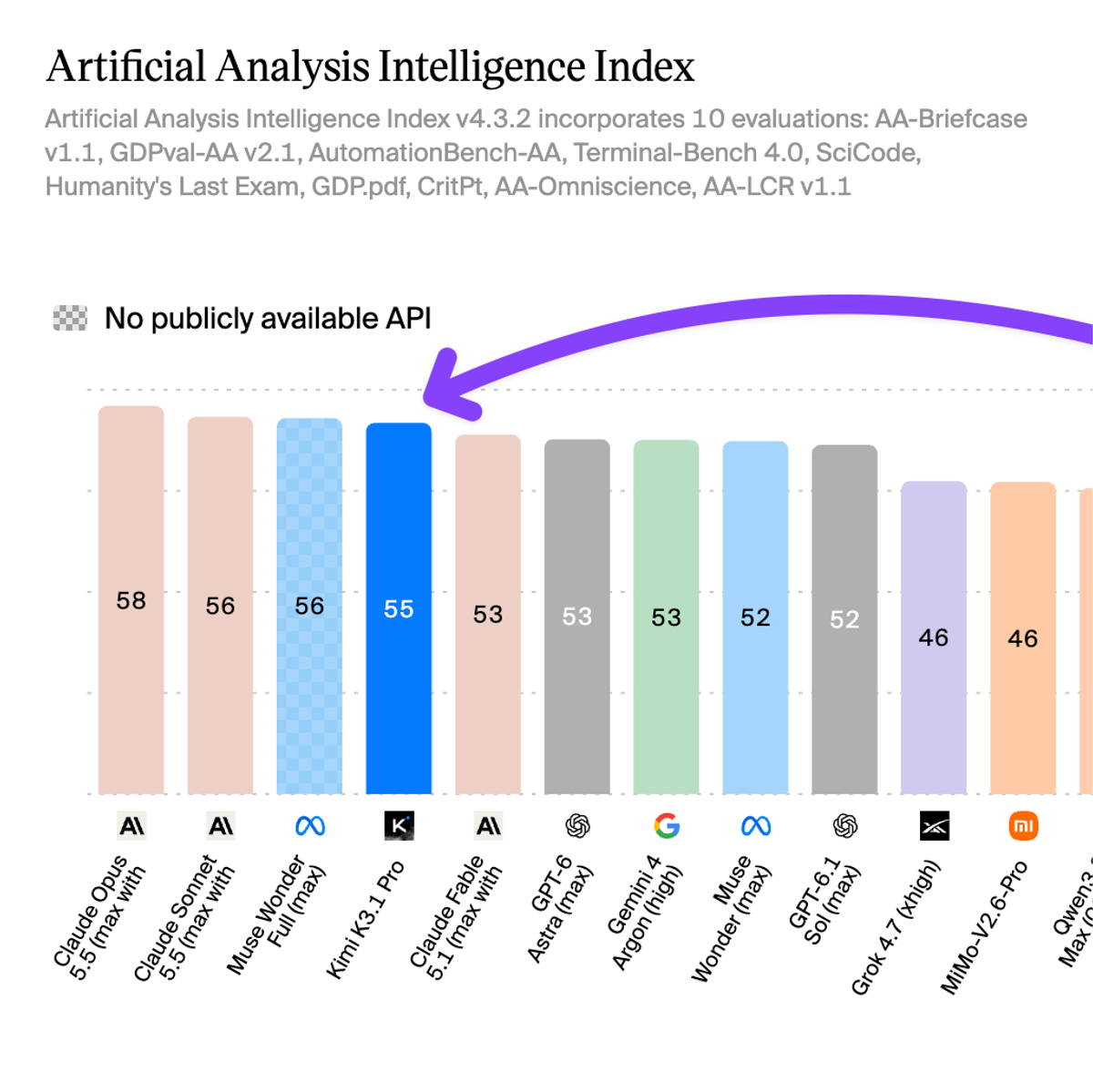
Inkling is the first production language model from Thinking Machines, whose earlier releases were research previews, and Artificial Analysis scores it 41 on its Intelligence Index, the highest for an open-weights model from a U.S. lab (artificialanalysis.ai). means the trained model can be downloaded and run or modified, here via HuggingFace. Inkling is 3 points above the previous U.S. leader, NVIDIA's Nemotron 3 Ultra (38), and ahead of Gemma 4 31B (29) and gpt-oss-120b (24).
Against the wider open-weights field, its standout results are agentic. On GDPval-AA v2, which rates models on realistic work tasks, Inkling's Elo of 1238 beats Moonshot AI's Kimi K2.6 (1190) and DeepSeek v4 Flash max (1189), and on 𝜏³-Banking it scores 24% against 21% and 23%. It is also economical with output: 25K tokens per index task against 43K for GLM-5.2 (max), 38K for Kimi K2.6 and 37K for DeepSeek v4 Pro (max). The model has 975B parameters, with 41B active at a time, and accepts text, image and audio input, which Artificial Analysis calls a key differentiator among open-weights models.
The weak spot is factual reliability. On AA-Omniscience, a knowledge test whose score reflects both accuracy and rate, Inkling scores +2, below leading open-weights models though above other U.S. ones; its accuracy is 40% but its hallucination rate is 63%. also depends on where it runs: 256K tokens on Thinking Machines' Tinker API against 1M for the open weights, a distinction its launch article also makes.
- Inkling is Thinking Machines' first production language model: 975B total parameters with 41B active, taking text, image and audio input and producing text, per Artificial Analysis.
- On agentic tests Artificial Analysis reports 1238 Elo on GDPval-AA v2, above Kimi K2.6 (1190) and DeepSeek v4 Flash max (1189), and 24% on τ³-Banking, just above DeepSeek v4 Flash max at 23%.
- Images and video pass through a hierarchical patch encoder and audio through discrete token encoding; all modalities are projected into one shared hidden space and processed jointly by the decoder.
- Context depends on access path: 256K tokens on Thinking Machines' Tinker API versus 1M for the open weights. Listed pricing at 64K context is $1.87 input, $0.374 cached and $4.68 output per 1M tokens, doubling at 256K.
- Hallucination is a weak spot: Inkling scores +2 on AA-Omniscience with 40% accuracy but a 63% hallucination rate, below leading open-weights models though above other U.S. ones such as Nemotron 3 Ultra (-1).
- open weights — A model whose trained parameters are published for anyone to download and run — unlike API-only models you can access but never possess.
- hallucination — When a model states something false with full confidence — inventing facts, citations, or APIs that don't exist.
- context window — The maximum amount of text a model can consider at once — its working memory for the current conversation or task.
- multimodal — A model that works with more than text — reading images, audio, or video, and sometimes generating them too.




Checking sign-in…
Loading comments…