Isaac GR00T
https://github.com/nvidia/isaac-gr00t- Category
- AI Tools
- Rank
- No. 246Tools index
- Pricing
- Open Source
- Type
- TOOL
- Use case
- Models: Train & Run
- Builder
- nvidia
- GitHub
- 8.3k stars
- Latest release
- n1.6.1-release
- Date
About
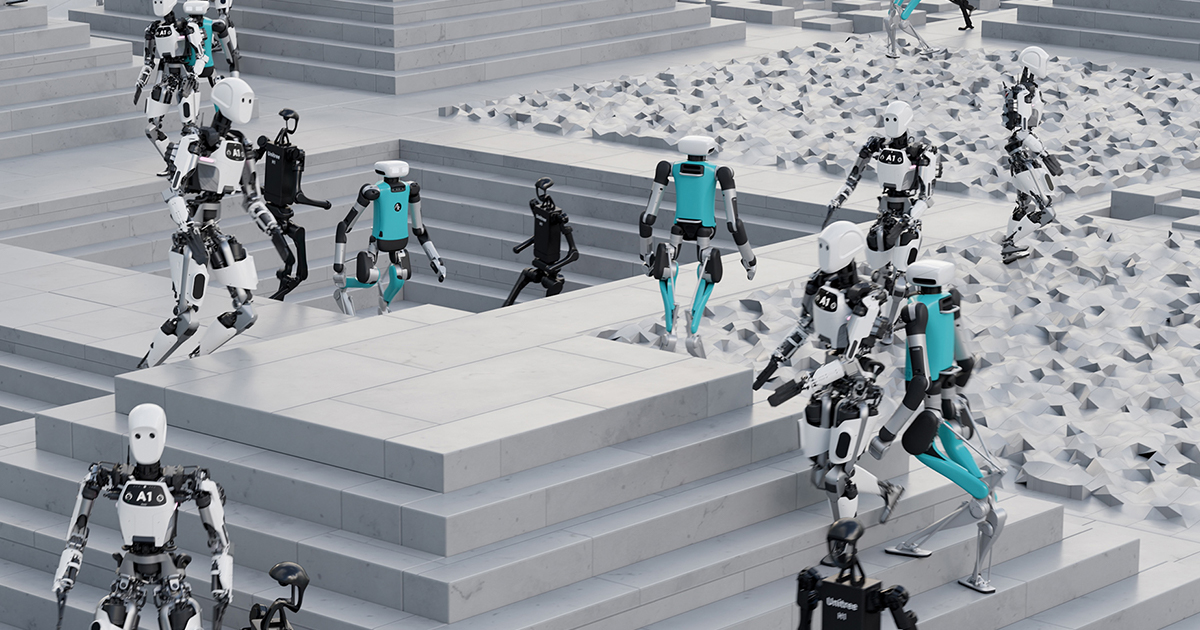
NVIDIA's foundation model for generalist humanoid robots (GR00T N1.7) — perception-to-action policy that transfers across body shapes and tasks.
What it does
Isaac GR00T turns language, camera images, and robot state into continuous manipulation actions. Its architecture pairs a vision-language backbone with a diffusion transformer action head. Teams can run pretrained checkpoints, adapt them with recorded demonstrations, evaluate behavior, and connect the resulting policy to a robot controller.
Why it's ranked here
The repository presents a unusually complete robotics stack: model weights, reference code, data preparation, fine-tuning, simulation and hardware evaluation, policy serving, and accelerated deployment. Relative end-effector actions and mixed-dataset training address practical adaptation problems. The substantial hardware and access requirements keep it from being a casual experimentation tool.
What's good
The workflow covers the difficult bridge from demonstrations to deployment. It accepts multiple datasets with mixture weighting, provides sample-data conversion tools, and supports open-loop checks before simulation or hardware tests. ONNX and TensorRT export offer a credible deployment route across desktop and edge NVIDIA systems. Configuration and dataset validation utilities catch errors that might otherwise surface during expensive training runs.
Tradeoffs
Inference requires a GPU with at least 16 GB of memory, while fine-tuning recommends 40 GB or more. Installation is tightly constrained by CUDA, Python, architecture-specific wheels, and FFmpeg compatibility. The vision-language backbone is gated, so every checkpoint requires approved Hugging Face access and authentication. Repository cloning also needs submodules, while bundled demonstration parquet files require Git LFS.
How to use it well
It best fits robotics teams that already collect video, state, and action demonstrations and have NVIDIA GPU infrastructure. Convert recordings into the supported LeRobot layout, establish an inference baseline, fine-tune for the target robot, then progress through open-loop, simulation, and hardware evaluation. Treat it as the learned policy layer, not a replacement for robot controllers, safety systems, or experimental validation.
Technical notes+
pyproject.toml defines the gr00t setuptools package, Python 3.12 constraints, uv environments, CUDA-indexed PyTorch wheels, architecture-specific FlashAttention and TensorRT dependencies, plus pytest and Ruff configuration. gr00t/__init__.py patches Transformers loading for cache-first behavior and supports weight-free test construction through GROOT_SKIP_HF_MODEL_WEIGHTS. scripts/download_droid_sample.py converts selected DROID data into LeRobot v2 episode parquet and video structure. scripts/repair_lerobot_metadata.py atomically removes metadata references to missing episode assets and regenerates statistics. tools/check_manifest_alignment.py compares dependency pins across the main, Orin, Spark, and Thor manifests. scripts/validate_hf_config_alignment.py checks model, processor, embodiment, checkpoint, and documentation consistency. scripts/verify_droid_rotation_correction.py compares rotation conventions against checkpoint statistics.
Observed
- License
- Apache License 2.0, including commercial licensing according to the README.
- Primary language
- Python, packaged as the gr00t module with setuptools.
- Installation
- Primary setup uses uv; editable pip installation is also documented.
- Interfaces
- Python library, command-line scripts, and a Policy API for controller integration.
- Platform support
- Linux x86_64 and aarch64 environments cover desktop GPUs, Jetson Orin, Jetson Thor, and DGX Spark.
- Runtime requirements
- Inference requires one GPU with at least 16 GB VRAM; fine-tuning recommends one or more GPUs with at least 40 GB VRAM.
- Model access
- The gated Hugging Face backbone requires approved access and authentication before inference or fine-tuning.
- Deployment surface
- The documented deployment path includes full-pipeline ONNX and TensorRT export.
Read from README.md, pyproject.toml, gr00t/__init__.py, scripts/download_droid_sample.py, tools/check_manifest_alignment.py, scripts/repair_lerobot_metadata.py, scripts/download_simplerenv_sample.py, scripts/validate_hf_config_alignment.py, scripts/verify_droid_rotation_correction.py.
What it can do
Generate robot control policies from visual input
Visual sensor data (cameras, depth sensors) → Motor control commands for robot actuators
Transfer learned behaviors across different robot body types
Trained policy model and target robot configuration → Adapted control policy for new robot morphology
Process multimodal sensory input for decision making
Camera feeds, depth data, IMU readings, joint encoders → Interpreted environmental state and object recognition
Execute manipulation tasks through learned policies
Task specification and current environment state → Coordinated arm and hand movements for object manipulation
Perform locomotion and navigation behaviors
Target destination and environmental obstacles → Leg coordination commands for walking and path planning
Adapt to new tasks through policy generalization
Novel task scenario and existing learned behaviors → Modified control strategy for unseen task execution
Tags
Tech Stack
Media
Comments (0)
No comments yet
Editorially curated, with community endorsements as a secondary signal. Corrections welcome.