Minimax M3
- Source
- artificialanalysis.ai
- Author
- Artificial Analysis articles
- Date
Context
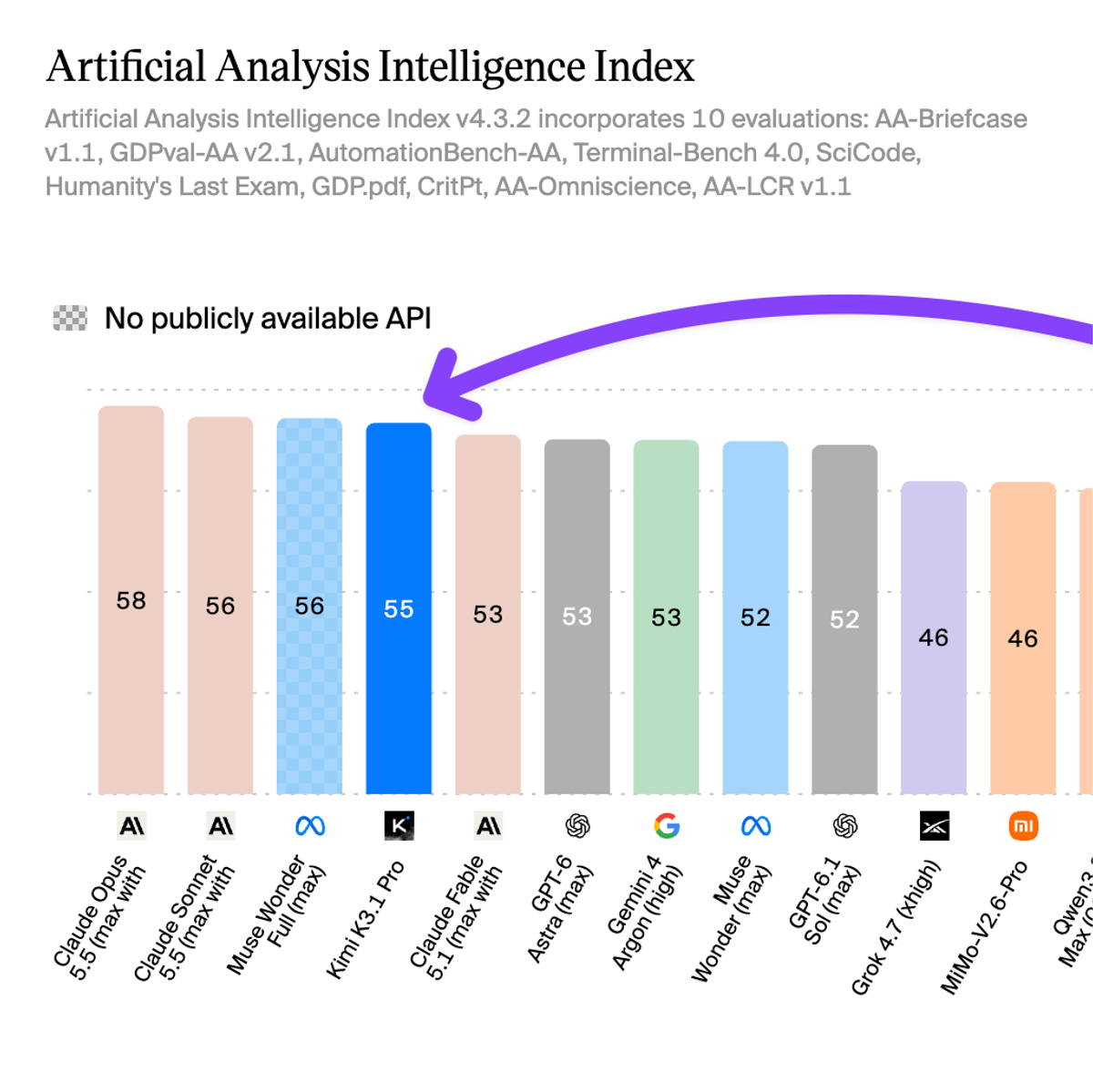
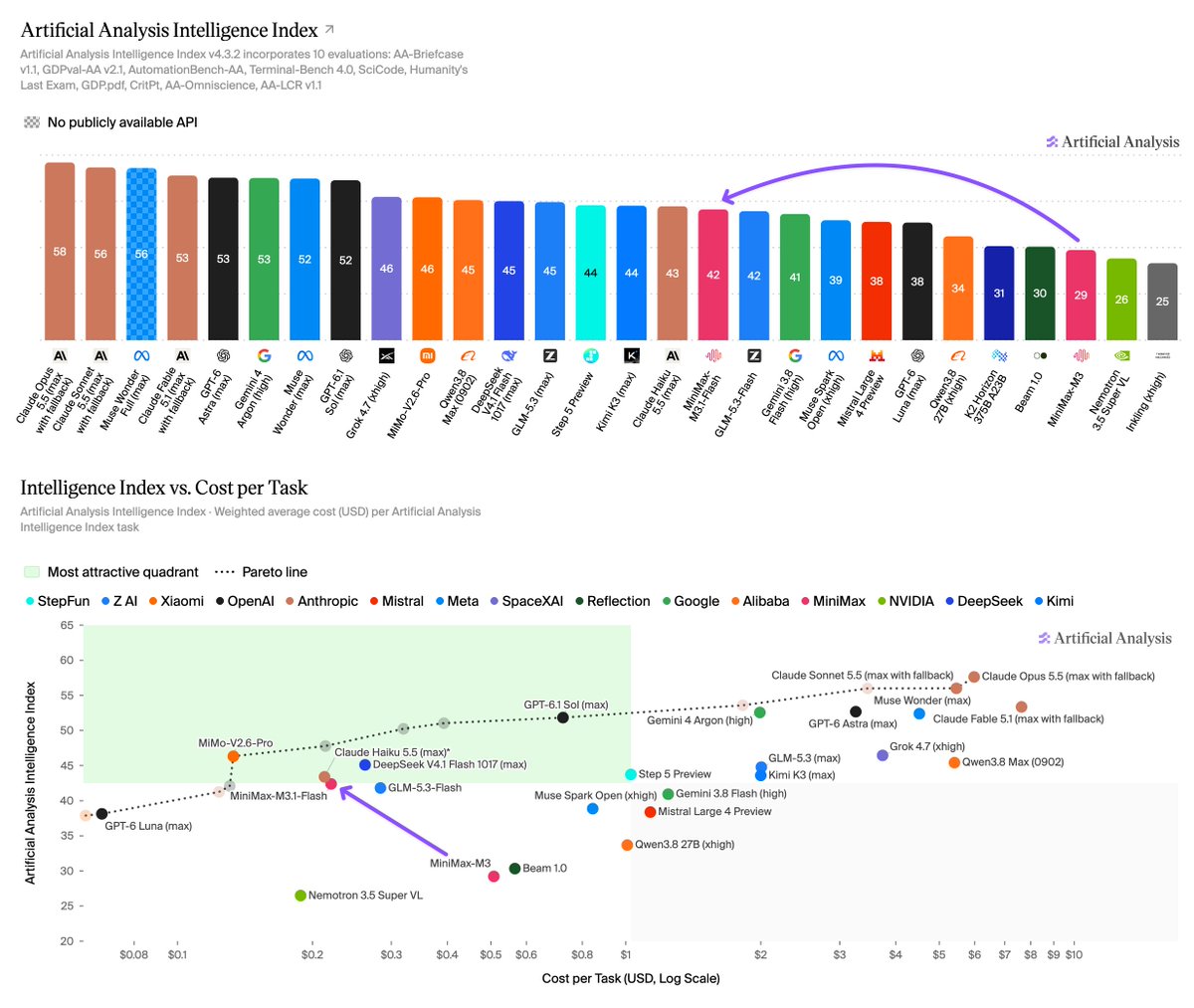
MiniMax-M3 scores 55 on Artificial Analysis's Intelligence Index, just ahead of the models Kimi K2.6 and MiMo-V2.5-Pro at 54 each (artificialanalysis.ai). The headline's condition is about status rather than performance. When the article was published, M3 was served through MiniMax's own API, SiliconFlow, GMI and Novita, but its weights had not been released. MiniMax said they would follow within about 10 days, and Artificial Analysis noted that M2.7's weights had come under a commercially restricted license. A MiniMax-M3 repository is now public on Hugging Face under a MiniMax Community License. It grants free use for non-commercial purposes, while commercial use requires a Built with MiniMax M3 notice and, for products with more than $20 million in yearly revenue, prior written authorization from MiniMax.
M3 is the first model in MiniMax's M series, adding image and video input to the text-only M2.7, and its grows from 200,000 to 1 million tokens. It improves on M2.7 on most evaluations, including Humanity's Last Exam from 28% to 37%, GPQA Diamond from 87% to 93% and IFBench from 76% to 83%, with a small drop on SciCode from 47% to 45%. It used about 91 million output tokens to run the index against M2.7's 87 million, so its 5-point gain over M2.7's index score of 50 did not come from much longer answers.
On GDPval-AA, a benchmark of real-world tasks across 44 occupations, M3 scores about 1670, behind Claude Opus 4.8 (max) at 1890 and GPT-5.5 (xhigh) at 1769, and level with Claude Sonnet 4.6 at 1676. AA-Omniscience shows a distinctive habit. M3 attempted only 30.9% of questions, the fewest among its peers. Declining to answer keeps its rate low at 16.1%, but it also holds accuracy down at 15.0%. Pricing is $0.30 per million input tokens and $1.20 per million output tokens up to 512,000 tokens of context, doubling to $0.60 and $2.40 beyond that.
- MiniMax-M3 is the company's first multimodal M-series model, adding image and video input and raising the context window from M2.7's 200K to 1M tokens, while scoring 55 versus 50 on the Intelligence Index.
- Gains over M2.7 include HLE 28% to 37%, GPQA Diamond 87% to 93% and IFBench 76% to 83%, with a small SciCode regression from 47% to 45%.
- On AA-Omniscience M3 attempts only 30.9% of questions, the lowest among peers, which produces both a low hallucination rate (16.1%) and low accuracy (15.0%).
- At writing, weights were not yet released; MiniMax said they would follow within about 10 days, and M2.7's weights had shipped under a commercially restricted license.
- open weights — A model whose trained parameters are published for anyone to download and run — unlike API-only models you can access but never possess.
- multimodal — A model that works with more than text — reading images, audio, or video, and sometimes generating them too.
- context window — The maximum amount of text a model can consider at once — its working memory for the current conversation or task.
- hallucination — When a model states something false with full confidence — inventing facts, citations, or APIs that don't exist.

Checking sign-in…
Loading comments…