GLM Legal: cheap open-weight legal model, with a research regression
- Source
- x.com
- Date

Zai just debuted a legal specific model: GLM Legal, and it is the new #1 open-weight model on Harvey’s Legal Agent Benchmark and LegalBench.

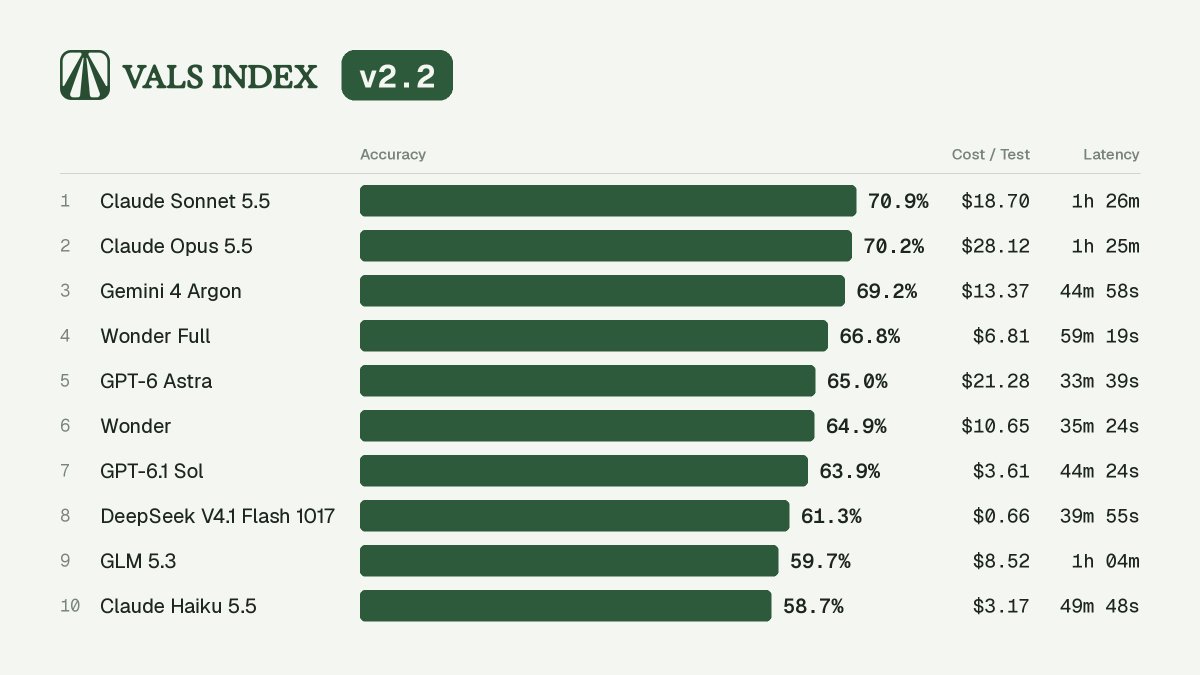
Harvey's Legal Agent Benchmark tests full legal assignments using documents, spreadsheets, and presentations. On this benchmark, it scored 19.2%, about 3x higher than the regular GLM 5.3 Flash (6.7%) and more than double the full-size GLM 5.3 (8.3%). GLM Legal met 92.5% of the individual criteria, up from 82.2% for GLM 5.3 Flash. It scored higher because it missed fewer requirements and fully finished so many more tasks. It scores #6 overall and at about $0.15 per task, it costs roughly 70 times less than Gemini 4 Argon (#5), which costs about $10.55 per task.

LegalBench tests short non-agentic legal reasoning questions. GLM Legal improved 2.3pp from GLM 5.3 Flash and the biggest gain came in interpretation tasks, which rose 5pts. It is now the top open-weight model on LegalBench, just ahead of Kimi K3. It also costs half as much per question as GLM 5.3 Flash. Per-token pricing is identical, so the savings come from the legal version using fewer tokens to answer.
Despite the increases on HLAB and Legal Bench, we saw a decrease on LegalResearchBench, which tests legal research using case-law search and the web. Although it scored 4 points behind GLM 5.3 Flash, its answers were mostly correct, earning 86.1% of rubric points. However, it missed a required point more often. It also searched case law much less frequently, about 6 times per question, compared with 16 for GLM 5.3 Flash.
Context
Vals AI ran GLM Legal, a legal-specific model from Z.ai, through its legal benchmarks and found large gains on full legal assignments, a small gain on short legal questions and a drop on legal research (thread). The biggest jump came on Harvey's Legal Benchmark, which hands a model complete assignments involving documents, spreadsheets and presentations. GLM Legal scored 19.2%, about three times the 6.7% of the general-purpose GLM 5.3 Flash and more than double the 8.3% of the full-size GLM 5.3. Its rate of meeting individual grading criteria rose less dramatically, from 82.2% to 92.5%, and Vals attributes the higher headline score to missing fewer requirements and fully finishing many more tasks. Vals says that makes it the top open-weight model on the benchmark.
Cost is the other part of the result. At about 0.15 dollars per task on Harvey's benchmark, Vals puts GLM Legal at roughly 70 times cheaper than Gemini 4 Argon at about 10.55 dollars. The thread ranks GLM Legal sixth overall with Gemini 4 Argon fifth, while Vals's model page lists it seventh of 79 and the cheapest model in the top 10; the two Vals sources do not explain the one-place difference. On LegalBench, a set of short legal reasoning questions without , it improved 2.3 points over GLM 5.3 Flash, with interpretation tasks up 5 points, and edged out Kimi K3 as the top open-weight model. It also cost half as much per question as GLM 5.3 Flash at identical per-token prices, because it used fewer tokens to answer. The model page lists those prices as 0.075 dollars per million input tokens and 0.25 dollars per million output tokens.
The regression came on Legal Research Bench, Vals's test of researching legal questions with case-law search, web search and document tools, where GLM Legal scored 4 points below GLM 5.3 Flash and ranked 24th of 78 at 41.83%. Vals says its answers were mostly correct, earning 86.1% of rubric points, but it missed a required point more often. That matters more than it sounds, because the benchmark's main score counts a question as correct only if every required rubric item is met. GLM Legal also searched case law about 6 times per question against 16 for GLM 5.3 Flash. Vals reports the lighter searching alongside the drop without showing it caused it, and its own benchmark analysis finds that across models, more tool calls do not predict higher accuracy.
These are Vals's runs at default provider settings and maximum reasoning effort, on a model with a 1M-token and 128k maximum output. Z.ai's own release material was not part of the evidence read here, so how the model was trained or specialized is not covered.
- open weights — A model whose trained parameters are published for anyone to download and run — unlike API-only models you can access but never possess.
- AI agent — An AI system that doesn't just answer once but works toward a goal in a loop — taking actions, reading the results, and deciding what to do next.
- tool use — A model's ability to call external functions — run code, search the web, edit files — instead of only generating text.
- context window — The maximum amount of text a model can consider at once — its working memory for the current conversation or task.
Checking sign-in…
Loading comments…