Vals Index v2.2 changes judges, harnesses and grading rules
- Source
- x.com
- Date

The Vals Index just got an upgrade! We are releasing v2.2, which includes minor version updates to four of its benchmarks: Finance Agent v2.1, Excel Modeling Benchmark v1.1, Code Migration v1.1, and Harvey's LAB v1.1.
Context
The Vals Index is Vals AI's attempt at a single number for how much economic work a model can do. According to the index page, it averages agentic results across four sectors, each weighted by its share of U.S. GDP: finance is weighted 8.0, coding 5.6, legal 1.2 and tax 0.5, matching each sector's approximate percentage of GDP, and the weighted sum is divided by their 15.3 total. Finance combines Finance and the Excel Modeling Benchmark, coding combines Terminal-Bench 4.0, Vibe Code Bench and Code Migration, legal combines Legal Research Bench and Harvey's Legal Agent Benchmark, and tax is a single private benchmark of corporate tax questions.
Version 2.2 does not add or remove sectors. It moves four components to newer versions, Finance Agent v2.1, Excel Modeling Benchmark v1.1, Code Migration v1.1 and Harvey's benchmark v1.1, as Vals announced, and the changelog adds one more change: the tax benchmark is now scored by what Vals calls all-pass accuracy, a grading change the changelog does not explain further. For Code Migration the index scores a fixed subset, 50 of the 120 command-line migration tasks plus all 10 COBOL tasks, and Vals reports that this subset still tracks the full v1.1 result closely, with a rank correlation of 0.99 and 1.4 points of average error. The changelog lists the other version bumps without detail, so how much each one moved scores is not stated there. The previous release, v2.1, had already lowered scores across the board by switching to the harder Terminal-Bench 4.0 (earlier Intel), so numbers from different index versions should be read as separate scales.
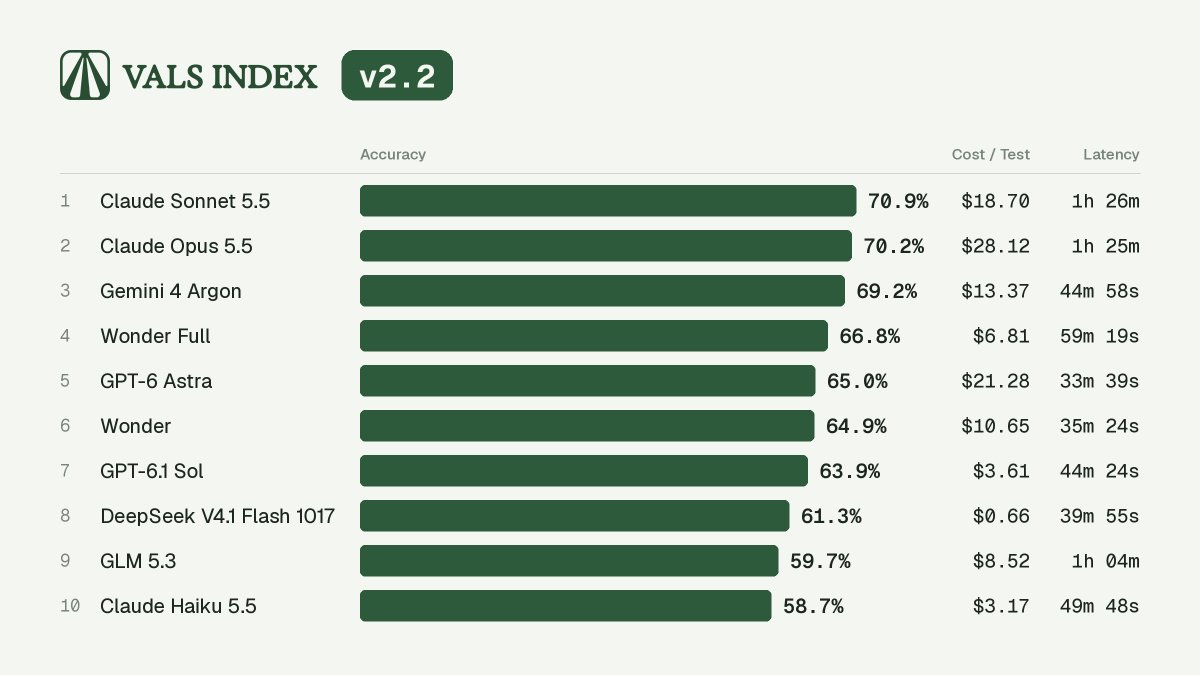
On the page as of October 21, Anthropic's Claude Sonnet 5.5 leads at 70.85%, ahead of Claude Opus 5.5 at 70.18% and Google's Gemini 4 Argon at 69.24%. Vals adds a caveat that matters for that order: some of the Claude models' component tasks were answered by a fallback model after the provider refused, and counting those as failures would drop Sonnet 5.5 to 69.03% and Opus 5.5 to 64.16%. Gemini 4 Argon needed no fallbacks, so under that stricter reading it would rank first.
- benchmark — A standard public test set for comparing AI models — the shared scoreboards behind every "model X beats model Y" claim.
- AI agent — An AI system that doesn't just answer once but works toward a goal in a loop — taking actions, reading the results, and deciding what to do next.
- agent harness — The scaffolding around a model that turns it into a working agent — the loop, the tools it can call, and the rules for when to stop.
Checking sign-in…
Loading comments…