Anthropic's Guide to Choosing a Claude Model and Effort Level
- Source
- claude.dev
- Author
- ClaudeDevs
- Date
Context
Anthropic's answer, in a guide by Addy Osmani on its developer blog, is to start most coding and knowledge work on Claude Opus 5.5 at its default medium effort and switch only when a task gives a reason to. Anthropic sells four generally available models: Haiku 5.5, Sonnet 5.5, Opus 5.5 and Fable 5.2, in rising order of capability. Opus 5.5 is the default in Claude Code and costs $4 per million input tokens and $20 per million output tokens, half of Fable 5.2's $8 and $40. From there the guide moves well-scoped work such as a bug fix down to Sonnet 5.5, high-volume classification, routing and extraction further down to Haiku 5.5, and the hardest technical projects in coding, finance and the sciences, or long unattended runs, up to Fable 5.2.
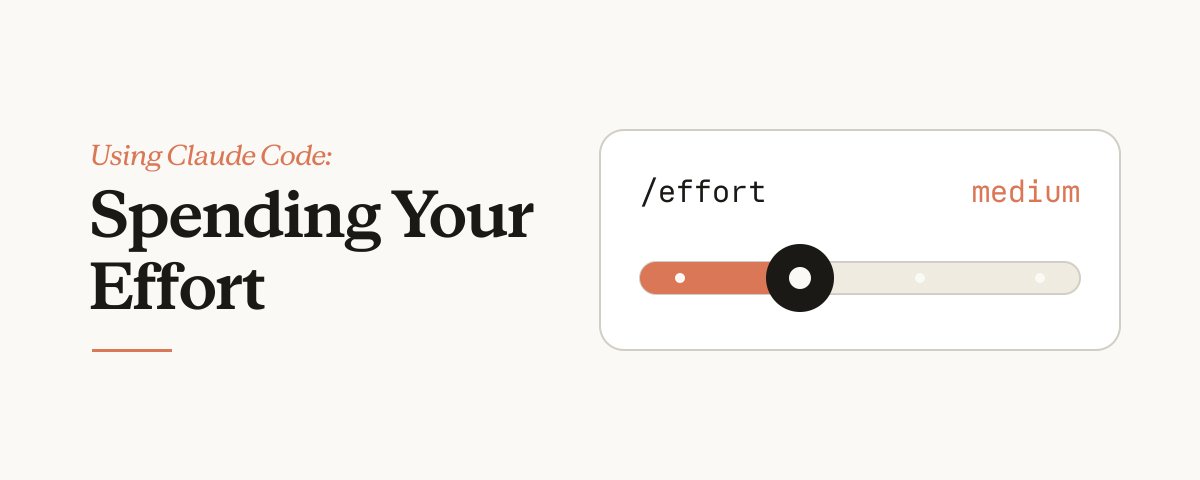
Before changing models, the guide says to try the effort setting. Higher effort lets a model think longer, call more tools and check its own work more, at the price of more tokens and more waiting, but it cannot give a model knowledge or it lacks. Past high effort, the two dials start to overlap. On FrontierCode 2.0, in results Anthropic reports, Fable 5.2 at high effort scored about level with Opus 5.5 at its maximum setting, 45.3% against 45.5%, for roughly half the cost per task. A model with twice the token price can therefore finish a hard task more cheaply, and the guide advises testing Fable 5.2 before pushing Opus 5.5 past high.
Often the cheaper fix is neither dial. The guide's first step when a model falls short is to make sure it can check its own work with a test, a build or a script. When results can be checked automatically, Anthropic reports that running Opus 5.5 at low effort and re-running only the failures at high passed about 97% of tasks in a Pro subset for about $0.17 each, against 95.3% for $0.29 with every task at high. The same logic applies to subagents, helper agents that work in their own and hand back a summary: the guide puts them on Haiku or Sonnet for work where a mistake is cheap to spot, like reading logs, and keeps code edits and judgment calls on the main model. Every figure here is Anthropic's own reported result, and the guide ends by telling developers to test candidate models on a sample of their own tasks before committing.
- Anthropic's model guide recommends starting most coding and knowledge work on Opus 5.5 at medium effort, at half Fable 5.2's per-token price, then moving to Sonnet 5.5 for scoped tasks, Haiku 5.5 for classification and routing, and Fable 5.2 for the hardest technical work.
- Per the guide, a pricier model does not always cost more per task: on FrontierCode 2.0, Fable 5.2 at high effort scored 45.3% against Opus 5.5 at max's 45.5% for roughly half the cost per task.
- The guide's order when a model falls short: let it verify its own work, raise effort one level, then move up a model at lower effort. Opus 5.5 at low with failures re-run at high passed about 97% of a SWE-bench Pro subset at $0.17 a task, vs 95.3% at $0.29 all at high.
- Switching models mid-session costs a fresh cache write on the whole conversation and can drop earlier reasoning, because a model never reads thinking blocks from a model above it. The guide suggests /compact or a short written plan before switching.
- In Anthropic's internal defect-search test over about 22 million tokens of code, an Opus 5.5 lead directing up to 25 Sonnet 5.5 workers cost about a third less than Opus 5.5 alone at default effort and scored about the same.
- agent skill — A reusable instruction file that teaches an agent how to do one job well — the procedure, the tools, and what counts as done.
- SWE-bench — The standard benchmark for AI coding agents: real GitHub issues from real repositories, scored by whether the agent's patch passes the project's own tests.
- Context and context window — Context is the information available for a generation; the context window is the capacity available to hold it.
- multi-agent — Using several AI agents on one problem — splitting work in parallel, checking each other, or filling different roles like planner and reviewer.

Checking sign-in…
Loading comments…