Reducing High-Bandwidth Memory Bottlenecks in JAX-Based LLM Training with Host Offloading
- Source
- developer.nvidia.com
- Author
- Tanya Lenz
- Date
Context
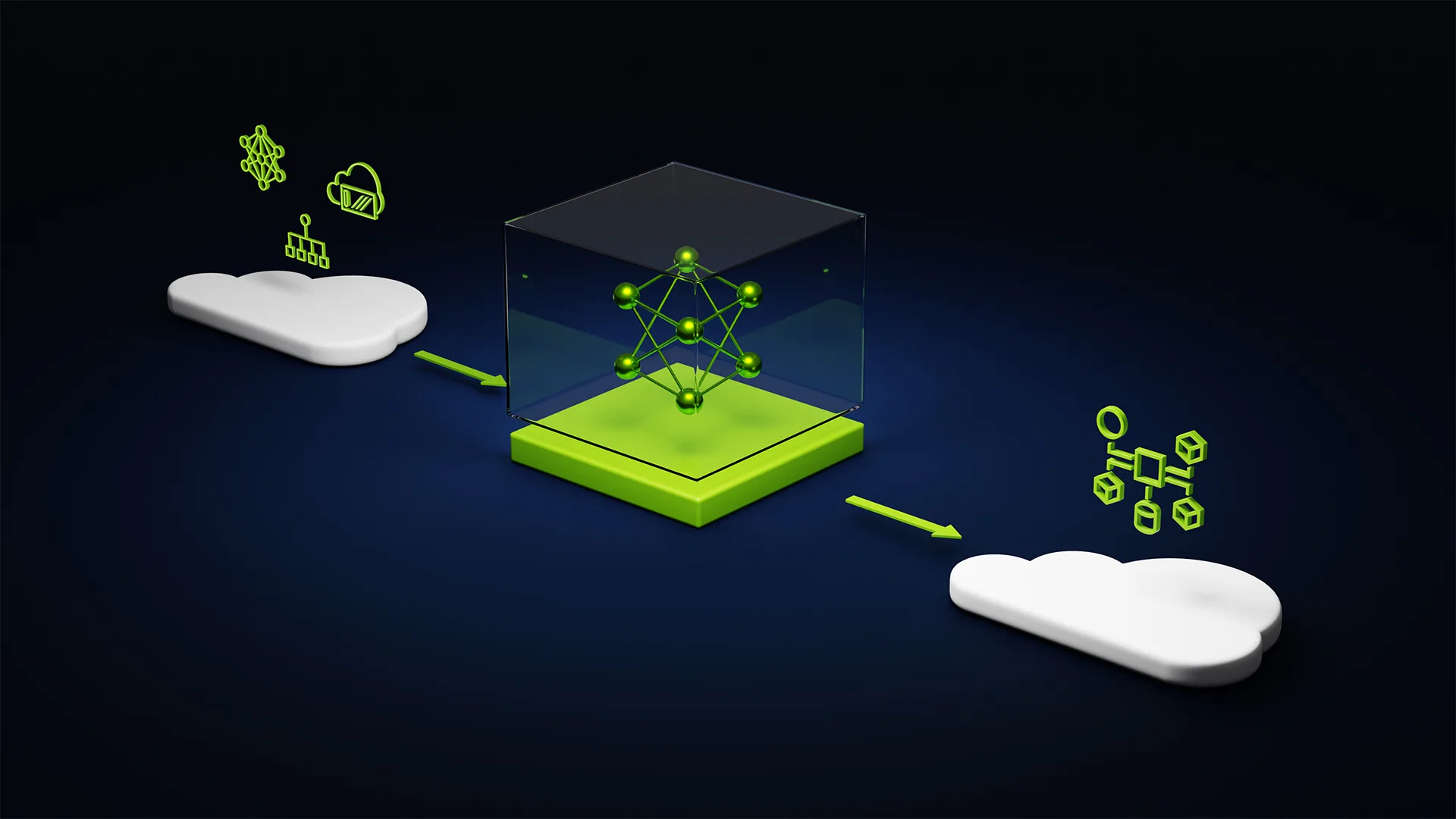
JAX host offloading frees GPU memory by temporarily storing selected intermediate training results in the CPU's memory. Those results, called activations, are brought back when training needs them to calculate updates. This offers an alternative to discarding them and recomputing them later. NVIDIA explains the approach in its training article.
Moving data introduces its own cost, so scheduling matters as much as available memory. Transfers need to overlap with useful GPU computation instead of leaving the GPU waiting. The article's experiments show that throughput changes with the model and scheduling configuration. Offloading therefore exchanges memory pressure and recomputation for communication that the system must efficiently hide. The reported comparisons show that dependency.
- mixture-of-experts — A model built from many specialist sub-networks where only a few activate per token, giving big-model capability at small-model running cost.
 articleScaling NVIDIA TensorRT Performance Optimization Beyond a Single Build Route with the Global Performance Tuner, Part 2
 articleAccelerating Mamba-2 with High-Performance Forward Pass Kernels in NVIDIA CUDA Tile
 articleScale Agentic Coding Workflows with Meta’s Muse Spark Open on NVIDIA GB300 NVL72
 articleOptimizing Agent Reliability and Tool Calling Efficiency for Chip Design Using NVIDIA NeMo Gym

Checking sign-in…
Loading comments…