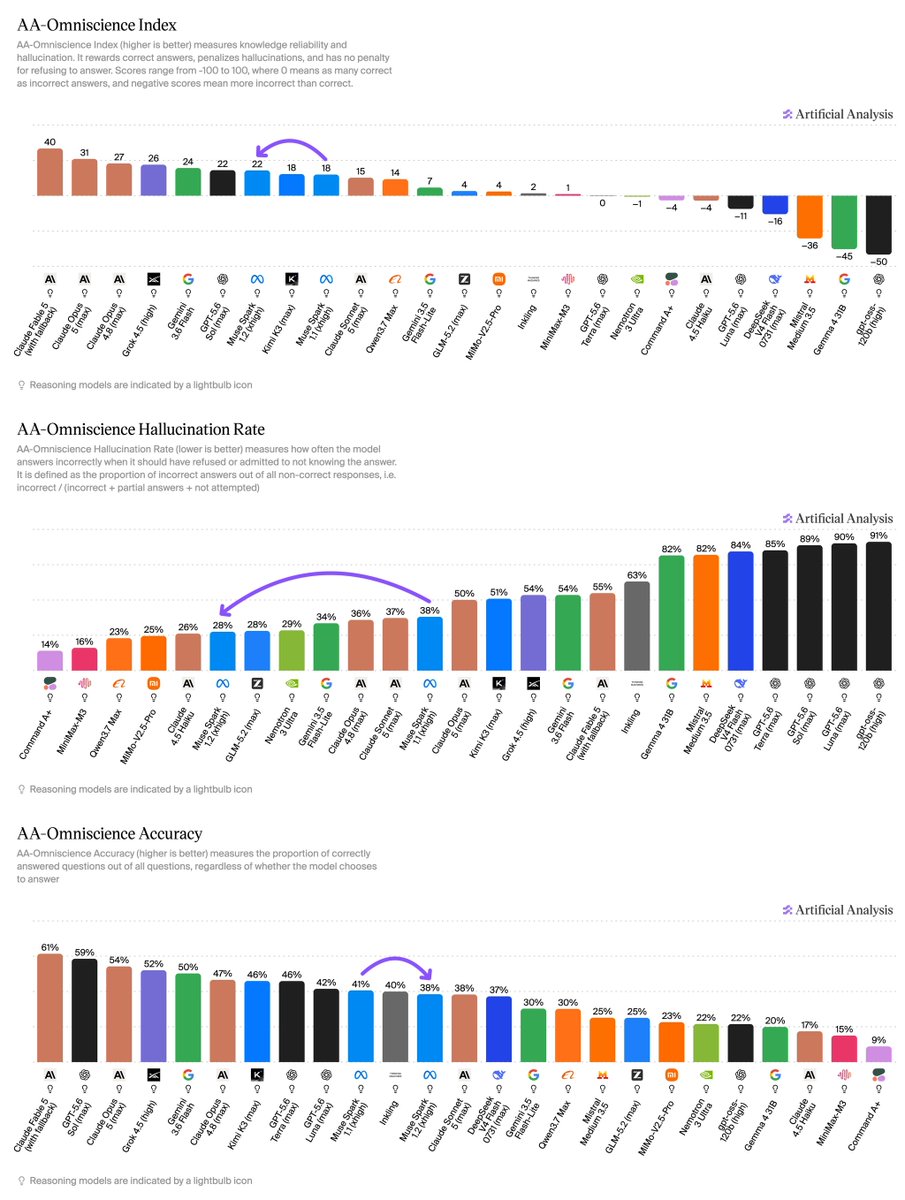
Meta's model is now competitive and cheap at about $0.26 per task, but its hallucination gain comes from answering less, not knowing more. Weigh that if you depend on factual recall.
Key takeaways · AI-distilled
Artificial Analysis attributed Muse Spark 1.1's July 2026 AA-Omniscience gain chiefly to abstention. Its hallucinationWhen a model states something false with full confidence — inventing facts, citations, or APIs that don't exist.Full definition → rate fell from 73% to 38%, while reported accuracy changed from 45% to 41%.
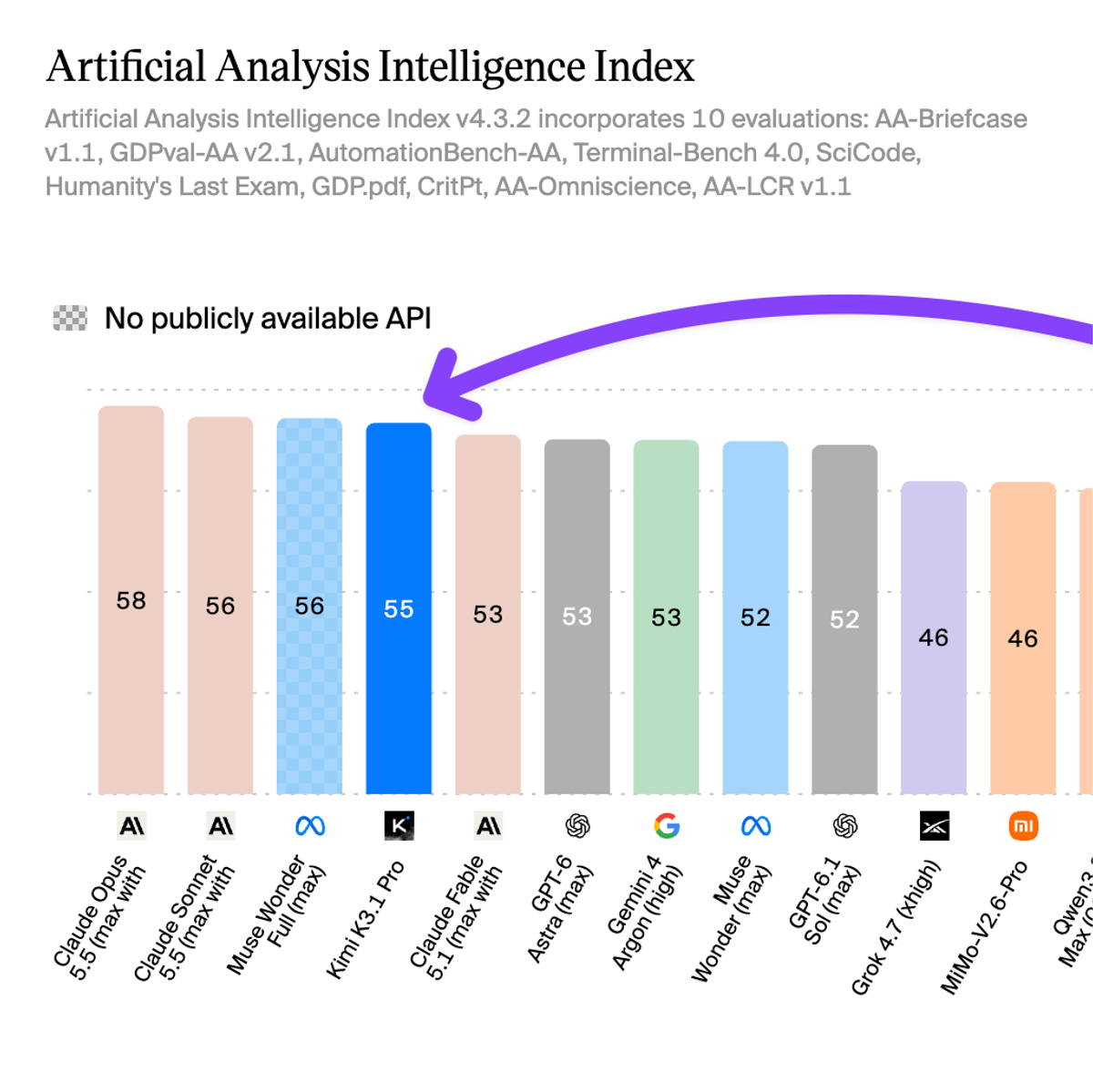
In July 2026, Muse Spark 1.1 used 94 million output tokenThe chunk of text a model reads and writes in — roughly three-quarters of a word — and the unit AI usage is billed in.Full definition → on the Intelligence Index, fewer than the listed models tied near its score of 51. Artificial Analysis estimated about $0.26 per task using Meta's published prices.
Muse Spark 1.1's July 2026 aggregate score concealed uneven strengths. Artificial Analysis highlighted scientific reasoning and coding gains, while agentic knowledge work still lagged the frontier on GDPval-AA v2.
Terms in this piece · Glossary
context window — The maximum amount of text a model can consider at once — its working memory for the current conversation or task.
token — The chunk of text a model reads and writes in — roughly three-quarters of a word — and the unit AI usage is billed in.
hallucination — When a model states something false with full confidence — inventing facts, citations, or APIs that don't exist.