Opus 4 6 Takes Lead In Agentic Real World Knowledge Tasks
Source
artificialanalysis.ai
Author
Artificial Analysis articles
Date
Why it matters
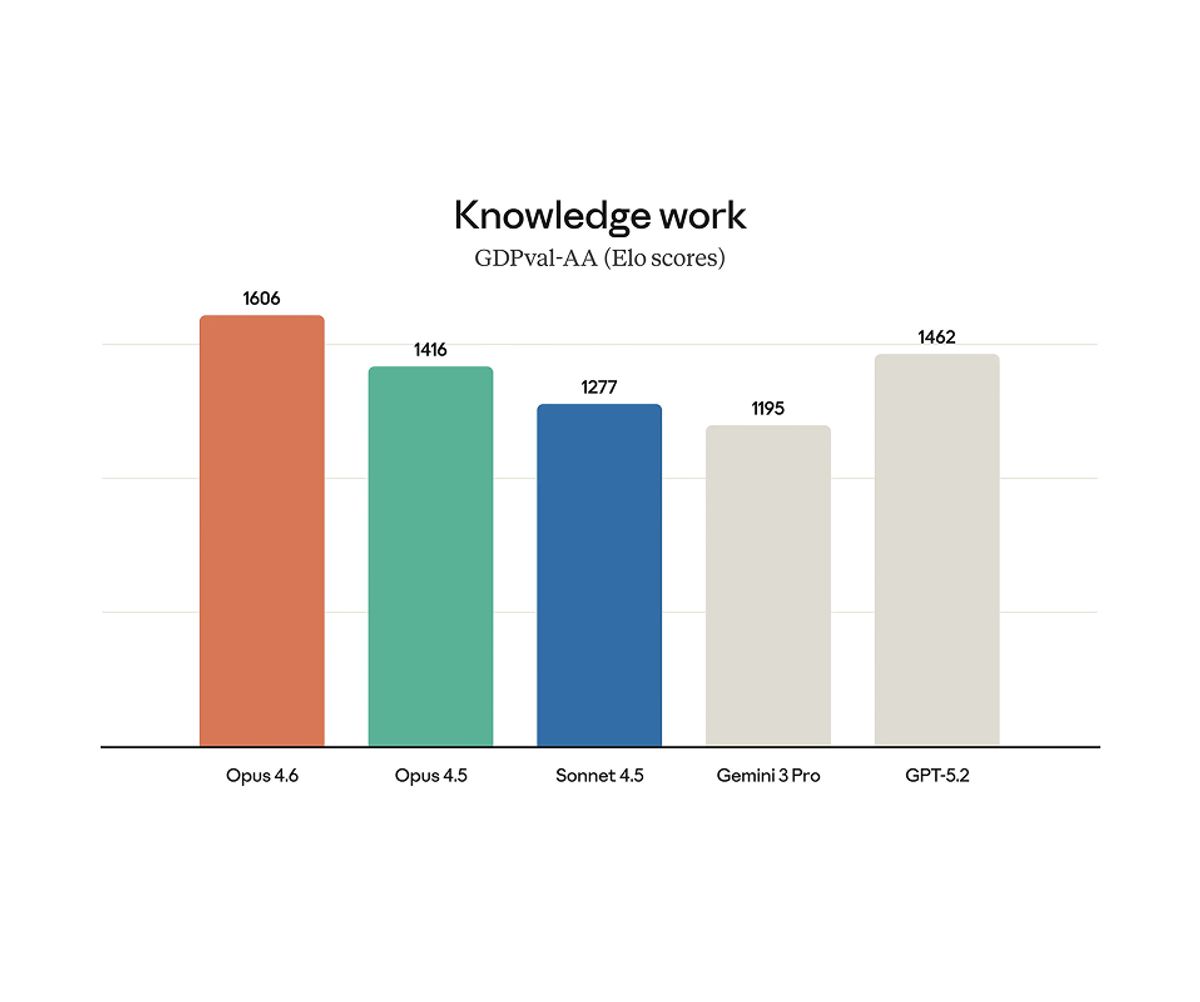
Opus 4.6 reaches 1606 Elo on GDPval-AA, about 70% head-to-head win rate over GPT-5.2 xhigh, by using more turns and viewing its own outputs. It was the costliest model tested on the evalA repeatable test for AI quality — a set of tasks plus scoring — used the way software teams use test suites, because model output is too variable to judge by eyeballing.Full definition →.
Key takeaways · AI-distilled
In February 2026, Artificial Analysis evaluated Opus 4.6 on 220 GDPval-AA knowledge-work tasks with shell and web tools through Stirrup. This measured an AI agentAn AI system that doesn't just answer once but works toward a goal in a loop — taking actions, reading the results, and deciding what to do next.Full definition → system on curated occupational tasks, not an isolated text response.
Artificial Analysis reported that Opus 4.6 used 30% to 60% more tokenThe chunk of text a model reads and writes in — roughly three-quarters of a word — and the unit AI usage is billed in.Full definition → than Opus 4.5 on GDPval-AA in February 2026. Its higher score came with the highest cost in the tested cohort, despite using fewer tokens than GPT-5.2 xhigh.
The February 2026 Opus 4.6 analysis observed more turns and more image-viewer use than its predecessor. Those tools let it inspect and revise its work, although the article did not isolate their causal contribution to its score.
Terms in this piece · Glossary
token — The chunk of text a model reads and writes in — roughly three-quarters of a word — and the unit AI usage is billed in.
eval — A repeatable test for AI quality — a set of tasks plus scoring — used the way software teams use test suites, because model output is too variable to judge by eyeballing.
AI agent — An AI system that doesn't just answer once but works toward a goal in a loop — taking actions, reading the results, and deciding what to do next.