Intelligence Index v5 goes majority-private and adds agentic coding and science
- Source
- x.com
- Date
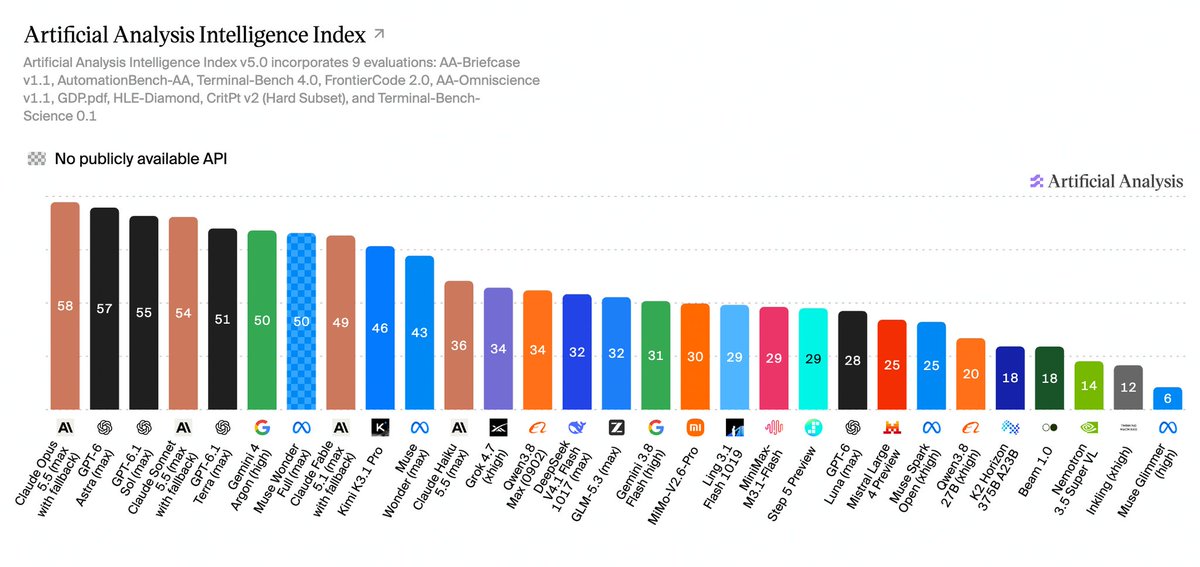
Artificial Analysis has released version 5 of its Intelligence Index, the composite score many teams use to shortlist models. The update adds Cognition's FrontierCode 2.0 for agentic coding and Terminal-Bench-Science for terminal-based science tasks, and it upgrades HLE, Omniscience and CritPt. About 60% of the evaluation now runs on private test sets, which makes it harder for a lab to train toward the questions. Claude Opus 5.5 leads the new index at 58. The gap between the best open-weights model and the leaders grew to 12 points, so self-hosted options sit further behind on this measure than before. Cost per task varies by more than 13x across the models measured, which means two models with similar scores can carry very different bills for the same workload.

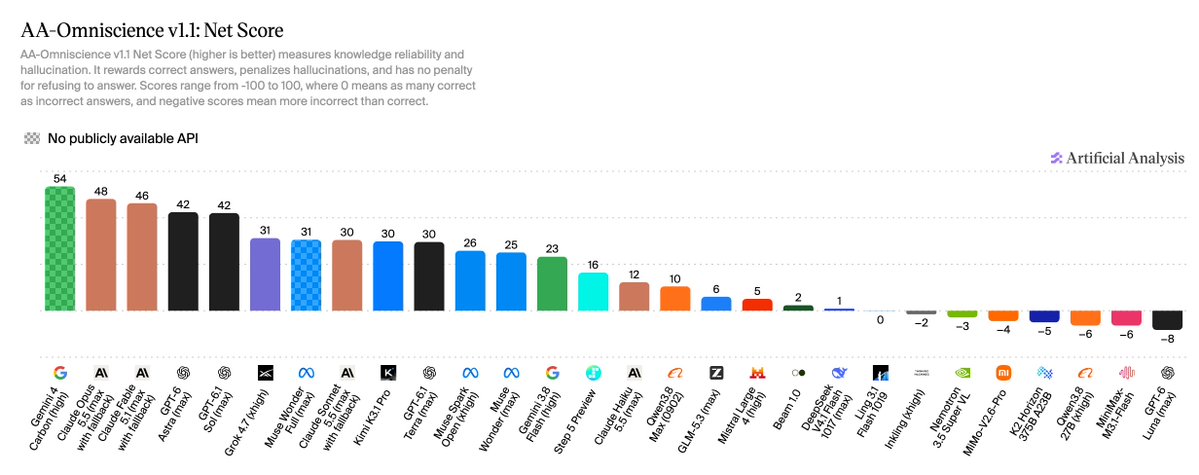
Announcing Artificial Analysis Intelligence Index v5, featuring 2 new benchmarks and 3 upgrades. For the first time, the majority of the Index is built on private datasets The Artificial Analysis Intelligence Index is our composite measure of model capabilities across tasks reflecting real-world usage today. v5 is our biggest upgrade since v4 launched in January. With v5, 60% of the Index is now based on evaluations with private test sets or held-out answers. Alongside Intelligence Index v5, we’re launching the Artificial Analysis Progress Index v1, which tracks model capability over time on one continuous scale. New to the Intelligence Index: ➤ FrontierCode 2.0: Cognition's newly-launched private benchmark of real-world coding tasks, graded on whether a repository maintainer would merge the agent's change ➤ Terminal-Bench-Science: 70 agentic scientific research tasks, run in a terminal environment Upgraded: ➤ HLE-Diamond (replacing Humanity's Last Exam): a refined 1,000-question version of Humanity's Last Exam, split evenly between reasoning and knowledge questions ➤ AA-Omniscience v1.1: An updated dataset with saturated and public set questions removed, new questions…
Context
Artificial Analysis has rebuilt its Intelligence Index, a composite score it calculates from a set of benchmarks to compare AI models, and the headline result of version 5 is a wider split between the leading closed models and the best ones anyone can download. Claude Opus 5.5 at its maximum setting leads at 58, ahead of GPT-6 Astra at 57 and GPT-6.1 Sol at 55. Models from Anthropic and OpenAI hold the top five places, and Google's Gemini 4 Argon is next at 50.
Open-weights models are ones whose trained parameters are published so others can run them. Artificial Analysis says the gap between the overall leader and the top open-weights model widened from 3 points to 12. That top open-weights model, Kimi K3.1 Pro at 46, has not had its weights released yet. Among models whose weights are actually out, DeepSeek V4.1 Flash 1017 and GLM-5.3 lead at 32, which is 26 points behind the leader and below Claude Haiku 5.5 at 36.
Version 5 also changes what is being measured. For the first time most of the index, 60% by Artificial Analysis's account, comes from evaluations with private test sets or held-out answers. Two benchmarks are new: FrontierCode 2.0, Cognition's coding graded on whether a repository maintainer would merge the 's change, and Terminal-Bench-Science, 70 scientific research tasks run in a terminal environment. Humanity's Last Exam is replaced by a refined 1,000-question version, and GDPval-AA, SciCode and AA-LCR are dropped.
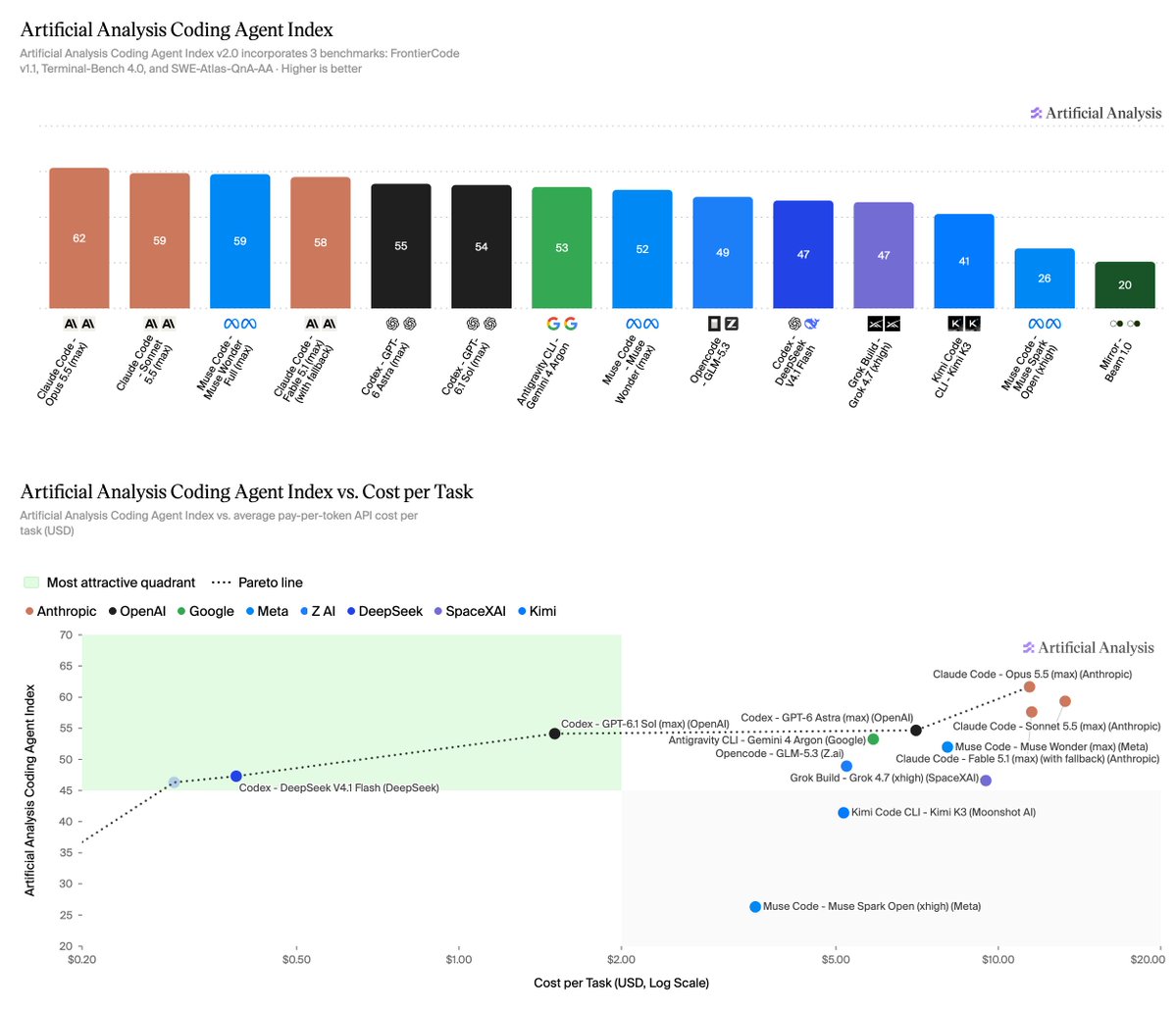
The index also reports what each run costs. Among the 10 highest-scoring models shown, the cost per index task ranges from $0.96 for GPT-6.1 Terra to $13.04 for Claude Fable 5.1, a spread of more than 13 times, so a ranking by score alone leaves out a large difference in price. Artificial Analysis also published a longer write-up of the v5 announcement.
- benchmark — A standard public test set for comparing AI models — the shared scoreboards behind every "model X beats model Y" claim.
- AI agent — An AI system that doesn't just answer once but works toward a goal in a loop — taking actions, reading the results, and deciding what to do next.
- eval — A repeatable test for AI quality — a set of tasks plus scoring — used the way software teams use test suites, because model output is too variable to judge by eyeballing.
Checking sign-in…
Loading comments…