Architecture of a maritime agent where wrong answers cost real miles
- Source
- x.com
- Date

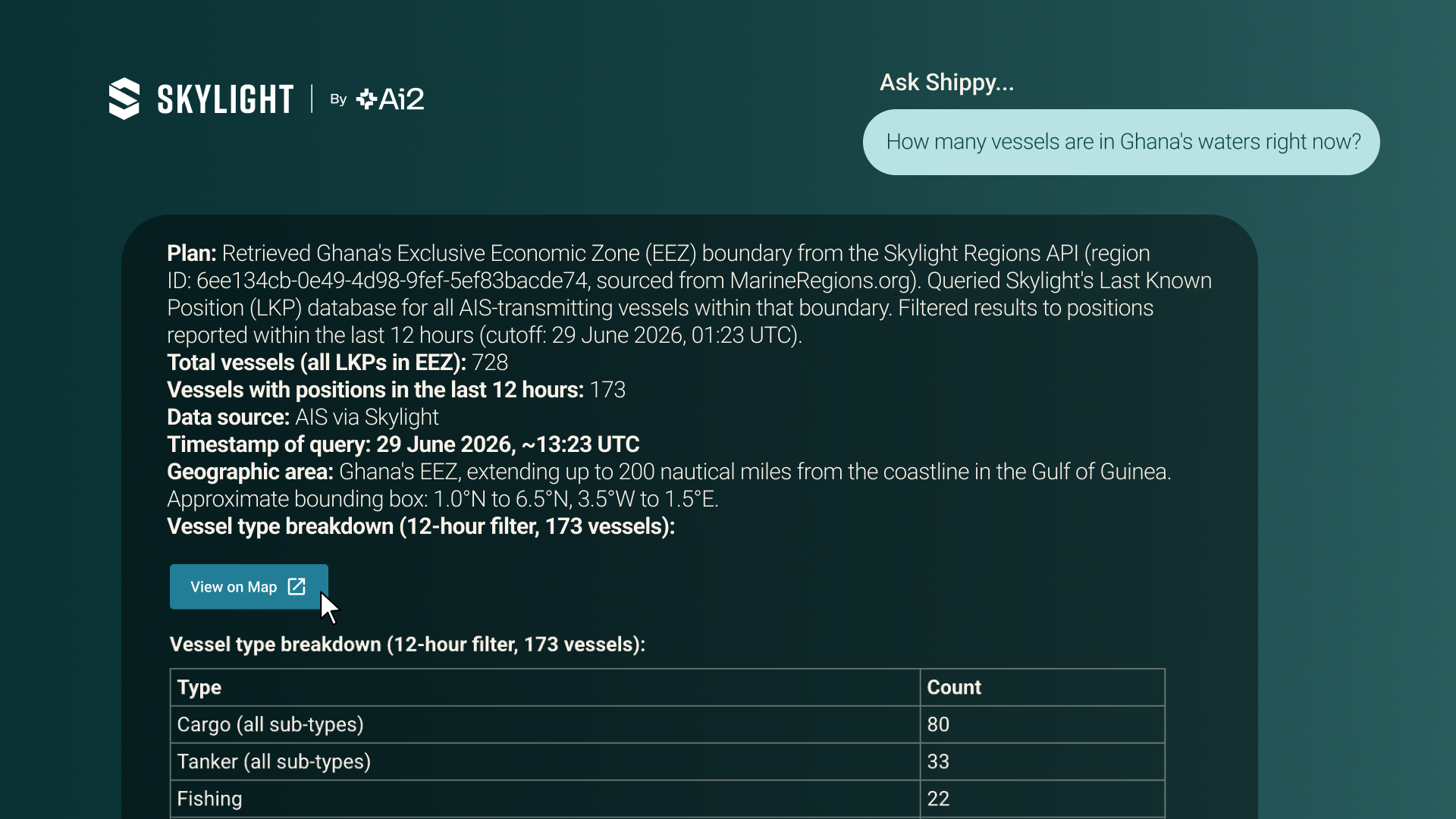
Our @SkylightMarine team is rolling out Shippy, an AI agent for the people protecting our ocean in real time. A wrong answer at these stakes can send a patrol vessel miles off course. Here's the architecture we built so analysts can trust it. 🧵

Context
Shippy is an AI agent inside Skylight, Ai2's free maritime monitoring platform, which Ai2 says more than 300 partners in 70 countries use to watch vessel activity at sea, such as a fisheries officer tracking suspicious fishing. Analysts can ask it about Skylight's vessel events and tracks and about exclusive economic zones and marine protected areas, and get map links back. Ai2's engineering post, which Intel also carries on its own, says a wrong answer here can misdirect a patrol, so much of the design is about making data access predictable and answers checkable.
The central change was taking API calls away from the model. Early prototypes let the agent write raw requests to Skylight's data service, and it silently lost results across pages of output, encoded map shapes wrongly and misused filters. The team replaced this with a command-line tool with typed options that handles login, fetches every page of results and writes to a local file, which avoids buffer limits and lets later steps reuse the data. The agent's skills, markdown instructions it follows, call that tool instead of building requests, and named regions are looked up through Skylight's regions service rather than typed-in coordinates. The underlying API, the tool and the skills can each be tested on their own, and answers include links to the Skylight map so an analyst can check a figure.
Other choices limit what the agent can see and say. Each user session runs in its own isolated deployment with that user's credentials and restricted network access, and its rules, such as never deciding whether a vessel broke the law, live in the , where they can be audited. Ai2 tests the whole agent against live data using expert-written scenarios and weighted rubrics scored by an . It reports consistent results on data retrieval and guardrail tasks, along with recurring failures: patrol-planning answers that drifted into tactical recommendations, simplified boundaries that missed events, and one invented command. The current version runs Anthropic's Claude Opus 4.6 through the OpenClaw , and Shippy is opening to early adopters on a rolling basis.
- structured output — Forcing a model's response to match a schema, so downstream code can parse it instead of guessing at prose.
- system prompt — The standing instructions a model receives before any user input — defining its role, rules, tools, and tone for the whole conversation.
- LLM-as-judge — Using one model to score another's output against a rubric, so quality can be measured at a scale human grading cannot reach.
- agent harness — The scaffolding around a model that turns it into a working agent — the loop, the tools it can call, and the rules for when to stop.


Checking sign-in…
Loading comments…