Qwen Ships Audio 3.1 Stack With Cheaper ASR, TTS, and Realtime Models
- Source
- x.com
- Date

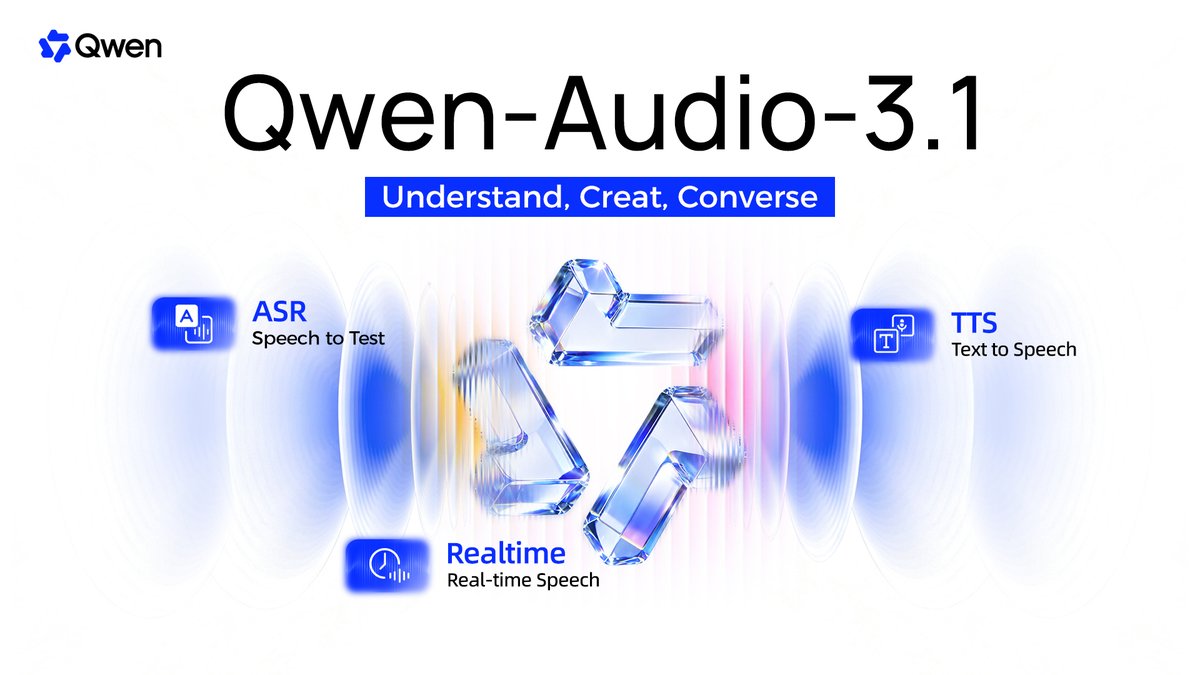
⚡ Meet Qwen-Audio-3.1! ASR, TTS & Realtime are fully upgraded, joined by two new models: TTS-Next for audio creation and ASR-Next for audio understanding. Five models, one complete audio stack: understanding, generation, interaction & creation. Plus big price cuts across the lineup: TTS ~70% off, Realtime ~85% off, and ASR up to 95% off. Highlights: 🥳 - ASR: stronger multilingual & dialect recognition, plus native polishing that auto-removes fillers & repetitions for cleaner, more logical transcripts. - ASR-Next: supports multi-speaker ASR with speaker labels, timestamps & aligned transcripts, and understands emotions, ambient & machine sounds for sound captioning, event localization, audio QA & reasoning. - TTS: multilingual & dialect synthesis with natural cross-lingual voice transfer; control emotion, speed & style via simple instructions. - TTS-Next: unified LM + diffusion framework generating voice, sound effects & background audio in one pass for audiobooks, podcasts, games & ads. - Realtime: speak & listen at once with anytime interruption, just like a real call; it even slows down and responds empathetically when it senses a low mood. Unlock the full potential of…
Context
Qwen, Alibaba's AI lab, announced Qwen-Audio-3.1 as a five-model audio stack. Three are upgrades of existing products: ASR, which turns speech into text; TTS, which turns text into speech; and Realtime, a voice model for live conversation. Two are new. ASR-Next is pitched at understanding audio beyond the words, producing multi-speaker transcripts with speaker labels and timestamps and recognizing emotions, ambient noise and machine sounds for tasks such as sound captioning and answering questions about a recording. TTS-Next, which Qwen describes as a unified and diffusion framework, is meant to generate voice, sound effects and background audio in one pass for audiobooks, podcasts, games and ads.
For developers the headline is price. Qwen says TTS is roughly 70% cheaper, Realtime roughly 85% cheaper, and ASR up to 95% cheaper. The upgraded ASR also gains what Qwen calls native polishing, which strips filler words and repetitions from transcripts, and Realtime can speak and listen at the same time, so a user can interrupt it mid-sentence as on a phone call.
The announcement linked public model pages for only two of the five models; the linked blog post could not be retrieved for this explanation, and Qwen said more APIs were coming soon on Qwen Cloud. The ASR model page lists qwen-audio-3.1-asr-flash-filetrans as an offline model for long recordings such as meetings and calls, with speaker separation, hot-word and enhancement and Chinese dialect support, priced at $0.15 per million input and $0.47 per million output tokens. The Realtime model page describes qwen-audio-3.1-realtime-plus as a full-duplex model, meaning it listens and talks over the same live connection, priced at $6.40 per million audio input tokens and $24 per million tokens of combined text and audio output, with a 262K context. Neither page lists earlier prices, so the percentage cuts rest on Qwen's announcement, and TTS, TTS-Next and ASR-Next had no public specs or pricing to check.
- LLM — A large language model — the neural network behind tools like Claude and ChatGPT, trained on huge amounts of text to predict what comes next.
- context window — The maximum amount of text a model can consider at once — its working memory for the current conversation or task.
- token — The chunk of text a model reads and writes in — roughly three-quarters of a word — and the unit AI usage is billed in.

Checking sign-in…
Loading comments…