Qwen Ships Omni-Modal Model With Native Audio-Video Agentic Tool Use
- Source
- x.com
- Date
Alibaba's Qwen team shipped an omni-modal model that pairs native audio and video understanding with agentic tool use in a single system, rather than routing between separate perception and reasoning models. The release cuts the cost of feeding video into the model by about 89 percent compared to the prior Omni release, and extends context to 1 million tokens with agentic video search built in, so the model can locate a specific moment in long footage instead of processing it linearly.
The cost cut matters more than the raw capability. Video understanding has been prohibitively expensive to run at agent scale because every frame competes for context budget, which has kept most production agents limited to text and images. An 89 percent reduction in that specific cost, combined with tool use that lets the model act on what it sees rather than only describe it, moves long-form video agents, reviewing recorded meetings, monitoring camera feeds, auditing screen recordings, from a research demo into something a team could plausibly deploy at volume.

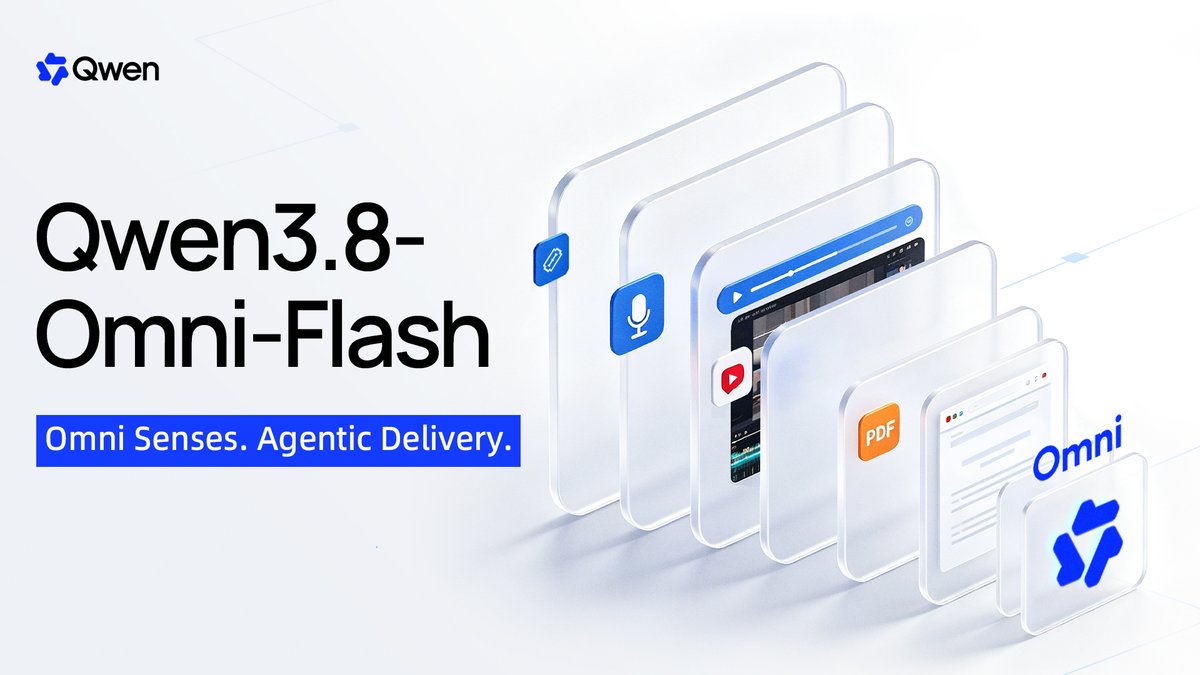
🚀 Meet Qwen3.8-Omni-Flash, Qwen's first omni-modal model built around agentic capabilities! Native audio-video understanding, reasoning, and tool use come together in one model: understand the content, plan the task, execute with tools, and deliver the result. Highlights: 🥳 - Audio-video intelligence that gets things done: jointly reason over what's seen and heard, and orchestrate tools across long workflows to auto-edit vlogs, translate short videos, and turn movies into recaps. - A major leap: approaching Gemini 3.8 Flash in audio-video capabilities; +19.5 points on average in agent performance across WildClawBench-MM & UniClawBench. - 1M-token context with agentic perception: actively explore long videos and locate key moments with higher accuracy, using 51.8% fewer tokens than static understanding on OmniVideoBench. Video input costs are reduced by about 89% compared with Qwen3.5-Omni-Plus, making long-form audio-video understanding and agentic workflows more affordable than ever. To help you build apps around Omni, we're also open-sourcing Qwen-MM-Plugins and Qwen-Live Harness! 🛠️ We can't wait to see what you build with Qwen3.8-Omni-Flash! 👀 - Blog:…
Context
Qwen, Alibaba's model team, released Qwen3.8-Omni-Flash, its first model built specifically to combine audio-video understanding with agentic : the model can listen to and watch a clip, reason about what happened, then call tools to act on it, such as editing a vlog or translating a short video. In Alibaba's announcement, the team reports the model can locate key moments in long videos using 51.8% fewer than a static frame-by-frame approach on its own OmniVideoBench evaluation, by adjusting how much of the video it processes rather than encoding every frame at full detail. Alibaba also reports video input costs are about 89% lower than its prior omni model, Qwen3.5-Omni-Plus. These are Alibaba's own and pricing comparisons rather than independently verified figures, and the reviewed post does not include an example of the model completing an actual tool-driven video task.
- tool use — A model's ability to call external functions — run code, search the web, edit files — instead of only generating text.
- token — The chunk of text a model reads and writes in — roughly three-quarters of a word — and the unit AI usage is billed in.
- benchmark — A standard public test set for comparing AI models — the shared scoreboards behind every "model X beats model Y" claim.
- context window — The maximum amount of text a model can consider at once — its working memory for the current conversation or task.

Checking sign-in…
Loading comments…