Stateless MCP has recaptured my interest (and inspired mcp-explorer and datasette-mcp)
- Source
- simonwillison.net
- Author
- Simon Willison
- Date
Context
The July 2026 MCP revision makes each tool request self-contained, removing the preliminary session handshake. is a standard for connecting AI agents to external tools. Its release specification explains that requests can consequently reach different server instances without preserving a protocol session between them. Applications can still retain their own state through explicit identifiers.
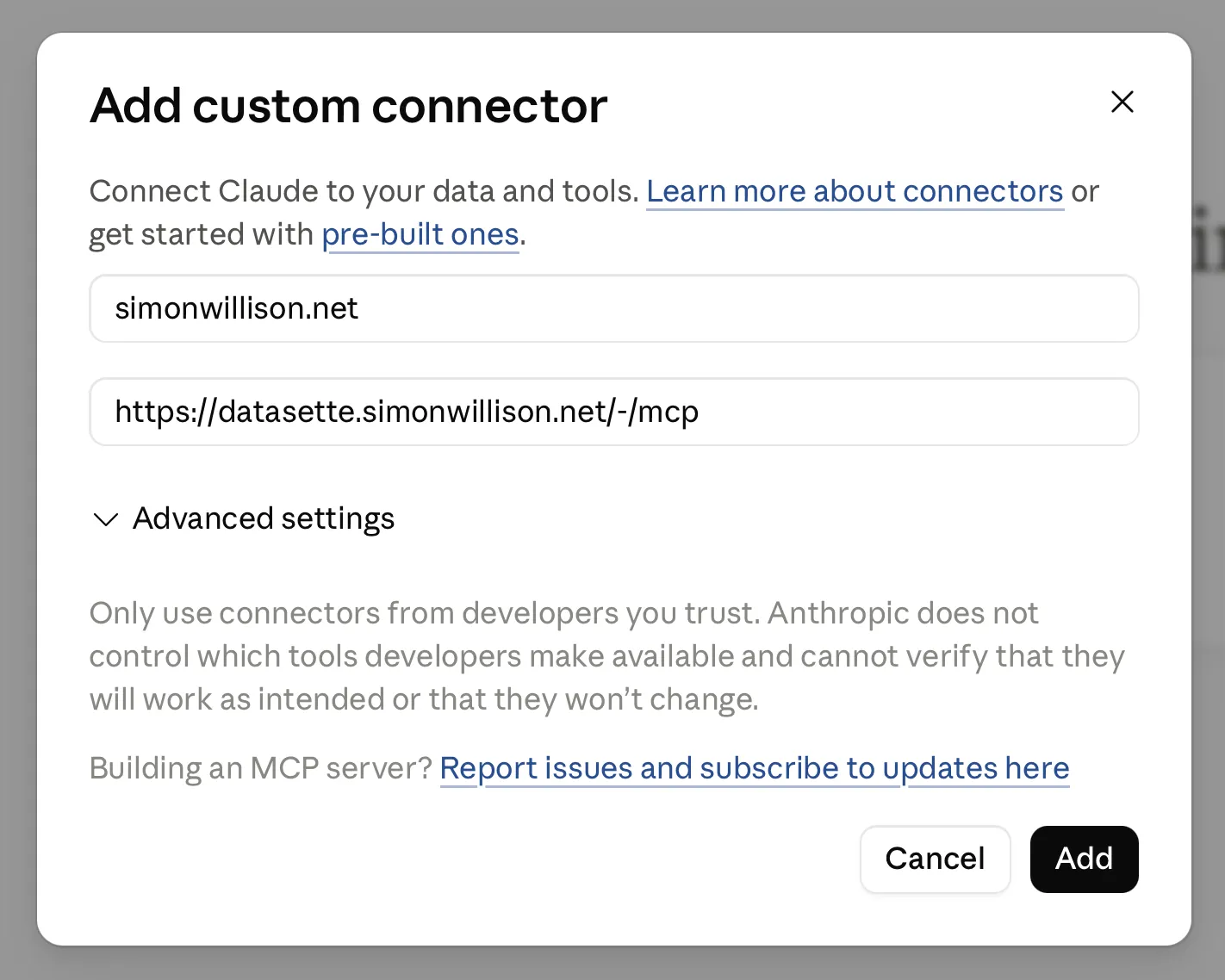
Simon Willison describes putting this simpler connection model to work in new MCP tools. His datasette-mcp plugin exposes database discovery, schema inspection and read-only SQL queries. These give an a defined route from finding available data to asking questions of it, while keeping the available operations explicit.
- Legacy MCP took two HTTP requests: one to initialize a session and get an Mcp-Session-Id, then one to call the tool. The 2026-07-28 spec collapses that into a single POST carrying MCP-Protocol-Version, Mcp-Method and Mcp-Name headers.
- Dropping session IDs removes server-side state, so you no longer need sticky routing that sends a client back to the same backend machine. That is what makes stateless MCP a normal scalable web app rather than a special deployment.
- The case for MCP over shell-and-curl agents is control surface: a fixed, declared tool list is far easier to audit than arbitrary command execution, and small laptop-sized models can drive MCP tools competently where they would flounder in a terminal.
- datasette-mcp shows how little a useful server needs — a /-/mcp endpoint on any Datasette instance with three tools: list_databases, get_database_schema, and a read-only execute_sql. That is enough for a chat client to answer questions by writing its own SQL.
- MCP — The Model Context Protocol — an open standard that lets any AI assistant plug into any tool or data source without custom integration code.
- AI agent — An AI system that doesn't just answer once but works toward a goal in a loop — taking actions, reading the results, and deciding what to do next.
“This is the most significant change to the MCP spec since it first launched, and has also served to reignite my personal interest in the protocol.”
“MCP tools are easier to audit and control, and simple enough that smaller models that run on a laptop can still drive them reasonably well.”
“It's also a better fit for building scalable web applications, since now you don't need to maintain server-side state to keep track of those session IDs, or worry about routing the same session to the same backend machine.”
“Something I've come to appreciate about MCP is that it's much easier to reason about agent capabilities and what might go wrong than with arbitrary command execution in an open network environment - the default for most of today's general and coding agent tools.”
“I plan to lean into MCP a whole lot more when I'm building sensitive applications on top of LLMs.”




Checking sign-in…
Loading comments…