Meta ships Muse Wonder models for agentic and coding work
- Source
- research.meta.ai
- Author
- AIatMeta
- Date

Context
Meta presents Muse Wonder as a model for personal and professional agents, built to keep track of what matters to a person and keep working toward what they want to accomplish. The research blog introduces Muse Wonder and Muse Wonder Full as Meta's most capable models and describes them as the next step after Muse Spark on its "scaling ladder." Muse Wonder is available through the Meta Model API and Muse Code, and Muse Wonder Full is available to Muse Code subscribers. Meta says Muse Wonder will soon power experiences in Muse, starting with subscribers.
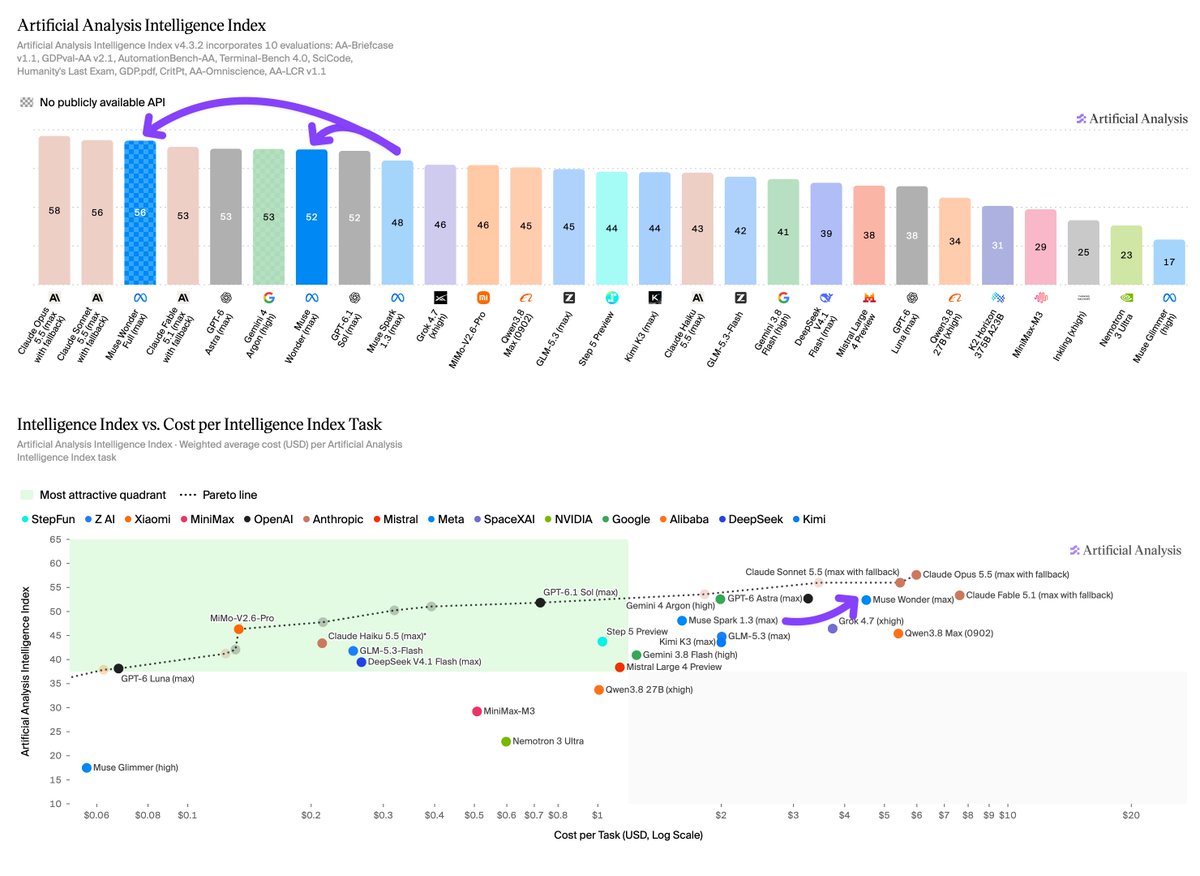
Meta organizes the claims around two named abilities. Active Memory means carrying important about the user across conversations and retrieving the earlier details that matter for the current task. Active Focus means continuing toward a difficult goal: trying other approaches, working through blockers, adapting to new information, asking for clarification when needed and checking in before important actions. Meta says it measures focus with FocusBench, and sustained work with SWE-Marathon, a test on long-running software projects. Coding is where Meta says the two come together, because building software means tracking requirements, changing code across a codebase and repeating cycles of testing and revision. The "state-of-the-art" results are Meta's own claims, and the score tables were not in the text collected from the blog. Artificial Analysis published its own Muse Wonder evaluation for an outside measurement.
Meta also claims the gains carry over to tasks it did not train for. The blog plots two kinds of score against each other as reasoning effort increases. One is a composite of the tasks Meta targeted in post-training ("in-distribution"). The other is an average over tasks it did not target ("out-of-distribution"). By Meta's account, Muse Wonder Full scores higher on the untargeted tasks than the Muse Spark 1.3 trend would predict for its in-distribution score. Meta attributes this to larger, stronger base models, whose post-training gains "carry over more effectively to unfamiliar tasks." Meta argues this matters for personal agents, which face combinations of goals, tools and constraints that training cannot anticipate.
- AI agent — An AI system that doesn't just answer once but works toward a goal in a loop — taking actions, reading the results, and deciding what to do next.
- context window — The maximum amount of text a model can consider at once — its working memory for the current conversation or task.
- benchmark — A standard public test set for comparing AI models — the shared scoreboards behind every "model X beats model Y" claim.
- eval — A repeatable test for AI quality — a set of tasks plus scoring — used the way software teams use test suites, because model output is too variable to judge by eyeballing.


Checking sign-in…
Loading comments…