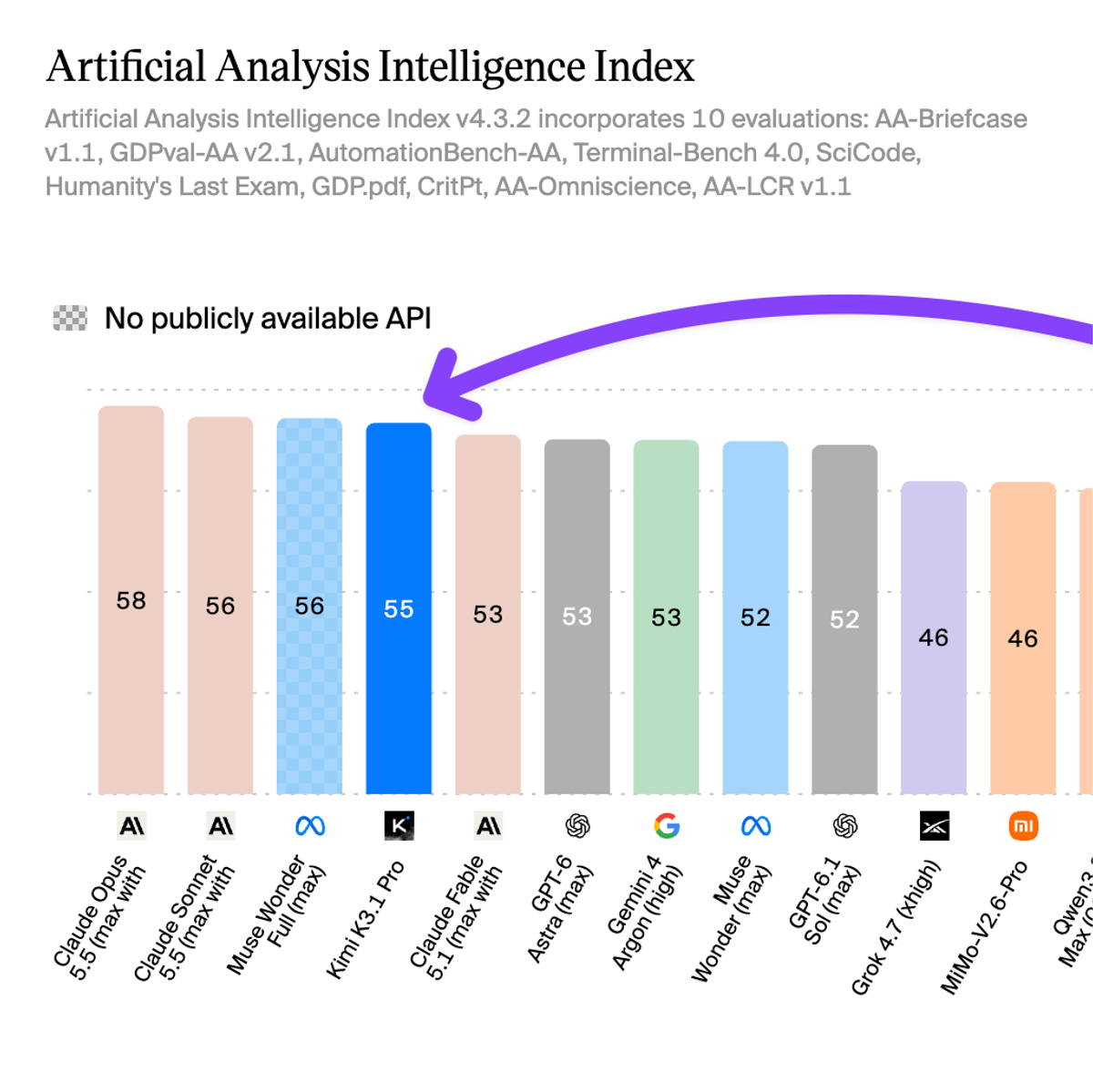
Opus 4.8 takes first on the index at 61.4 with a roughly 67% implied win rate over GPT-5.5 on GDPval-AA, at the same $5/$25 pricing as Opus 4.7.
Key takeaways · AI-distilled
Opus 4.8 scored 61.4, up 4.1 points from Opus 4.7 and 1.2 ahead of GPT-5.5 (xhigh), while using about the same number of output tokenThe chunk of text a model reads and writes in — roughly three-quarters of a word — and the unit AI usage is billed in.Full definition → as Opus 4.7 across the full Index.
Its GDPval-AA Elo of 1,890 is 137 points above Opus 4.7, reached with 15% fewer turns and 35% fewer output tokens, though it still used about 30% more turns than GPT-5.5.
Claude now leads Humanity's Last Exam by about 1 point over Google and OpenAI and beats Gemini 3.1 Pro on the CritPt physics benchmarkA standard public test set for comparing AI models — the shared scoreboards behind every "model X beats model Y" claim.Full definition →, but trails GPT-5.4 and GPT-5.5 there.
On AA-Omniscience, Opus 4.8 scored 27.4, second to Gemini 3.1 Pro's 32.9, with 46.6% accuracy and a roughly flat 35.9% hallucinationWhen a model states something false with full confidence — inventing facts, citations, or APIs that don't exist.Full definition → rate.
Other gains over Opus 4.7 include τ²-Bench Telecom (+5.9) and IFBench (+3.6), with AA-LCR, GPQA and SciCode roughly flat.
Terms in this piece · Glossary
context window — The maximum amount of text a model can consider at once — its working memory for the current conversation or task.
token — The chunk of text a model reads and writes in — roughly three-quarters of a word — and the unit AI usage is billed in.
benchmark — A standard public test set for comparing AI models — the shared scoreboards behind every "model X beats model Y" claim.
hallucination — When a model states something false with full confidence — inventing facts, citations, or APIs that don't exist.