DeepSeek V4.1 Flash Agentic Inference Results Across NVIDIA and AMD
- Source
- x.com
- Publisher
- Artificial Analysis
- Date

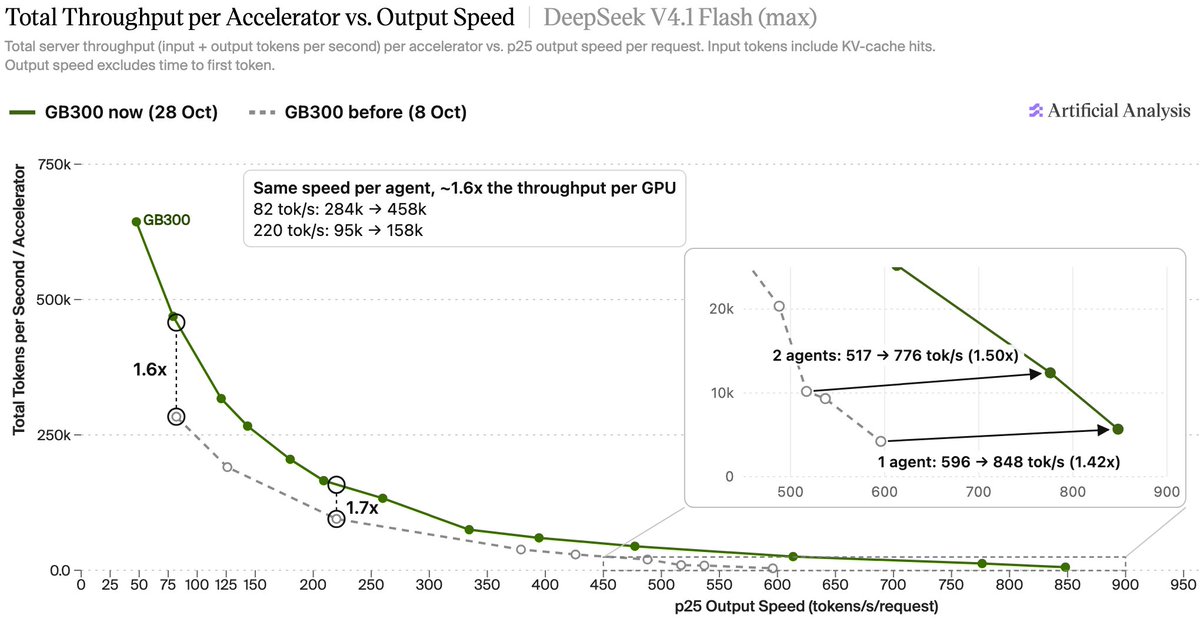
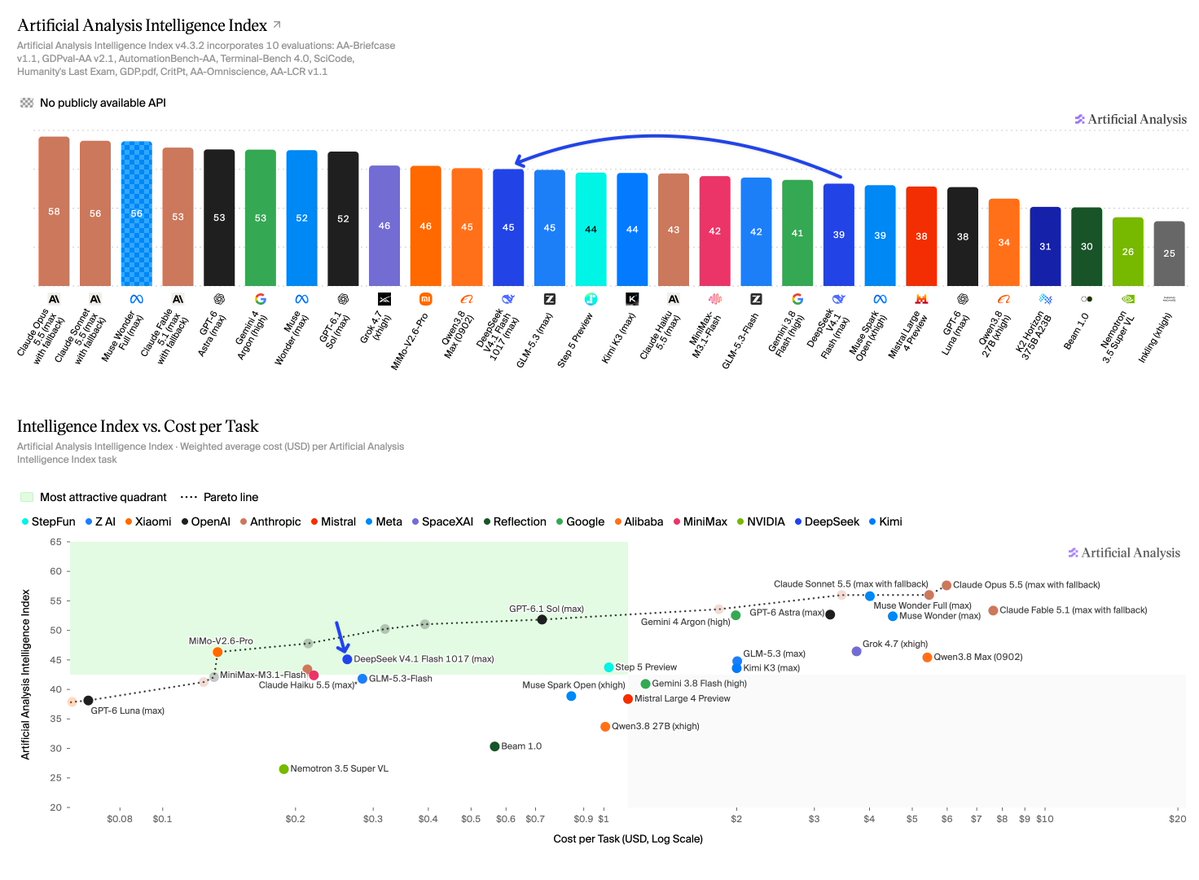
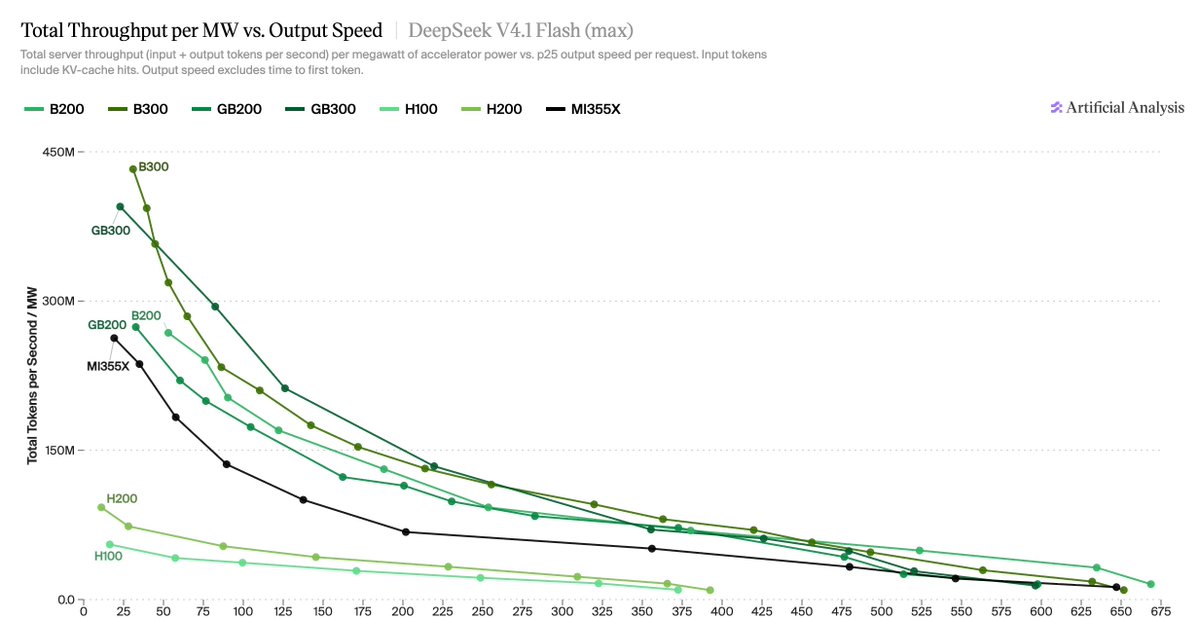
We’ve added DeepSeek V4.1 Flash to AA-AgentPerf, with results for NVIDIA and AMD hardware. At 100 tokens/s per user, NVIDIA GB300 is in first place with throughput up to 261M tokens/s per MW. AA-AgentPerf is our agentic inference performance benchmark. It replays real agentic coding sessions, including prompt caching and tool-call delays, to give a realistic measure of inference performance in day-to-day agentic workloads. We measure total system throughput per megawatt of runtime power, and per-agent output speed at varying concurrency levels, to show the trade-off between system utilization and individual user experience. DeepSeek V4.1 Flash joins the leaderboard today. It brings the leaderboard to four featured models, joining DeepSeek V4 Pro 0813, Kimi K3, and GLM-5.2/5.3. We are evolving the featured models as popular new open-weights models release, and will feature day-0 results for major future releases. Background on DeepSeek v4.1 Flash: ➤ It scores 39 on the Artificial Analysis Intelligence Index, ahead of DeepSeek’s earlier V4 Pro 0813 at 36, with about a third of the parameters (552B ‘backbone’ and 16B active, against 1.6T and 49B) ➤ It is built on a new…
Context
Artificial Analysis found that DeepSeek's V4.1 Flash shrinks the advantage NVIDIA's rack-scale systems have over 8-GPU single servers, because the model can run on as few as two GPUs. On its AA-AgentPerf benchmark, an 8-GPU B300 server stayed within about 20% of the rack-scale GB300 NVL72 across the measured range and led at both ends of it. Artificial Analysis ties this to the model's size: when the weights fit on a couple of GPUs, a system built from many interconnected GPUs has less to offer. Benchmark thread.
AA-AgentPerf replays real coding-agent sessions, including and the pauses while an agent waits on tool calls, and measures two things at once: total per megawatt of runtime power, and the output speed each agent receives as more agents share the hardware. Packing in more agents raises system utilization but slows each one, so results are read at a fixed per-user speed. At 100 tokens per second per user, GB300 led with about 261 million tokens per second per megawatt, ahead of B300 at about 220 million, B200 at about 193 million, GB200 at about 178 million and AMD's MI355X at about 128 million. For a single agent running alone, every Blackwell system and the MI355X reached roughly 600 to 670 tokens per second, against 372 to 392 on the older H100 and H200. The same day, Artificial Analysis also added MI355X results for its other featured models, Kimi K3, GLM-5.2/5.3 and DeepSeek V4 Pro.
The model is cheap to serve because it keeps little on the accelerator. It has a 552 billion parameter backbone with 16 billion active, against 1.6 trillion and 49 billion for DeepSeek's earlier V4 Pro 0813. A further 196 billion parameters of Engram n-gram memory can sit in the host computer's memory rather than on the GPU, and its compressed sparse needs about a quarter of the per token that the earlier V4 Flash needed. The KV cache is the per-conversation working memory a model holds while generating, so a smaller one leaves room for more concurrent agents on each GPU. By Artificial Analysis's measurements, V4.1 Flash scores 39 on its Intelligence Index against 36 for V4 Pro 0813 while delivering about 1.3 times (on GB300) to 6.2 times (on B200) the throughput per megawatt at 100 tokens per second per user. These figures describe this replayed coding workload and that speed target, not every way the model might be deployed.
- prompt caching — Reusing the model's processed form of a repeated prompt prefix so subsequent calls skip re-reading it, cutting cost and latency substantially.
- throughput — How much model output a provider can generate over time, commonly measured in output tokens per second.
- attention — The mechanism that lets a model weigh which earlier words matter for the word it's currently processing — the core operation of a transformer.
- KV cache — The memory a model keeps about text it has already read, so generating each new token doesn't require reprocessing the whole conversation.