AA-AgentPerf debuts AMD MI355X results versus NVIDIA Blackwell
Source
x.com
Date
Post unavailable on X
The source post has been deleted, protected, or is otherwise unavailable.
Why it matters
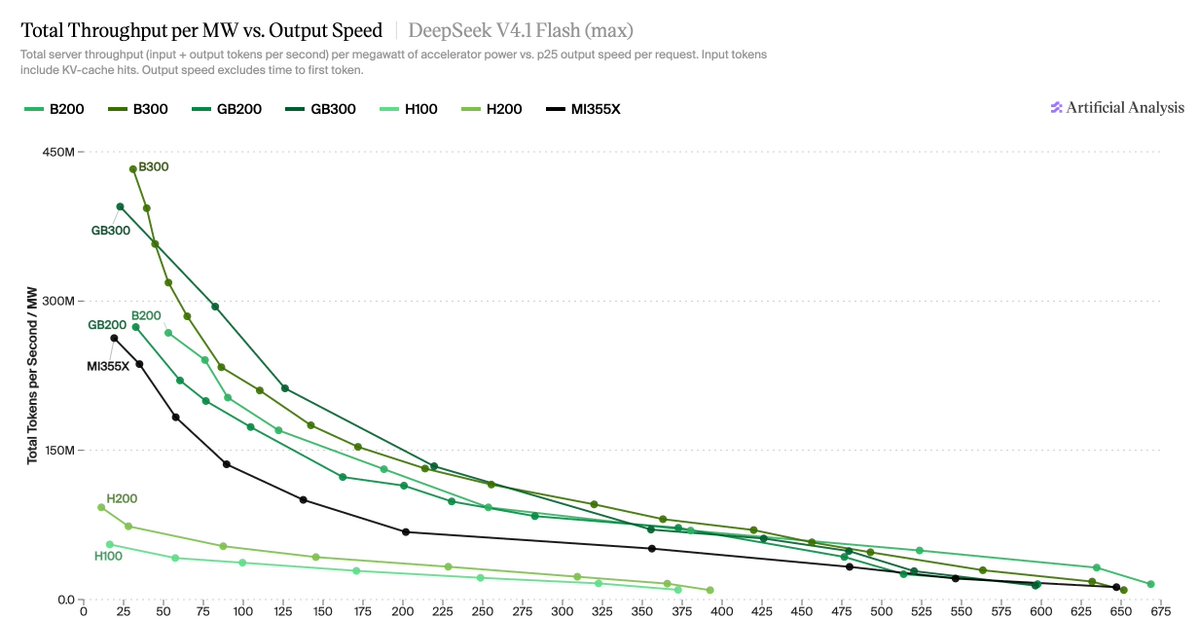
Shows how AMD's MI355X compares with NVIDIA Blackwell on realistic coding-agent traffic, including up to 40% more throughputHow much model output a provider can generate over time, commonly measured in output tokens per second.Full definition → per MW on DeepSeek V4 Pro. Useful when choosing or pricing InferenceUsing a trained model to produce an output from a supplied input.Full definition → hardware.
Key takeaways · AI-distilled
Artificial Analysis notes the MI355X matches B300's 288GB of HBM3E at 8TB/s and offers about 10 PFLOPS of dense FP4 (B300 about 13.5, B200 about 9), with board power up to 1,400W.
All MI355X results ran on ROCm nightly with dev builds of vLLM and SGLang on a single 8-GPU node, and the authors expect the numbers to change as AMD's serving software improves.
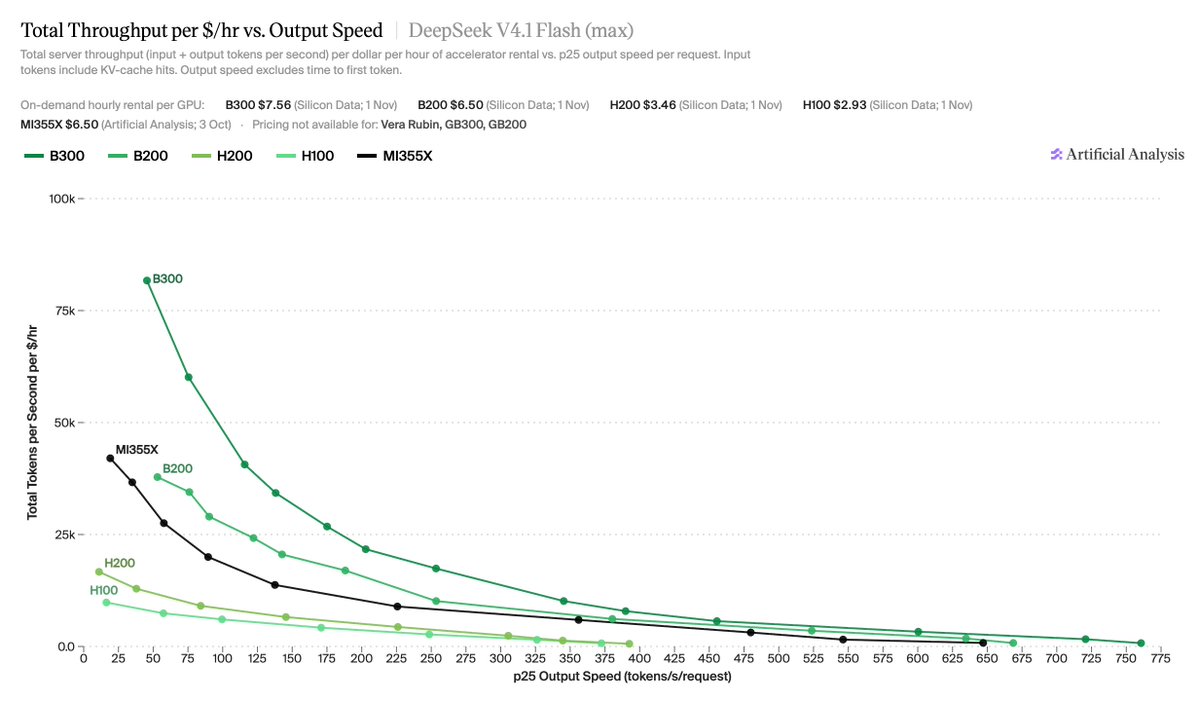
On DeepSeek V4.1 Flash, MI355X matched Blackwell for a single agent (647 tok/s vs 652 on B300) but fell behind under load, reaching about 128M TokenA piece of text, such as a word, part of a word or a punctuation mark, that a language model represents as numbers and handles as a unit.Full definition →/s per MW at 100 tok/s per user versus about 220M on B300.
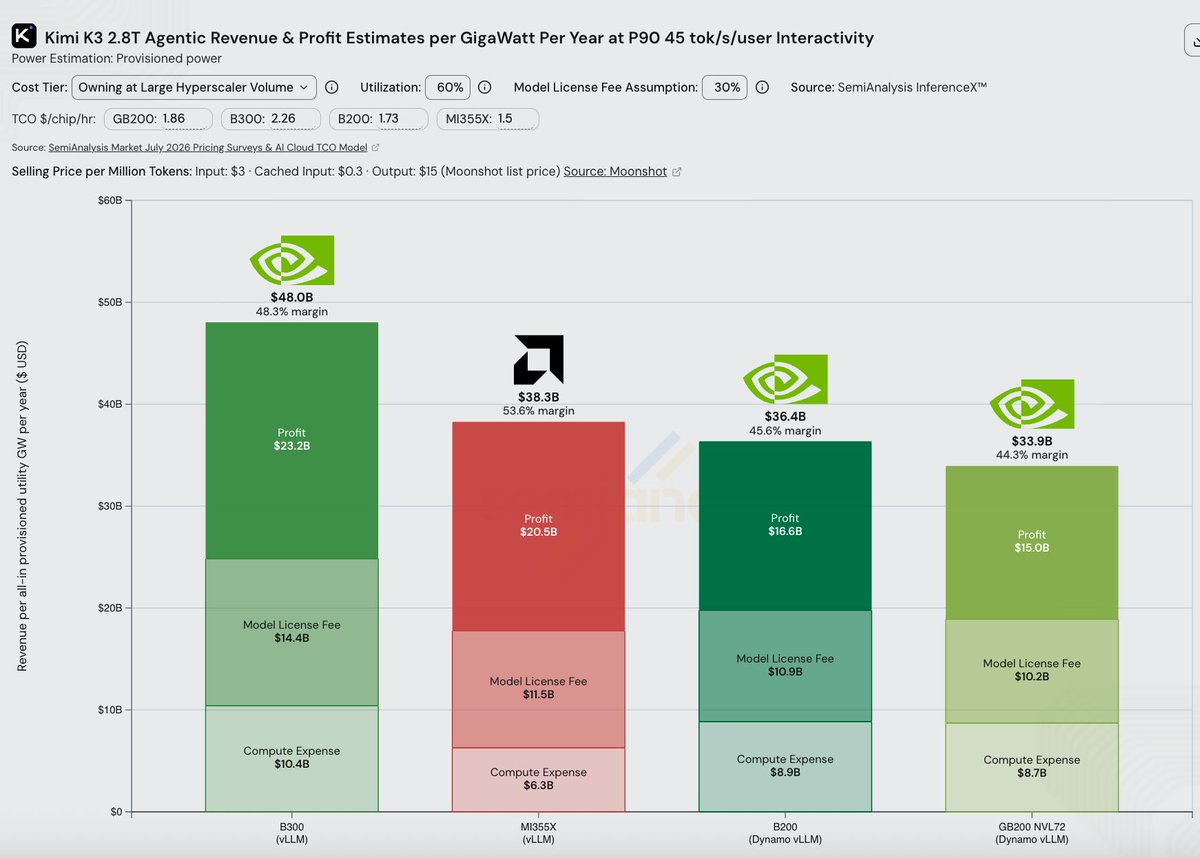
The gap was widest on the 2.8T-parameter Kimi K3: about 8M tokens/s per MW at 50 tok/s per user on MI355X versus about 24M on B300, though B300 used NVIDIA's multi-node configs.
On GLM-5.2/5.3, MI355X trailed both NVIDIA parts at 100 tok/s per user, with about 26M tokens/s per MW against about 42M for B200 and 44M for B300.
Terms in this piece · Glossary
Benchmark — A fixed set of tasks with a stated way of scoring them, used to compare models or setups.
throughput — How much model output a provider can generate over time, commonly measured in output tokens per second.
Inference — Using a trained model to produce an output from a supplied input.
Token — A piece of text, such as a word, part of a word or a punctuation mark, that a language model represents as numbers and handles as a unit.