Parsimony – an open-source benchmark for how much code AI models add
- Source
- parsimony.lasu.dev
- Publisher
- Parsimony
- Author
- lasu
- Date
Context
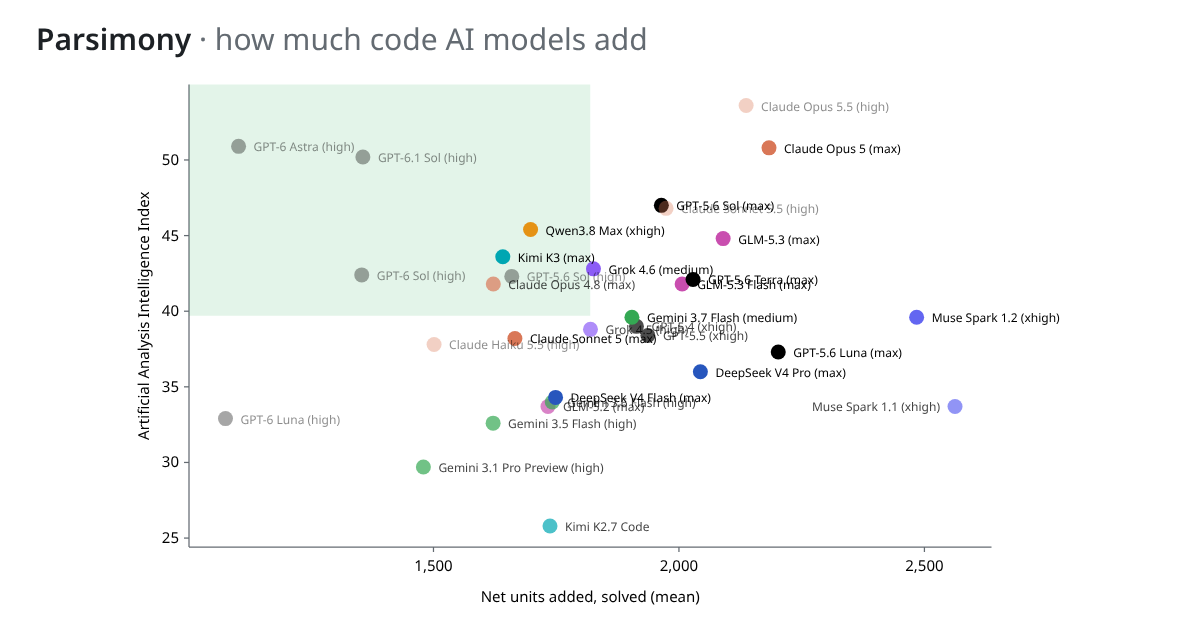
Parsimony measures how much code an AI adds while solving a task. It takes the patches that coding benchmarks already publish, counts syntax elements such as statements, calls and names, then subtracts removed code. Lines are not counted, so squeezing code onto fewer lines cannot improve the score. Its leaderboard ranks models by average net additions on the tasks they solved and shows the benchmark's published solve rate alongside. The project page explains the calculation.
This gives maintainers another dimension to compare alongside task success. A smaller patch still requires judgment about readability and design: Parsimony measures code size, covers only Python, and takes pass/fail outcomes from the benchmark's published results without rerunning tests. Its stated limits make that explicit.
- Parsimony re-scores patches already published by DeepSWE, and SWE-bench Live, counting syntax-level coding units such as statements, calls, names and literals.
- It counts syntax units rather than lines of code, so cramming code onto fewer lines earns no credit, and deleted code is subtracted to give a net figure.
- GPT-6 and Claude 5.5 have no public patches, so the author ran them on only 3 to 10 tasks; those results are shown faded and are not ranked.
- Agent mode — A mode in which one agent can inspect, edit, run commands, and iterate toward an outcome.
- Function — A named block of instructions that takes inputs, called arguments, and hands back a result, called its return value.
- Boundary — A point in a program where one part finishes its job and hands its result to another.
- SWE-bench — The standard benchmark for AI coding agents: real GitHub issues from real repositories, scored by whether the agent's patch passes the project's own tests.