Google DeepMind begins rolling out Gemini 4 Neon
- Source
- x.com
- Date

Gemini 4 Neon is rolling out now. Sitting between Carbon and Hydrogen, it brings frontier intelligence and fast task completion for complex software engineering, knowledge work, and science.
Context
Gemini 4 Neon is the middle model of Google DeepMind's Gemini 4 lineup, meant for demanding work that a team runs often enough for speed and price to matter. The announcement post places it between the two models Google released the week before. Gemini 4 Carbon, which Google opened to developers and subscribers on November 10, is Google's strongest model and is aimed at long, multi-step projects. Gemini 4 Hydrogen, launched on November 12, is the fast, cheaper option for everyday coding and tasks. Google's launch post describes Neon as the balance between the two.
The price shows where that balance lands. Google lists Neon at $3 per million input and $15 per million output tokens through the Gemini API, and says that at its default thinking setting it completes a task for 32% less than Carbon. Developers can use it on the API's paid tier, and Google AI Pro and Ultra subscribers can pick it in the Gemini app and in Antigravity, Google's agent-based coding tool.
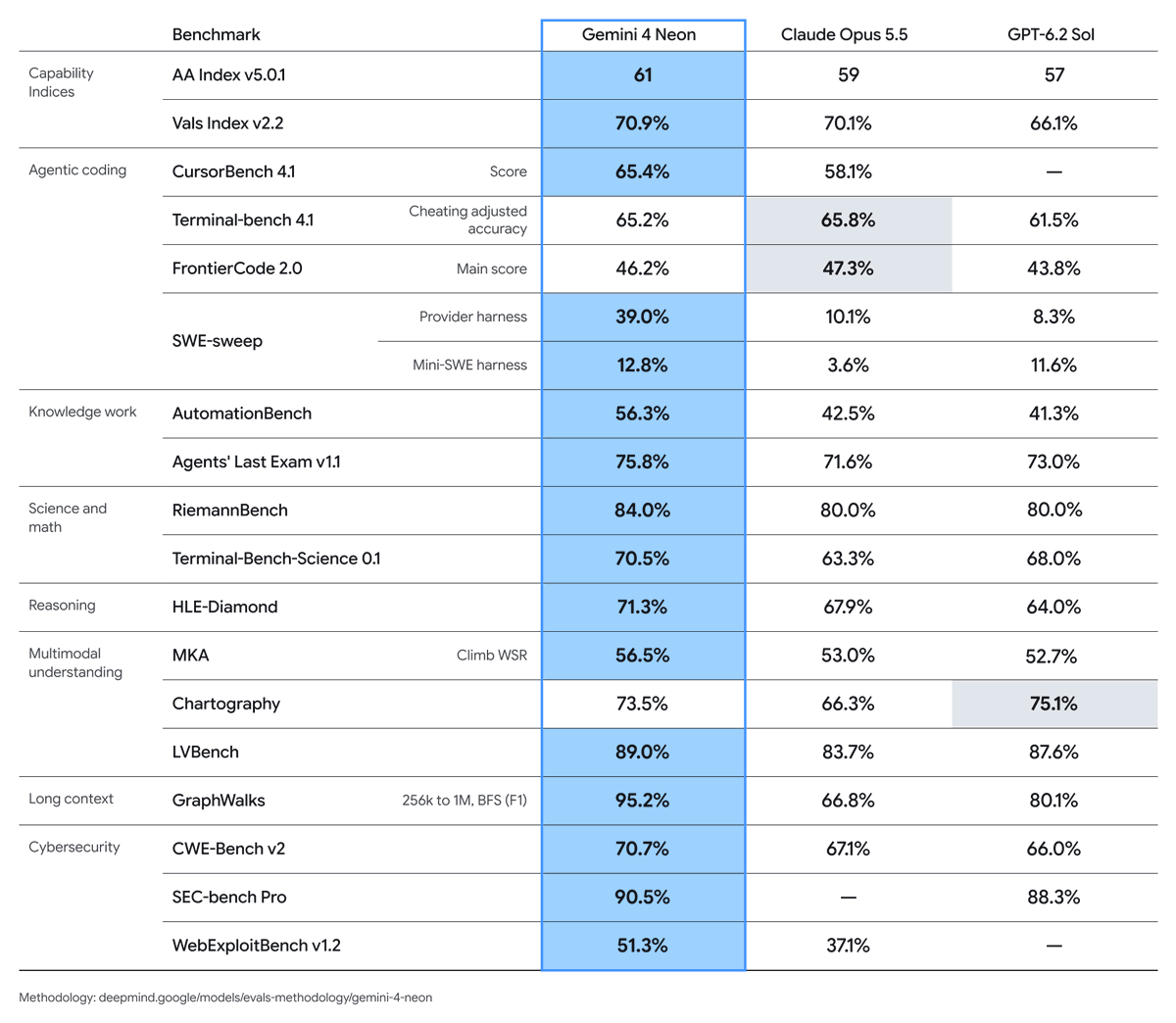
The image attached to the post is a benchmark table that compares Neon with Claude Opus 5.5 from Anthropic and GPT-6.2 Sol from OpenAI. Neon has the top score on most rows, including 61 against 59 and 57 on the Artificial Analysis Intelligence Index, a composite score that combines many tests. Opus 5.5 leads on two agentic coding tests, Terminal-bench 4.1 and FrontierCode 2.0, and GPT-6.2 Sol leads on the chart-reading test Chartography. Carbon does not appear in the table, so the post does not show how Neon scores against Google's own top model. Google chose which tests to show, and the numbers come from mixed sources. Its evaluation methodology document says the index score and several other rows are taken from outside leaderboards such as Artificial Analysis, some Neon results are Google's own runs, and, unless another source is named, rival scores are the figures Anthropic and OpenAI reported for their own models. The table therefore mixes independent measurements with self-reported ones rather than presenting a single controlled test.
A companion Google AI post about Neon lists its and adjustable thinking levels.
- AI agent — An AI system that doesn't just answer once but works toward a goal in a loop — taking actions, reading the results, and deciding what to do next.
- token — The chunk of text a model reads and writes in — roughly three-quarters of a word — and the unit AI usage is billed in.
- eval — A repeatable test for AI quality — a set of tasks plus scoring — used the way software teams use test suites, because model output is too variable to judge by eyeballing.
- context window — The maximum amount of text a model can consider at once — its working memory for the current conversation or task.



Checking sign-in…
Loading comments…