Gemini 4 Neon: 1M context, four thinking levels, coding focus
- Source
- x.com
- Date

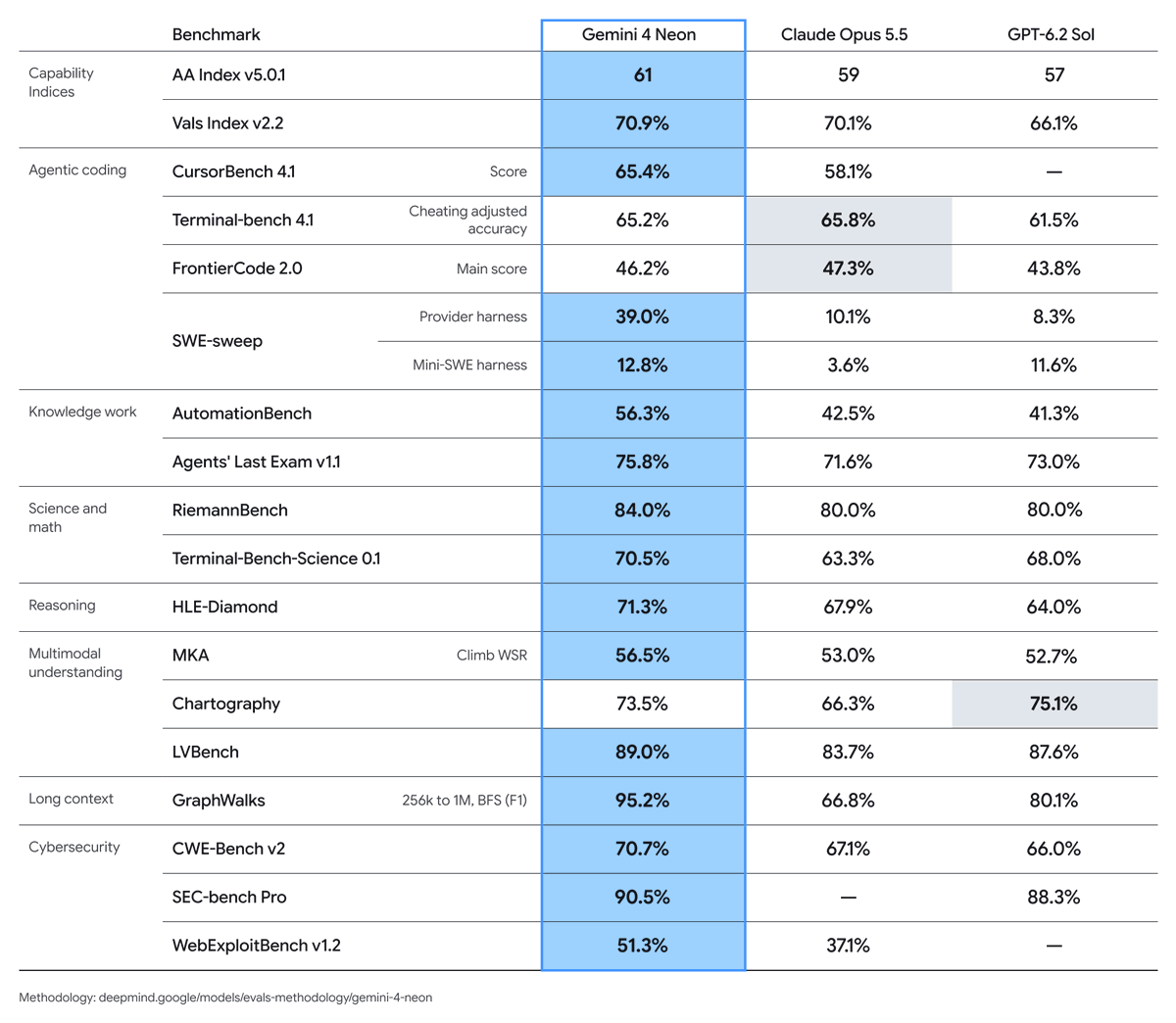
Meet Gemini 4 Neon — our newest model that brings frontier-level intelligence with fast end-to-end task completion across complex software engineering, knowledge work, and science workflows. Neon brings frontier-level performance to your everyday work and is built to handle complex coding and problem-solving without the wait. How, you might ask? ⬇️ — Smarter coding: Multi-file debugging and refactoring with targeted, surgical edits — Grounded answers: Excels at multi-step instruction following and builds on our ongoing progress to curb fabrication, recording our lowest fabrication rate yet in internal Google Antigravity testing — 1M-token context window: Synthesize massive projects, tables, and charts at once — Adjustable thinking: Balance and adjust speed and depth on the fly with 4 thinking levels Watch Gemini 4 Neon run a 12-hour /swarm in @antigravity to reconstruct Alan Turing’s 1936 study from archival photos — complete with a running Universal Turing Machine, the blueprint for modern computing.

Context
The two most practical features in this Google AI post concern how developers run Gemini 4 Neon, the new mid-tier model from Google DeepMind: a dial for how much the model thinks, and a large working memory. Google places Neon between Carbon, its model for the hardest long-horizon projects, and Hydrogen, built for fast everyday execution. Neon has four thinking levels. Before answering, a can work through a problem in intermediate steps, and the thinking level sets how much of that work it does. More thinking takes longer and uses more , the units a provider bills by, so the setting trades depth against speed and cost on each request. Google's launch post says the levels scale steadily, makes "high" the default, and describes the top level, xhigh, as adding deeper multi-step reasoning for the hardest engineering, analytical and scientific tasks.
The 1M-token is the amount of material Neon can take in at once, measured in tokens. The post pitches it for taking in "massive projects, tables, and charts at once," and the launch post adds that Neon can work across spreadsheets, PDFs, charts, audio and video in that single window, which lets the model handle the whole set without the developer cutting it into pieces.
The reliability claim is narrower than it may sound. Google says Neon recorded its lowest fabrication rate yet, meaning the model invented the fewest facts or results, in internal testing in Antigravity, Google's -based coding tool. That compares Neon with Google's earlier results on Google's own test. The post gives no rate and no comparison with other companies' models.
The post closes with a demo in which Neon ran for 12 hours using Antigravity's /swarm command to reconstruct Alan Turing's 1936 study, meaning his room rather than his paper, from archival photos. Google's launch post describes the result as an interactive 3D recreation at King's College, Cambridge, with a working Universal Turing Machine on the desk. The attached video could not be retrieved for this explanation, and Google does not say how faithful the recreation is. Google DeepMind's own announcement of the rollout is a short post that places Neon between Carbon and Hydrogen.
- reasoning model — A model trained to think — generating extended internal reasoning before answering — trading time and tokens for accuracy on hard problems.
- token — The chunk of text a model reads and writes in — roughly three-quarters of a word — and the unit AI usage is billed in.
- context window — The maximum amount of text a model can consider at once — its working memory for the current conversation or task.
- AI agent — An AI system that doesn't just answer once but works toward a goal in a loop — taking actions, reading the results, and deciding what to do next.



Checking sign-in…
Loading comments…