Introducing Gemini 4 Neon
- Source
- deepmind.google
- Date
Context
Gemini 4 Neon is a new model in Google DeepMind's Gemini 4 family, meant for work that needs close to top-tier reasoning but runs too often to pay for the largest model every time. In its launch post, Google places it between Gemini 4 Carbon, which it describes as the model for the hardest long-horizon projects, and Gemini 4 Hydrogen, the fast model for everyday execution. Neon costs $3 per million input and $15 per million output tokens, with cached input at $0.15, and reads up to 1 million tokens of , enough to take in long spreadsheets, PDFs, charts, audio and video in one request.
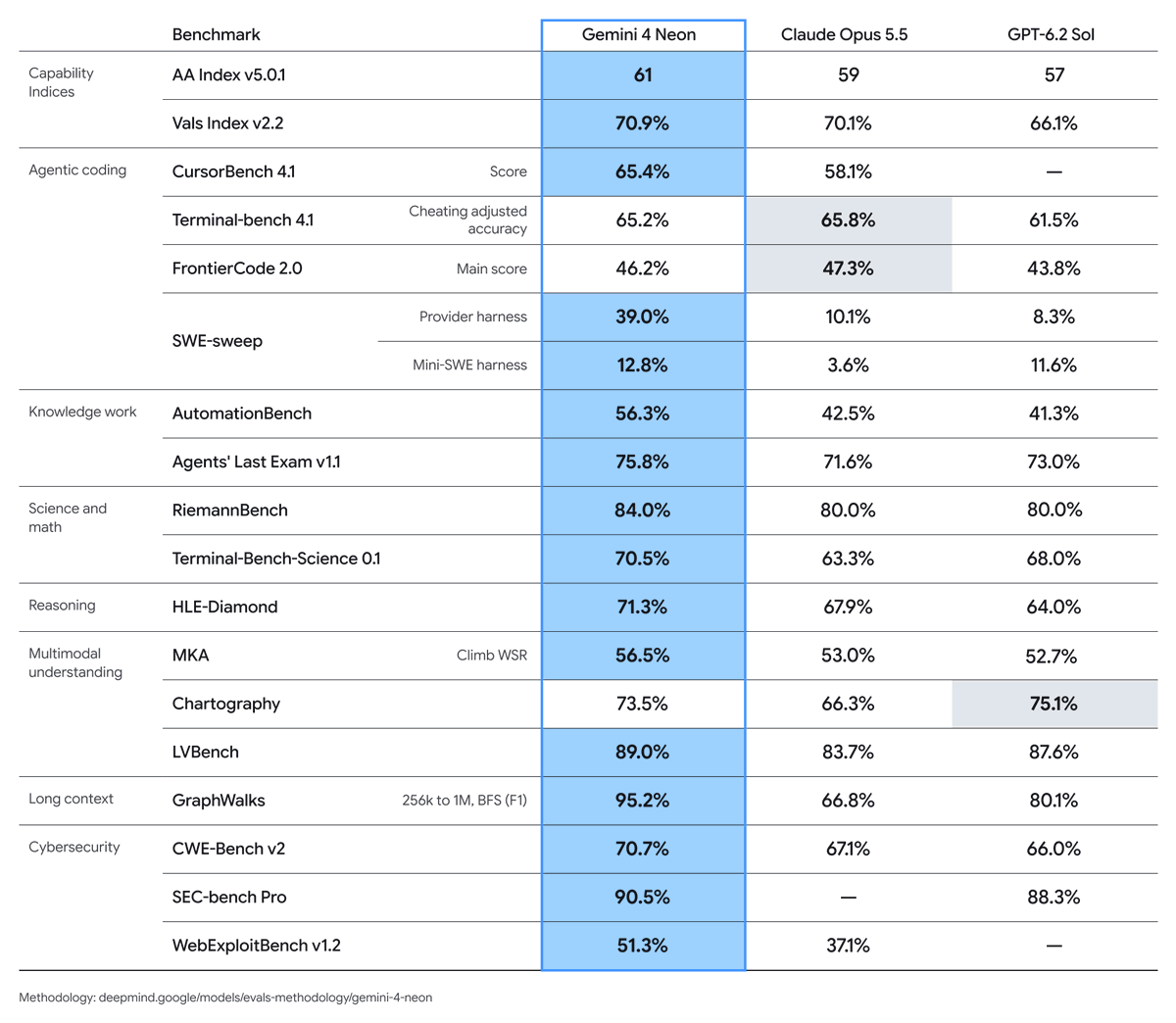
Google's case rests mostly on its placement in other organizations' leaderboards, and the setting matters. Neon has four thinking levels, which trade more reasoning time and tokens for better answers. Google says Neon is third overall on the Artificial Analysis Intelligence Index with a score of 61, but that result is at xhigh, the most expensive level. Its cost claim is made at high, the default: there, Google says, Neon pairs a high Intelligence Index score with a 32% lower cost per task than Carbon. Artificial Analysis published its own measurements of the release, which compare Neon at high and at xhigh separately against Carbon at high, using Carbon's standard rather than its discounted price, so a team choosing between Neon and Carbon should check the comparison at the level it plans to run. Google also lists second place on the Vals Index at 70.9% and first place on Artificial Analysis's Coding Index at 58.6.
Neon is rolling out now in the paid tier of the Gemini API in Google AI Studio, in Gemini for business, in Google Antigravity (Google's agent coding tool) for paid Google AI Pro and Ultra subscribers, and in the Gemini app for Pro and Ultra subscribers. A separate version tuned for security work, which Google calls Gemini 4 Neon for cyber, goes only to vetted defenders in its Fairwind Program over the next few days. Google says the general model has safeguards against cyber and biosecurity misuse comparable to Carbon's while refusing much less legitimate work in those areas, and its model card holds the details. These safety and benchmark figures are Google's own reporting at launch.
- Google says the changes Neon's measured coding ability: on SWE-sweep it scores 12.8% in the mini-SWE harness and 39.0% inside Google Antigravity, more than triple.
- Neon costs $3/$15 per million input/output tokens with cached input at $0.15, and Google claims a 32% lower cost per task than Gemini 4 Carbon at the default high thinking level, with four thinking levels to trade intelligence against token spend.
- Google places Neon between Carbon, for the hardest long-horizon work, and Hydrogen, for fast everyday execution, and says Neon can act as an orchestrator directing parallel Hydrogen subagents in Antigravity.
- On safety, Google reports Neon refused 1.98% of Terminal-Bench 4.0 tasks while keeping Carbon-level misuse safeguards, and took shortcuts on 2.45% of its coding cheating evaluation, the lowest of any Gemini 4 model.
- A cyber variant goes only to vetted defenders in Google's Fairwind Program. Google reports 90.5% on SEC-bench Pro for finding vulnerabilities at roughly half the cost per challenge, and 70.7% on CWE-bench v2 for patching.
- token — The chunk of text a model reads and writes in — roughly three-quarters of a word — and the unit AI usage is billed in.
- context window — The maximum amount of text a model can consider at once — its working memory for the current conversation or task.
- AI agent — An AI system that doesn't just answer once but works toward a goal in a loop — taking actions, reading the results, and deciding what to do next.
- agent harness — The scaffolding around a model that turns it into a working agent — the loop, the tools it can call, and the rules for when to stop.

Checking sign-in…
Loading comments…