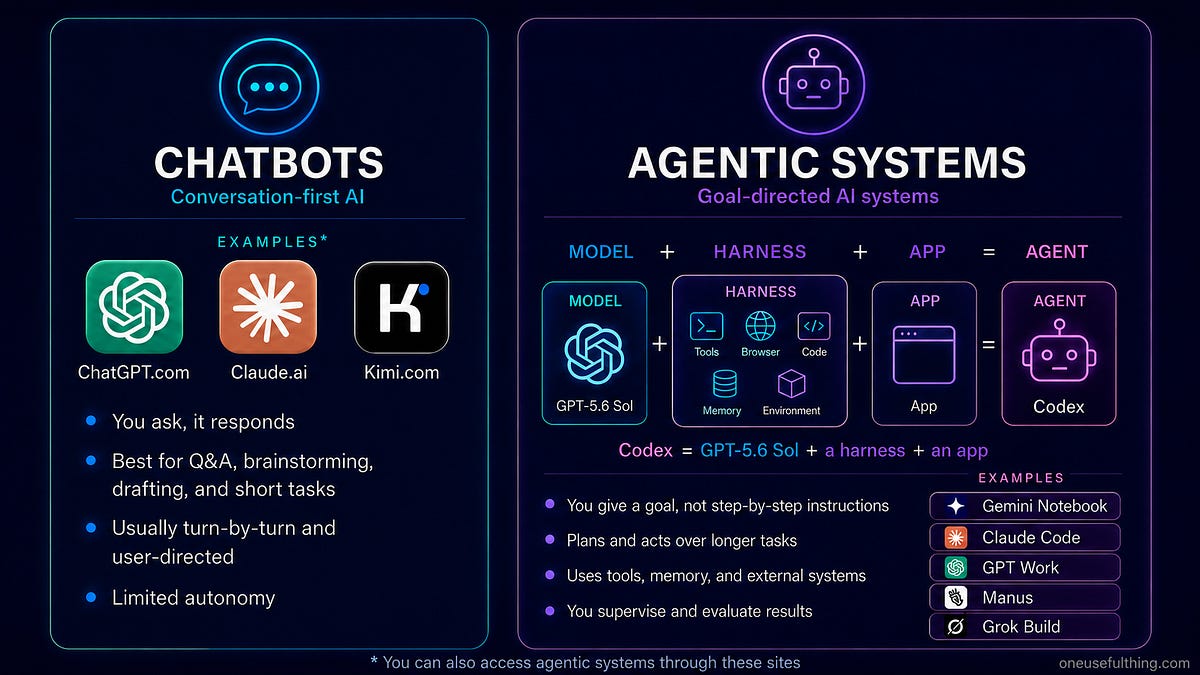
Ethan Mollick says he got a major prediction wrong: he expected people would have to carefully design how AI agentAn AI system that doesn't just answer once but works toward a goal in a loop — taking actions, reading the results, and deciding what to do next.Full definition → teams are organized, like building a company, but now treats organizing agents as one more task models learn, an instance of the Bitter Lesson.
Mollick says personal agents such as dots and Muse matter less for their task lists than for what you no longer have to tell them: they pick up context windowThe maximum amount of text a model can consider at once — its working memory for the current conversation or task.Full definition → from your messages, make their own plans, and in his use have started catching his mistakes.
He describes OpenAI's reported Navier-Stokes proof (not yet formally accepted) as a swarm of thousands of agents under thin coordination: a few groups, one change of direction, and Codex passing ideas between them, with about 2.7 million messages over 88 hours.
In his own test, a Codex prompt with GPT-6 Astra Ultra spun up three agents; sketching three teams in a few sentences (brainstormers, researchers, a reader panel) produced thirteen, with the model doing the rest of the organizing.
Mollick argues much of management exists to fix human problems like conflicting incentives, scattered information and costly communication, which agents largely lack, but says principal-agent problems now sit between agents and people, citing OpenAI shelving GPT-6.1 Astra.
Terms in this piece · Glossary
AI agent — An AI system that doesn't just answer once but works toward a goal in a loop — taking actions, reading the results, and deciding what to do next.
context window — The maximum amount of text a model can consider at once — its working memory for the current conversation or task.
Why it matters
Argues that hand-built agent orchestration, like elaborate prompt chains and context pipelines, tends to be overtaken by stronger models, which should change how much structure you invest in.