Parallelization Constraints Could Delay A Technological Singularity
- Source
- epoch.ai
- Author
- Epoch AI publications
- Date
Context
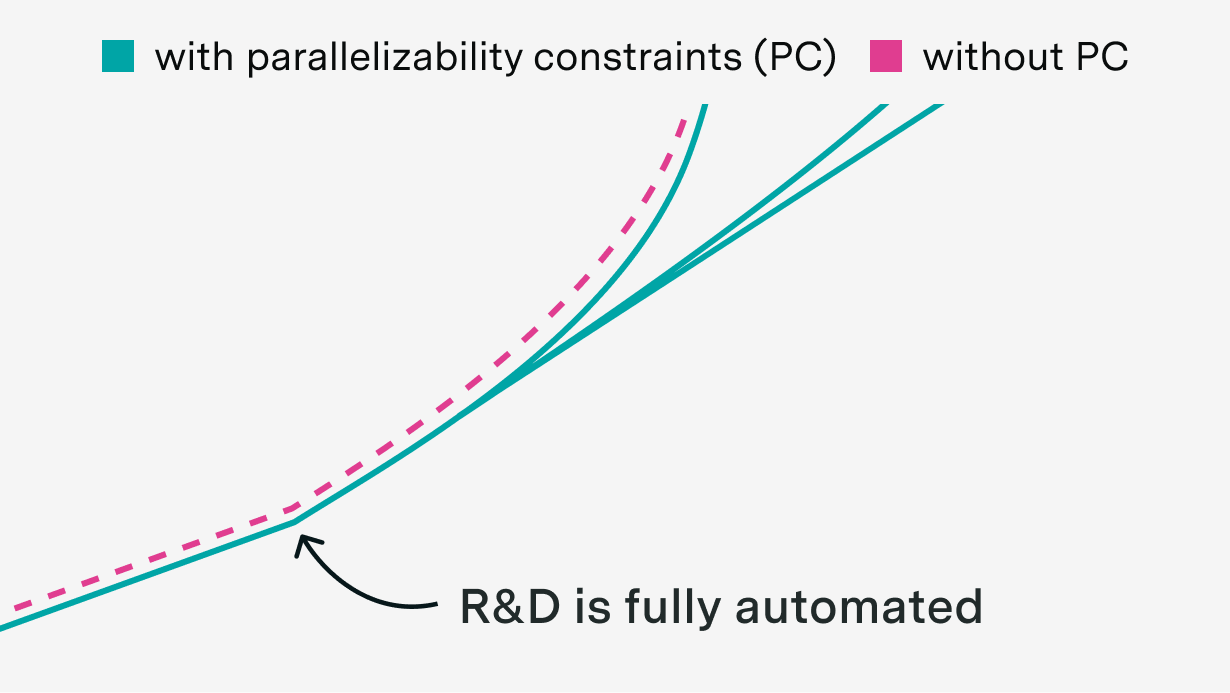
Standard growth models of automated AI research assume research can be parallelized without limit: however many effective researchers exist, doubling them speeds progress by a constant proportion. In a July 2026 essay summarizing a new paper, Epoch AI senior researcher Phil Trammell argues that assumption is implausible. Because ideas are nonrival, two teams doing the same work produce one result, not two. More researchers help only to the extent the work can be split into different useful tasks, carried out at once and recombined.
Trammell proposes treating parallelization technology, the tools for dividing, coordinating and integrating research work, as a separate input. Effective research effort is then limited by whichever is scarcer: raw research inputs or the ability to use them in parallel. Trammell cites Anthropic's teams as one example of such technology. Trammell sees two bottlenecks in AI research. Experiments have serial steps that only technological advances, like faster chips, can compress, and a million AI researchers are useful only if they avoid redundant plans, learn from each other's results and integrate their work. Automated researchers may be much easier to coordinate than humans, which could produce a large one-time jump, but Trammell argues a large jump is not an unlimited ceiling.
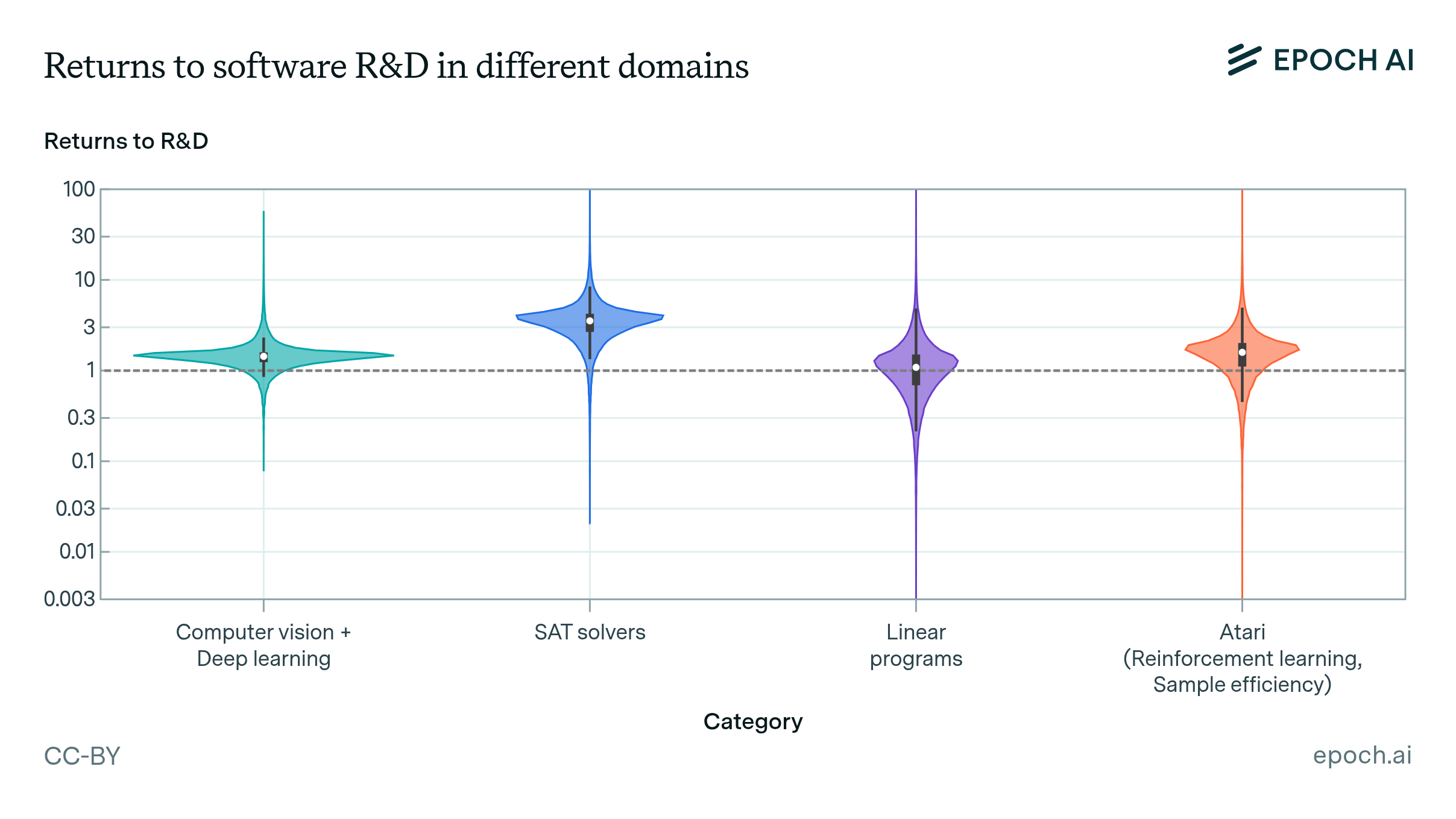
Adding this input yields three cases. If parallelization technology improves at least as fast as effective research inputs, the conventional explosion result holds. If it improves faster than the technological frontier but more slowly than inputs, an explosion still occurs, only more slowly. If it improves only enough to sustain ordinary exponential growth, automation may raise the growth rate without making it accelerate indefinitely. So evidence that AI algorithm quality has grown faster than the research inputs behind it, the usual empirical case for an explosion and the kind of estimate Epoch made in its 2024 paper on returns to software R&D, no longer settles the question on its own.
Trammell does not claim parallelization limits will prevent or necessarily delay an explosion, and they say automating R&D will still probably produce one. Trammell's point is that the speed at which parallelization improves is a missing and barely studied parameter. They suggest measuring it by giving increasingly large populations of AI agents a well-defined problem, such as improving NanoGPT training efficiency, and observing when additional agents mostly duplicate work or add coordination costs.
- AI agent — An AI system that doesn't just answer once but works toward a goal in a loop — taking actions, reading the results, and deciding what to do next.

Checking sign-in…
Loading comments…