The Plunging Price Of Thought
- Source
- epoch.ai
- Author
- Epoch AI publications
- Date
Context
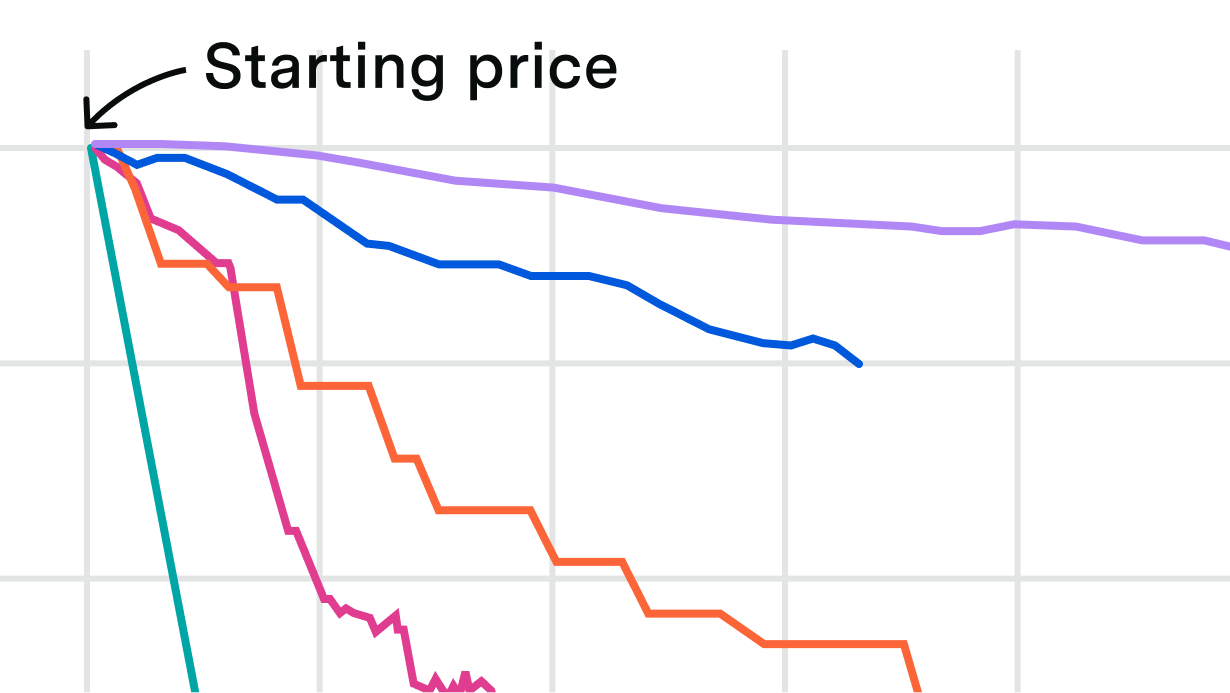
Epoch AI estimates, in a September 2026 report by Luke Emberson and David Roodman, that the cost of reaching a given score on its benchmarks has fallen about 47% per quarter since 2023, or 13x per year. Its headline example: OpenAI's o3, released January 31, 2025, scored 75% on GPQA Diamond, a multiple-choice exam of PhD-level science, at an estimated 30 cents per question. GPT-5.6 Luna, released just under 18 months later, matched that score for $0.0004 per question, a 725-fold drop.
What sets the estimate apart is that it measures what it actually costs to reach a score, not the per- price of a model capable of reaching it, which is what earlier work, including Epoch's own March 2025 analysis finding 9-900x annual declines, compared. The authors say reasoning models make that distinction harder to ignore, because they can use many more tokens to get good results from a model that is cheaper per token. To trace each model's full range of cost and performance, Epoch used a method from the federal Center for AI Standards and Innovation: from the record of a high-budget run, it counts how many questions the model answered correctly within smaller token budgets. It applied this across five main benchmarks in math, science and games, ran low-effort settings and small models itself to fill gaps, and tracked the cheapest available way to reach each score over time.
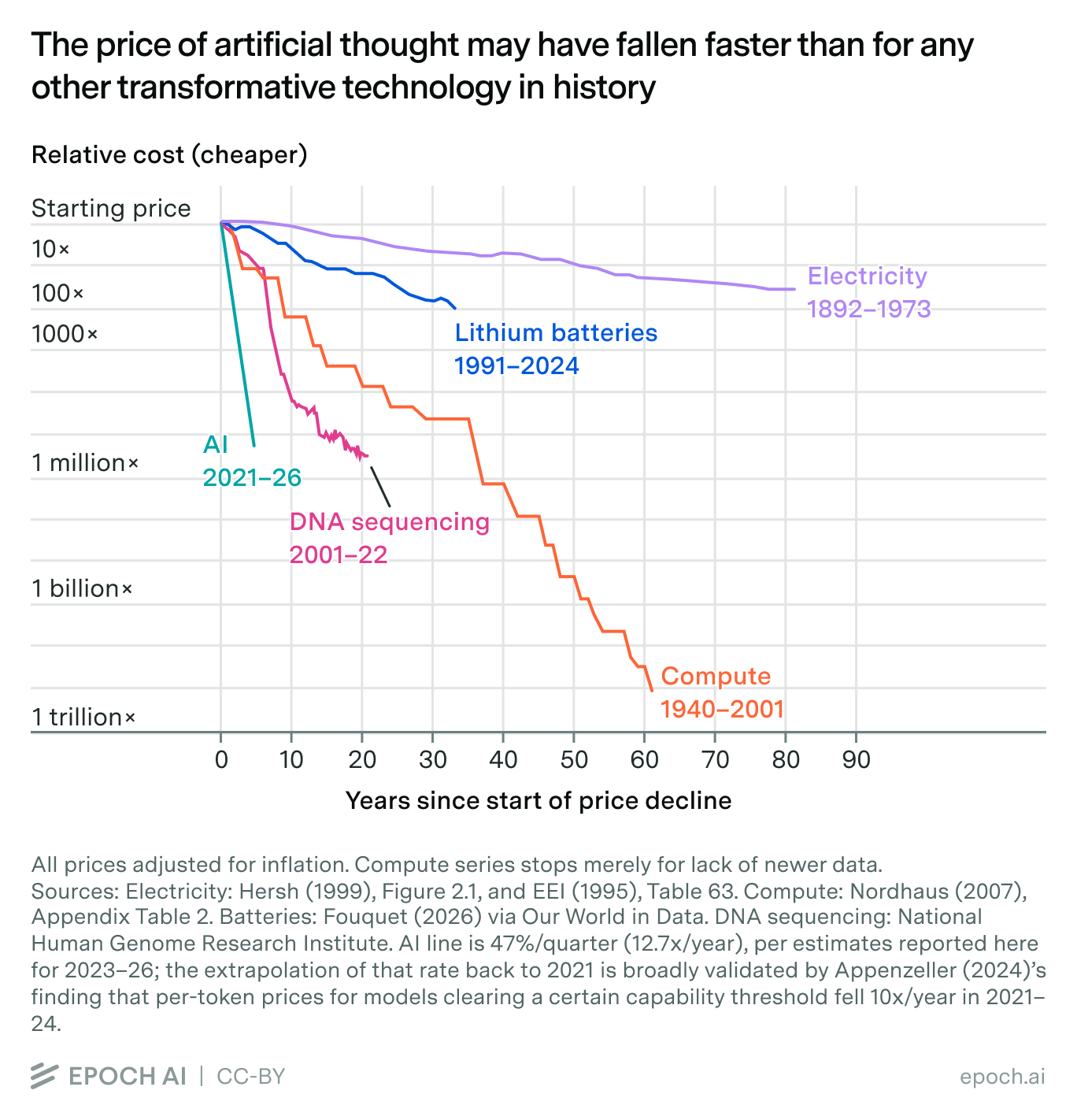
The rate varies. Costs fell more slowly on game puzzles (39-43% per quarter) and faster on math (50-52%). On three of the five main benchmarks, the decline was fastest just after a score first became state of the art; averaged over all five, the rate was 66% per quarter at that point and 32% two years later. The authors suggest the leading model's maker can briefly charge a premium before competitors catch up. Converting to comparable rates, they put the decline at four times faster than DNA sequencing, six times faster than compute, 18 times faster than lithium-ion batteries and 54 times faster than US electricity prices over 1892-1973, while conceding the comparison is partly apples and oranges because the price of thought is a less uniform product than a kilowatt-hour.
The authors list substantial caveats. Labs may train models to do well on specific benchmarks, benchmarks are imperfect stand-ins for useful work, and real users do not keep switching to the cheapest model for every task, so they do not capture the full savings. The data cover only about three years, and other reasonable ways of averaging give 42.9-58.0% per quarter instead of 47%. They call the rapid decline itself indisputable but say their specific numbers should not be read as exact.
- token — The chunk of text a model reads and writes in — roughly three-quarters of a word — and the unit AI usage is billed in.
- benchmark — A standard public test set for comparing AI models — the shared scoreboards behind every "model X beats model Y" claim.
- open weights — A model whose trained parameters are published for anyone to download and run — unlike API-only models you can access but never possess.
Checking sign-in…
Loading comments…