How Anthropic builds software in 2026 with Katelyn Lesse
- Source
- newsletter.pragmaticengineer.com
- Publisher
- Gergely Orosz
- Author
- Gergely Orosz
- Date
Context
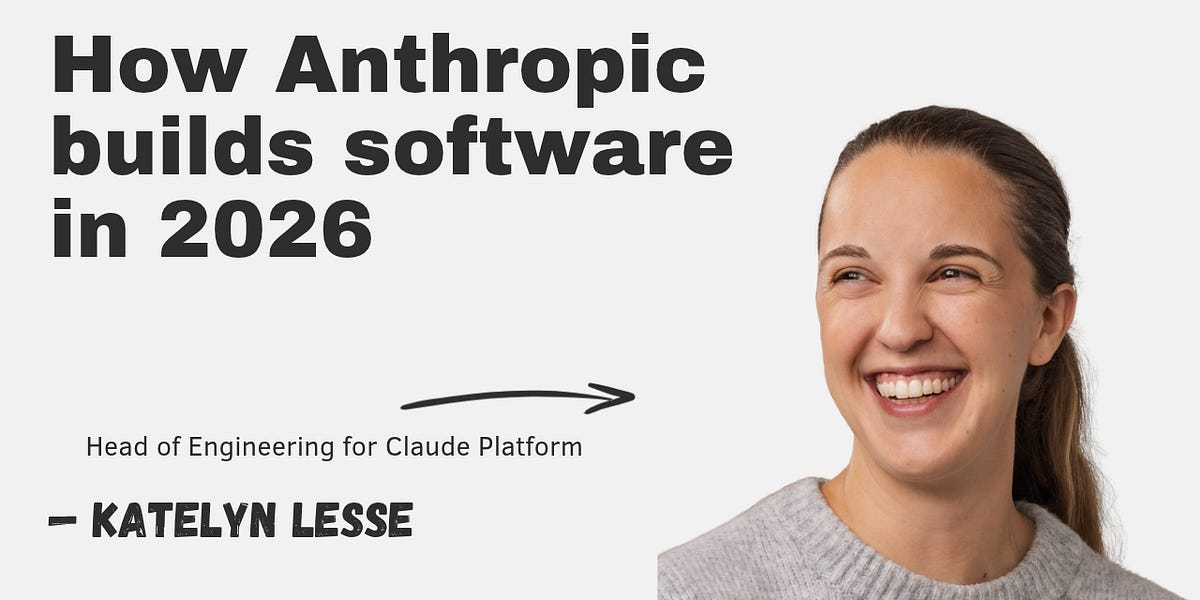
Katelyn Lesse, who leads platform engineering at Anthropic and whose team owns the Claude and the infrastructure behind Claude Code and Claude Desktop, describes a company where how closely people read AI-written code depends on how easily a change can be verified and how risky it is. The evidence here is the episode page for her Pragmatic Engineer podcast conversation with Gergely Orosz: his show notes and twelve written takeaways, not the 1 hour 49 minute recording or its transcript, so the claims below are Lesse's as Orosz summarizes them.
The clearest case is the Messages API, the service that handles , tokenization, billing and safety checks for every Claude request before calling the GPUs that generate the reply. It began in 2023 as a Python monolith, when Anthropic was still mainly a research company and its researchers worked in Python. As its CPU use grew, the team found that optimizing Python still left too much overhead, and a few engineers rewrote it in Rust in about five months without a Rust expert among them, with Claude helping them learn the language. A year earlier the same team had chosen Go for new services because its members could read and write it.
Strict code review was replaced by comparison against the old system. The Rust version received the same production traffic as the Python one in shadow, and the team iterated until all responses were identical. Lesse estimates engineers looked closely at only about 20% of the generated code, saying that once a task is made "verifiable in some way," nobody has to read every line. Anthropic's own engineering write-up explains how that comparison worked in detail (earlier coverage).
The same sorting by risk applies to everyday work, according to the takeaways. A Claude classifier looks at every pull request and decides whether a human must review it: mechanical, low-risk changes such as an SDK version bump can go without one, flaky-test fixes are reviewed, merged and deployed by another Claude, and riskier changes get a risk score that sets how many human reviewers are needed and which teams. On the API team's oncall rotation, a Claude that shadowed the rotation for months now sorts incoming alerts into real problems and noise before a human is paged, though it does not yet handle incidents alone.
Other parts of the job have not changed, by Lesse's account. Planning and getting teams aligned take about as long as before AI, the average engineer spends more time coordinating than implementing, and teams are still groups of about five to eight people who own systems and staff their own oncall. Her team dropped its coding interview after strong candidates kept failing it because they no longer write code by hand, and it is experimenting with interviews done alongside coding agents. Promotions now weigh a project's impact, such as CPU saved or incidents avoided, rather than how long it took.
- Per Katelyn Lesse, Anthropic rewrote its Python Messages API, which handles auth, tokenization, billing and safety checks before calling the GPU stack, in Rust in about five months with a few engineers and no Rust experts, driven by the CPU cost of the monolith.
- Instead of strict code review, the team ran the Rust service as a shadow of the Python API and iterated until responses matched. Lesse estimates engineers looked closely at only about 20% of the generated code.
- A Claude classifier runs on every Anthropic pull request to decide whether human review is needed, how many reviewers a riskier change needs and which team should review. Low-risk changes such as SDK bumps or flaky-test fixes can be reviewed and merged by Claude.
- A Claude agent that shadowed the API on-call rotation for months now classifies incoming alerts as real or noise before a human is paged. Lesse says it does not yet handle actual incidents without waking a human.
- Lesse's team dropped the hand-coding interview after strong candidates kept failing it and is experimenting with agent-assisted interviews. Promotions now weigh measured impact, such as CPU saved or cut, rather than time to finish a project.
- API — Application programming interface: the agreed set of operations, inputs and outputs through which one piece of software uses another.
- Authentication — The check that a presented credential matches the identity it claims.
- Agent — A system in which a model repeatedly chooses operations, a harness carries them out, and the results return to the model to inform its next choice.
- Latency — The time between asking for a result and having it, including the model's generation time, tool calls, retries and any queueing.