OpenAI keeps Zero Data Retention, previews Private Safety Processing
- Source
- x.com
- Date

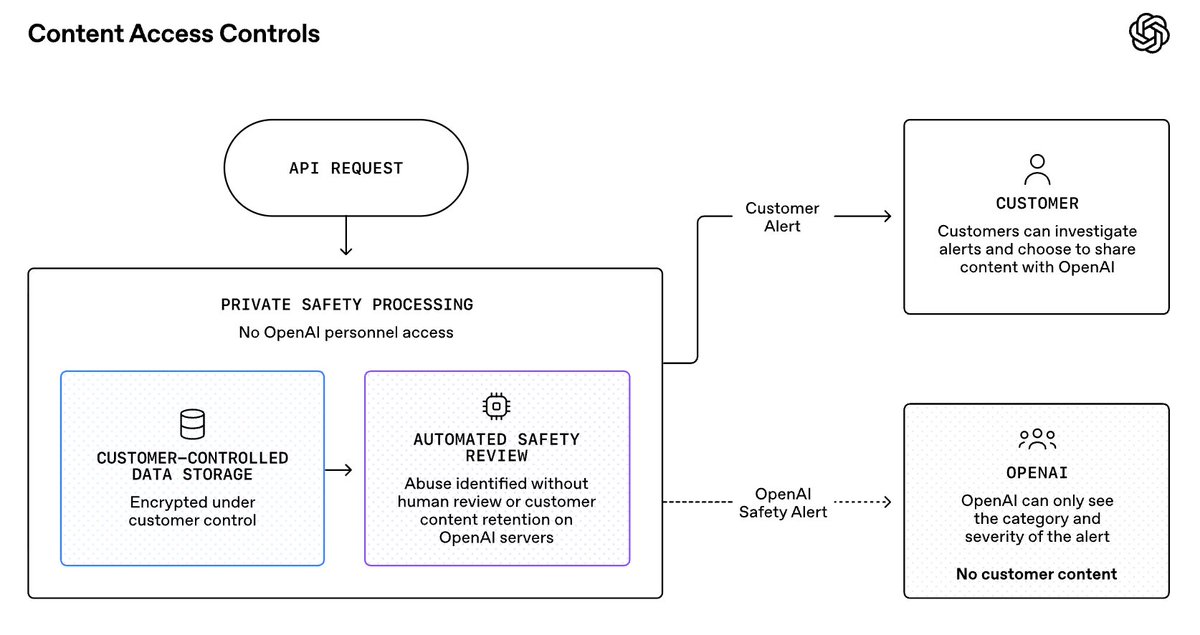
We will continue to offer Zero Data Retention for frontier models. As AI takes on longer, more autonomous work and delivers greater value to businesses, safety systems also need to identify risks across related interactions. To help address those risks, we're previewing Private Safety Processing, which is designed to improve safety without giving OpenAI personnel access to the underlying content.

Context
OpenAI says its most capable models will stay available under Zero Data Retention, the API arrangement in which it keeps no customer prompts or responses, but its developer guide shows that for some models this now comes with a safety-review layer attached. The guide refers to models that require ZDR with Private Safety Processing and says they may become unavailable if a project disconnects its storage. Once a project turns the layer on, it covers all API traffic in that project.
The design moves the stored content onto the customer's side. Eligible records are encrypted and written to the customer's own cloud storage on AWS, Azure, Google Cloud or Oracle Cloud, where they expire after 30 days, and OpenAI keeps only an index of operational metadata and a pointer to each record. A safety classifier or an approved sampling policy selects records for review. They are decrypted only inside a hardware-attested runtime that disables human access, and only predefined safety signals and approved metadata come back to OpenAI in readable form. The detailed results go back, encrypted, into the customer's storage. The guide says a referral does not establish a policy violation, and customers are expected to work with OpenAI when it raises a concern. Revoking the encryption key blocks further decryption but does not delete records or undo review already done.
The purpose is to catch misuse that only shows up across several related requests, which per-request checks miss. The Next Web reported that Anthropic had recently taken the opposite route, requiring 30-day retention on its most capable models, and that OpenAI's announcement alludes to such deployments without naming Anthropic. Anthropic's Boris Cherny later said that an option in which customers control their data and Anthropic retains none is coming this fall for its Mythos-class models.
The claim that patterns can be traced without anyone at OpenAI reading the content rests on OpenAI's own description. OpenAI's post calls this a preview, and The Next Web noted that the technical detail needed to check it was due in a white paper alongside a September rollout. This explanation draws on the developer guide, not that paper.
- AI agent — An AI system that doesn't just answer once but works toward a goal in a loop — taking actions, reading the results, and deciding what to do next.


Checking sign-in…
Loading comments…