OpenAI previews Private Safety Processing for ZDR customers
- Source
- x.com
- Publisher
- Thibault Sottiaux
- Date

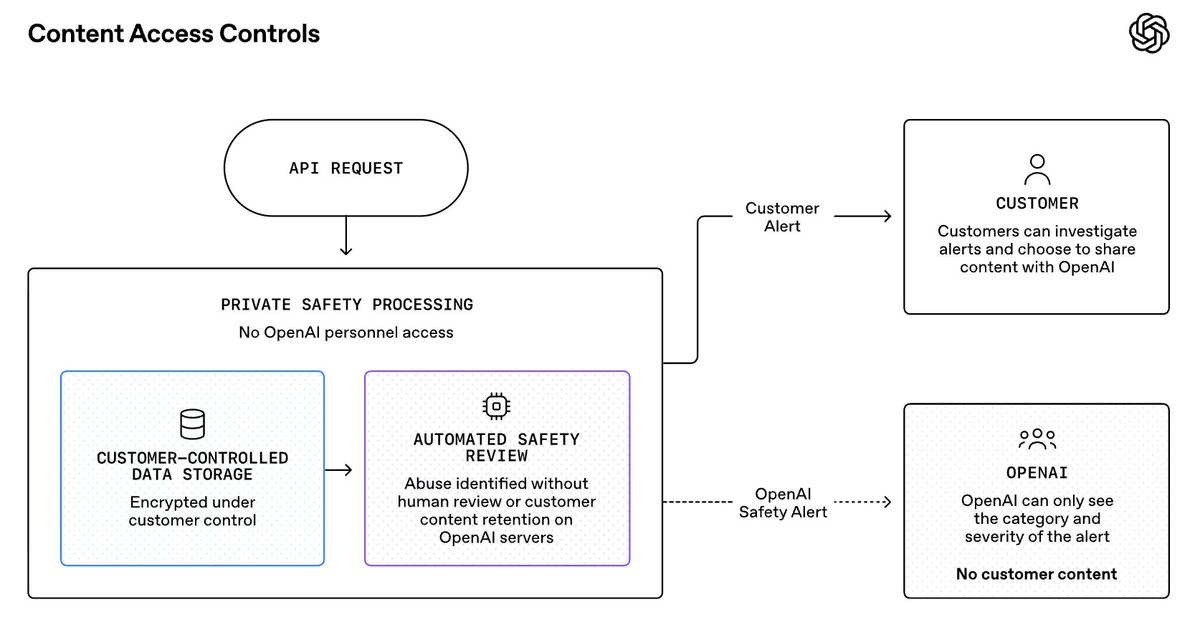
Today we’re previewing Private Safety Processing, designed to let us keep offering Zero Data Retention while improving our safeguards. Even when benefiting from frontier intelligence, customers shouldn’t have to give up control of sensitive data. For ZDR deployments, content stays on infrastructure the customer controls. Automated systems look for patterns across related interactions and return limited safety signals, without exposing the underlying prompts or responses to OpenAI employees (even me!). We’re also developing an OpenAI-hosted option encrypted with customer-controlled keys. We’re testing this with early customers now and plan to begin rolling it out in September.
Context
OpenAI wants to do two things at once: keep its promise not to retain some customers' data, and still catch safety risks that only show up across several related interactions. Zero Data Retention is an arrangement, offered to eligible API customers, in which OpenAI does not store their prompts and responses. In its own announcement the same day, OpenAI said that as AI takes on longer, more autonomous work, safety systems need to identify risks across related interactions rather than judging each request alone.
Private Safety Processing is the proposed answer. As Tibo described the preview on August 19, 2026, content in Zero Data Retention deployments stays on infrastructure the customer controls. Automated systems there look for patterns across related interactions and send back only limited safety signals, without exposing the underlying prompts or responses to OpenAI employees. OpenAI is also developing a version hosted on its own servers but encrypted with keys the customer controls, which it was testing with early customers and planned to start rolling out in September.
The posts describe a design and its intent. They do not say what a safety signal contains, what OpenAI does when it receives one, or how a customer can confirm that no content leaves its control. On the evidence of these posts, the privacy protection is OpenAI's stated design rather than something a customer can independently check.
- API — Application programming interface: the agreed set of operations, inputs and outputs through which one piece of software uses another.