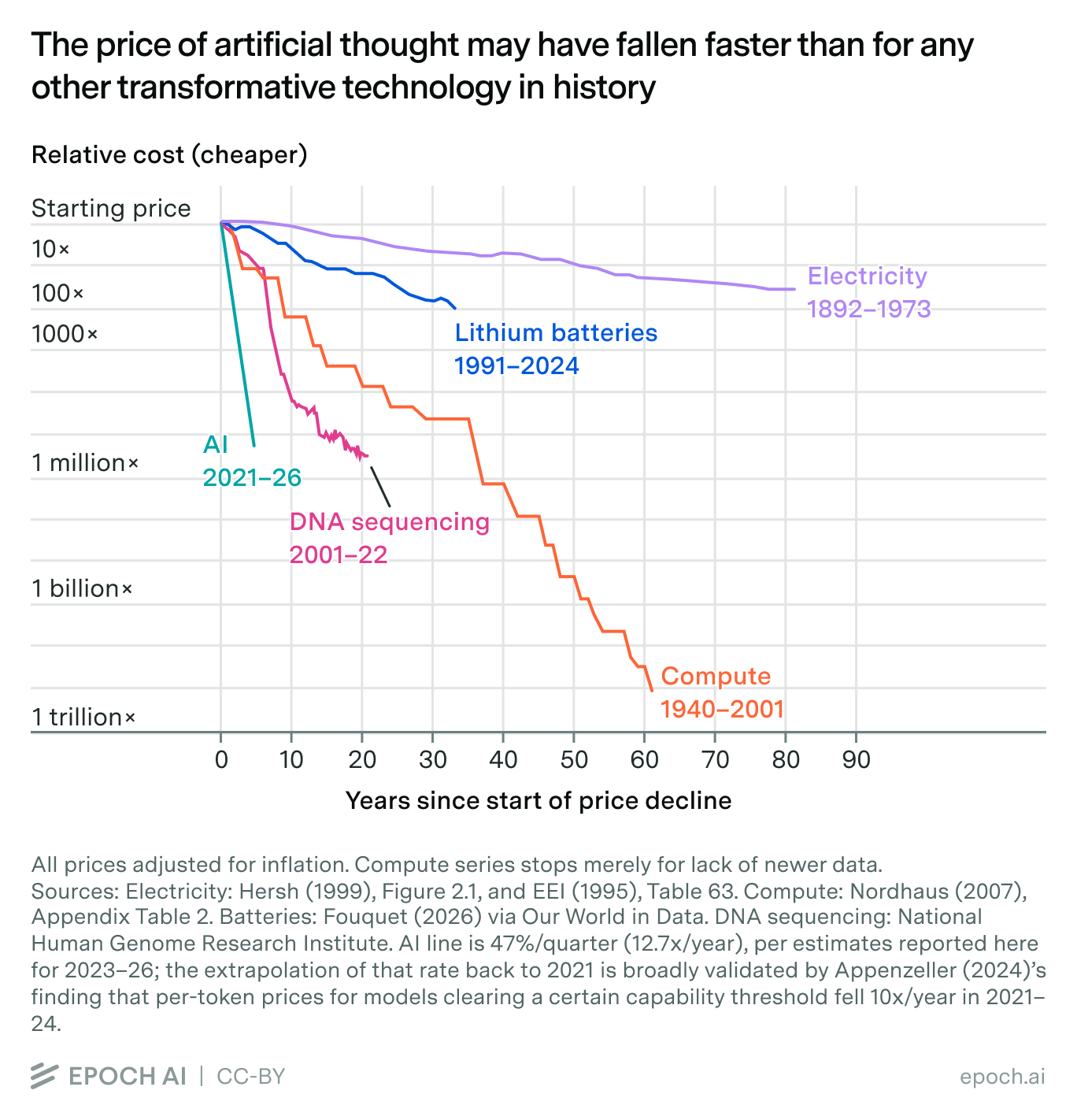
AI is getting cheaper faster than any other transformative technology
Source
epochai.substack.com
Author
David Roodman
Date
Why it matters
Cost to reach a fixed benchmark score has fallen about 13x per year, faster than other technologies. Builders can plan for sharply cheaper inferenceRunning a trained model to get answers — the phase where AI is actually used, as opposed to trained.Full definition → when sizing AI agentAn AI system that doesn't just answer once but works toward a goal in a loop — taking actions, reading the results, and deciding what to do next.Full definition → products and budgets.
Key takeaways · AI-distilled
Epoch AI measures the 'price of thought' as the cheapest way to reach a given benchmarkA standard public test set for comparing AI models — the shared scoreboards behind every "model X beats model Y" claim.Full definition → score, and finds it fell about 47% per quarter, roughly 13x per year, across five benchmarks in math, hard sciences and games over the last three years.
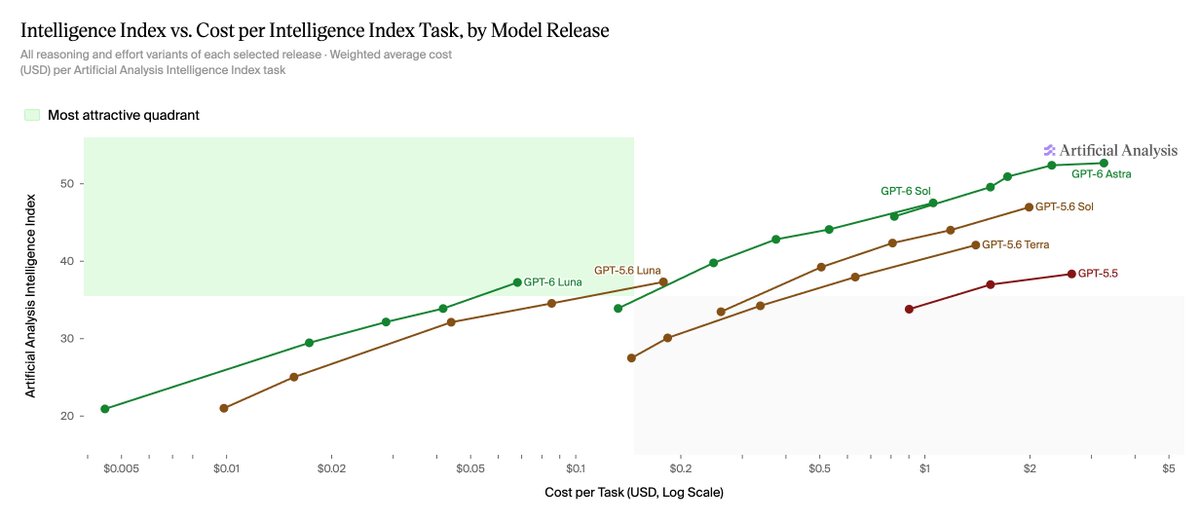
Its headline example: o3 reached 75% on GPQA Diamond for about 30 cents per question in January 2025, and GPT-5.6 Luna matched that score for $0.0004 per question under 18 months later, a roughly 725-fold drop.
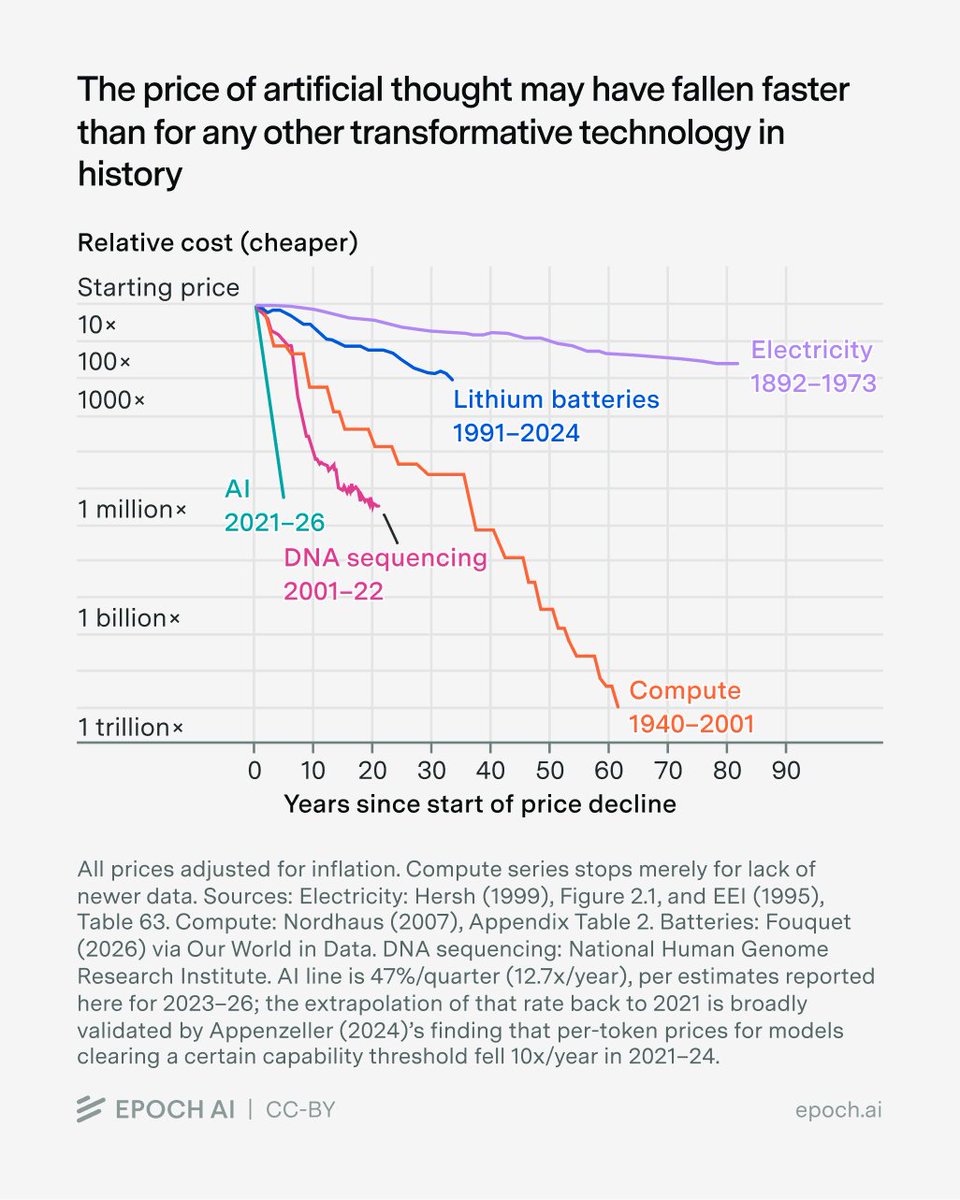
Epoch puts that pace at about 4x faster than DNA sequencing costs fell, 6x faster than compute and 18x faster than lithium batteries, with math falling fastest (16-19x a year) and games slowest (7-10x).
Declines are steepest right after a performance level is first reached (about 75x a year) and halve to about 4.7x a year two years later; Epoch suggests early premium pricing gives way to competition, and cautions that benchmarks are an imperfect proxy for market prices.
Terms in this piece · Glossary
benchmark — A standard public test set for comparing AI models — the shared scoreboards behind every "model X beats model Y" claim.
inference — Running a trained model to get answers — the phase where AI is actually used, as opposed to trained.
AI agent — An AI system that doesn't just answer once but works toward a goal in a loop — taking actions, reading the results, and deciding what to do next.