How Meta Uses AI Agents to Scale ML Innovations Across Ads Ranking Models
- Source
- engineering.fb.com
- Date
Context
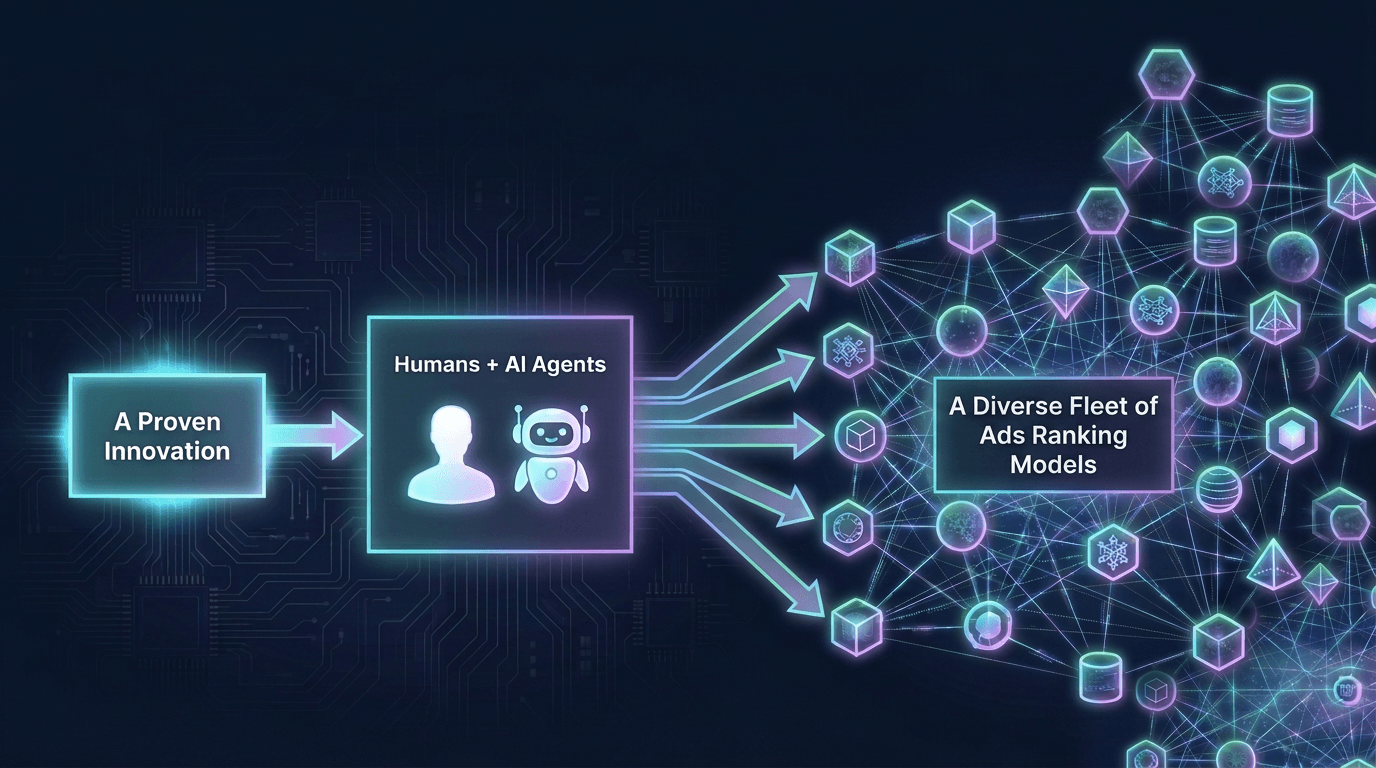
Meta serves ads through many separate ranking models, the machine learning models behind its ads recommendation system, each built for a different product surface or advertiser goal with its own architecture, training data and serving limits. When engineers prove an improvement on one of them, such as a new network layer or a training optimization, Meta calls it a "technique", and it almost never carries over to the next model unchanged. A Meta Engineering post describes how the company now uses AI agents for much of the work of adapting proven techniques to the rest of the fleet, which it calls technique propagation, while engineers review the agents' choices and approve what ships. Speed matters because, as Meta puts it, techniques have a shelf life: one that helps today may be superseded within a couple of model development cycles. An earlier post in the series covered the Ranking Engineer , which finds new techniques by proposing hypotheses and running experiments. This one is about spreading techniques that have already been proven.
The agents take over judgment calls that Meta's earlier automation could not make. Meta had already standardized many of its models on shared templates, so a technique validated once on a template reaches every model built from it, and the post says that approach shipped more than 5,000 technique-model combinations over two years while cutting per-model engineering time by 92%. What still needed people were decisions such as which technique is worth trying on which model, how wide a hyperparameter search should be, and why a model shows no gain. Agents now rank candidate pairings by expected impact using a shared record of past training runs, architectures and outcomes. They help adapt techniques to models the templates do not cover, launch and watch the multi-day training runs, recover from failures and stop unpromising runs early. For Meta's highest-revenue models, an engineer still adapts a technique by hand on a few models first while the agent records each decision, and the agent then proposes and tests adaptations for the remaining models under the engineer's review. Every result must clear the same bar as an engineer's: better offline prediction quality without higher training or serving cost, then a statistically significant win in a live A/B test.
The headline numbers are Meta's own early figures, and each is narrower than a quick reading suggests. Agents began driving the work in March 2026, and Meta estimates that they now handle over 60% of technique propagation. Against the same work done before agents, it reports 3x engineering productivity, which it defines as each engineer handling three times as many technique-model adaptations, and a median 4x reduction in training compute measured "across select combinations" that the post does not identify. The more than $45 million in compute savings is a projection to the end of the year, not a measured total, and the post gives no figure for what the faster spread of techniques has done to ad performance or revenue. Meta says a proven technique can currently take over a year to reach every applicable model, and it aims to cut that to three months, which it says will require about 5x higher end-to-end throughput from the agents. That target is a plan, not a result.
- Meta says a ranking technique proven on one ads model almost never copy-pastes onto the next, because each has its own architecture, data and serving limits, and techniques have a shelf life, so slow propagation loses value before newer techniques arrive.
- Before agents, Meta standardized models into reusable templates so a technique validated once at the template level reaches every model built from it. Over two years that shipped 5,000+ technique-model combinations and cut per-model engineering time by 92%.
- For its highest-revenue models Meta still adapts techniques per model: the agent watches an engineer adapt the first few, records which decisions were model-specific versus general, then proposes adaptations for the rest while the engineer reviews.
- Meta weights recall over precision when grading the agent's discovery stage, because a model it fails to surface never gets a second chance. Adoption is scored on human interventions per experiment and the share of issues agents fix on their own.
- Agent-propagated techniques face the same bar as human work: better offline normalized entropy without regressing training or cost , then a statistically significant online A/B win. Meta aims to cut technique-to-fleet time from over a year to three months.
- AI agent — An AI system that doesn't just answer once but works toward a goal in a loop — taking actions, reading the results, and deciding what to do next.
- inference — Running a trained model to get answers — the phase where AI is actually used, as opposed to trained.
- guardrails — The checks around a model that block bad inputs and outputs — filters, validators, and permission rules the model itself can't override.
Checking sign-in…
Loading comments…