Interviewing Ai Researchers On Automation Of Ai Rnd
- Source
- epoch.ai
- Author
- Epoch AI publications
- Date
Context
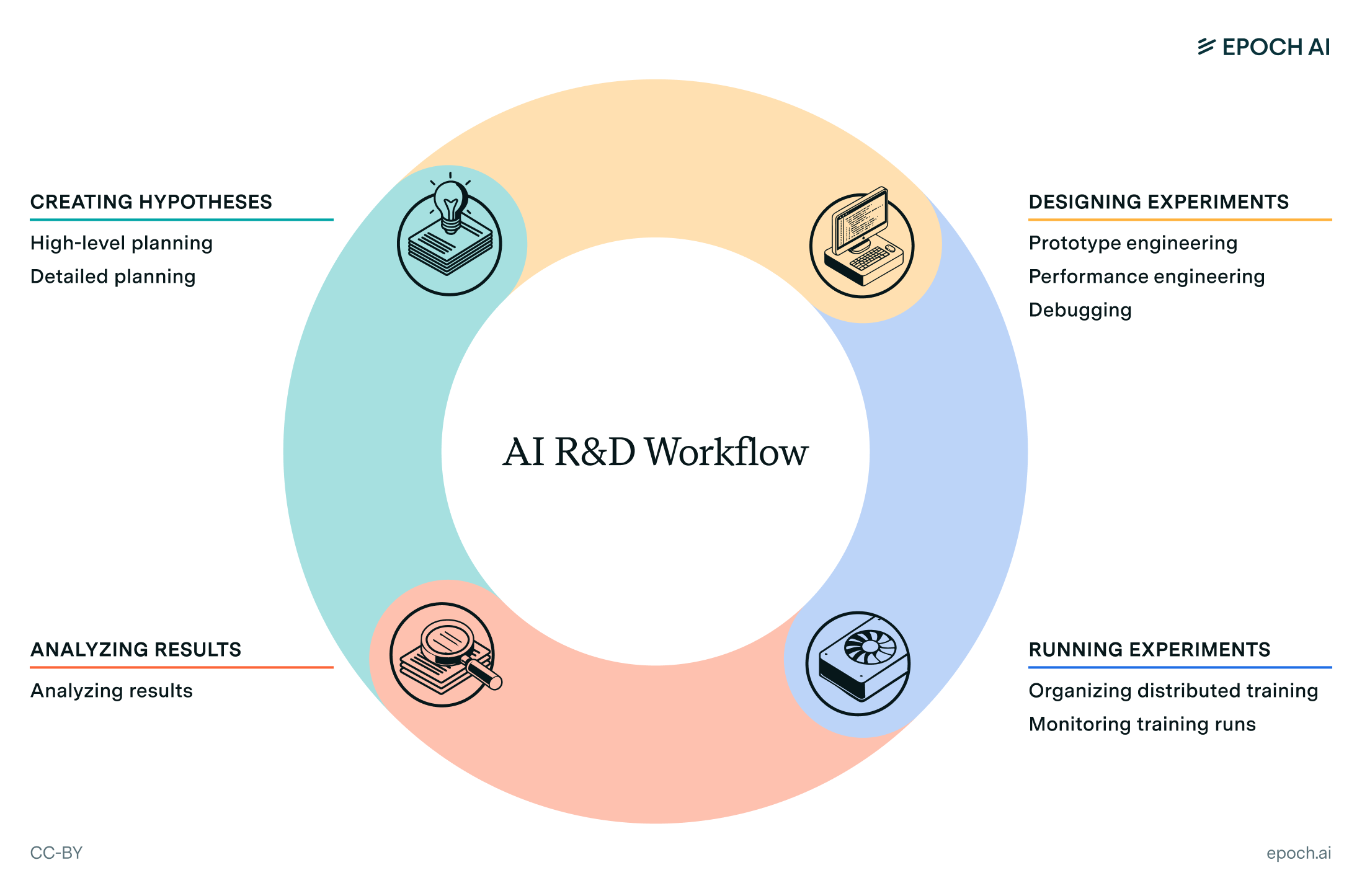
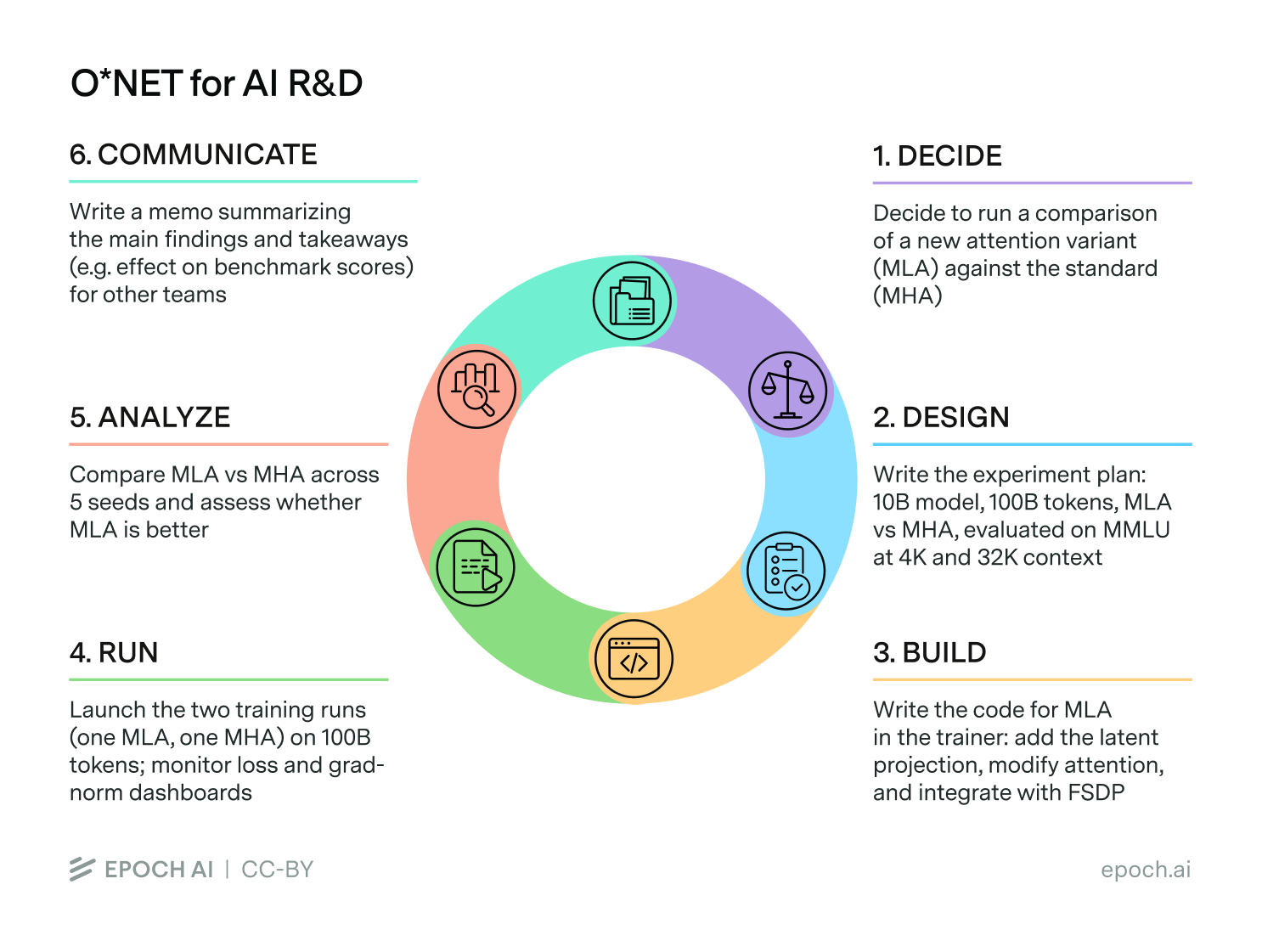
In a 2024 study, Epoch AI researcher David Owen found that AI researchers disagree sharply on how fast their own work will be automated, but agree on where it would start: the engineering, meaning writing and debugging code for experiments (epoch.ai). Owen interviewed eight researchers from industry, nonprofit and academic labs, in work funded by the UK AI Safety Institute. They described research as a loop of forming a hypothesis, running experiments and reading results. Planning and hypotheses were called vital but took relatively little time; implementation and debugging were just as important and far more time-consuming, and stayed central even for senior researchers with management duties. That reframes the forecasting debate: the open question is when engineering gets automated, not which tasks matter.
The spread of predictions for the following five years was wide. Two participants expected agents to implement code and experiments from plain-language descriptions, which by their own accounts could automate half or more of their work. Two expected coding assistants to keep improving with only a modest effect on research, one calling a 20 to 50% productivity gain an extremely optimistic upper bound. The other four fell in between, and most stressed their predictions had low confidence. The obstacles they named were reliability, open-ended planning, long- reasoning, deep reasoning and novelty. On reliability, one asked whether a failed run means an idea doesn't work or that the agent made a mistake, and another argued that processing a longer context is "orthogonal" to actually using it.
Owen also showed participants sample tasks from AI R&D evaluations then in development, such as swapping a model's for sparse attention and it, or fixing a CUDA concurrency bug. Six of eight said an AI that could do such tasks autonomously would automate a substantial share of their hours; one put it at 60% of their time. Two were skeptical because their work relies on more open-ended problems, and five preferred evaluations that measure partial automation rather than end-to-end completion. Since six of eight also doubted AI would reach that level soon, Owen suggests full-automation evaluations are best suited to catching an extreme outcome: rapid, substantial automation of AI research.
The interviews predate today's agents, and one participant's critique referred to GPT-4, so they show how researchers reasoned in 2024 rather than where the tools stand now. Owen returned to the question later in Can AI automate AI R&D yet?, which tests models on a research task directly instead of asking researchers.
- The study is qualitative: open-ended interviews with eight AI researchers from industry, nonprofit and academic labs, with recurring themes summarized rather than a statistical survey.
- Participants described hypothesis creation and research planning as vital but taking relatively little project time, while coding and debugging are similarly important and more time-consuming, even for senior researchers.
- Timeline predictions differed greatly, but all participants agreed engineering tasks will drive R&D automation over the next five years, so disagreement is about when engineering is automated, not which tasks matter.
- Existing engineering-focused AI R&D evaluations were seen as a promising start; most participants said an AI that could solve them would significantly accelerate their own work.
- context window — The maximum amount of text a model can consider at once — its working memory for the current conversation or task.
- AI agent — An AI system that doesn't just answer once but works toward a goal in a loop — taking actions, reading the results, and deciding what to do next.
- attention — The mechanism that lets a model weigh which earlier words matter for the word it's currently processing — the core operation of a transformer.
- fine-tuning — Taking a trained model and training it a bit more on your own examples so it gets better at one specific job.
Checking sign-in…
Loading comments…