Meta S Muse Ember Is The Cheapest Model Scoring 36 On The Intelligence Index
Source
artificialanalysis.ai
Author
Artificial Analysis articles
Date
Why it matters
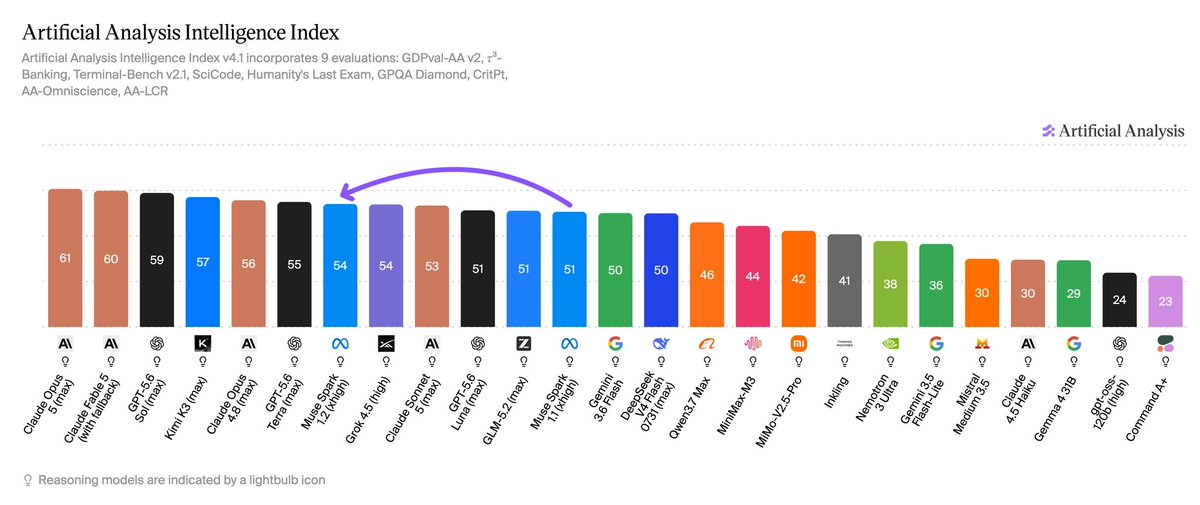
Meta's Muse Ember matches Claude Haiku 5.5 on the Intelligence Index at about a third of the cost per task ($0.14), but with weak knowledge accuracy. This helps you choose a cheap model for agentic workloads.
Key takeaways · AI-distilled
Artificial Analysis traces Muse Ember's lower cost per task to two things: cached input, most of the cost in its agentic evaluations, is 60% cheaper than Claude Haiku 5.5's, and Muse Ember (max) uses roughly a third as many output tokenThe chunk of text a model reads and writes in — roughly three-quarters of a word — and the unit AI usage is billed in.Full definition →.
Muse Ember (max) scores 36 against Muse Wonder (max)'s 44 on the Intelligence Index at about 1/50th the cost per task ($0.14 vs $6.95), and ties Muse Wonder on AutomationBench-AA at 68.1%.
Agentic coding results split by benchmarkA standard public test set for comparing AI models — the shared scoreboards behind every "model X beats model Y" claim.Full definition →: Muse Ember (max) beats Claude Haiku 5.5 (max) on Terminal-Bench 4.0 (40.9% vs 32.8%) but trails on FrontierCode 2.0 (27.2% vs 34.9%). Run in Muse Code, it scores 46 on AA's Coding AI agentAn AI system that doesn't just answer once but works toward a goal in a loop — taking actions, reading the results, and deciding what to do next.Full definition → Index vs 37 for Haiku in Claude Code.
Its 21.1% AA-Omniscience accuracy is the lowest among the similarly intelligent models compared, mainly because it declines to answer 64% of questions. That refusal habit holds its hallucinationWhen a model states something false with full confidence — inventing facts, citations, or APIs that don't exist.Full definition → rate to 17.4%, half of Claude Haiku 5.5 (max)'s.
Terms in this piece · Glossary
hallucination — When a model states something false with full confidence — inventing facts, citations, or APIs that don't exist.
token — The chunk of text a model reads and writes in — roughly three-quarters of a word — and the unit AI usage is billed in.
benchmark — A standard public test set for comparing AI models — the shared scoreboards behind every "model X beats model Y" claim.
AI agent — An AI system that doesn't just answer once but works toward a goal in a loop — taking actions, reading the results, and deciding what to do next.