[AINews] Fable 5.2 retakes World #1 LLM spot as $ANT IPO roadshow begins
- Source
- latent.space
- Author
- swyx .ai
- Date

Context
Anthropic cut Claude Fable 5.2's list price 20% below Fable 5.1's, to $8 per million input and $40 per million output tokens, yet the model can cost more per job because it does more work on each one. That is the lead point of Latent Space's AINews issue collecting launch-week results. SemiAnalysis ran Fable 5.2 on GDPx, its of professional tasks, where it placed first at 16.4%, and reported an average cost per task of $88.15, 31% more than the $67.16 it measured for Fable 5.1.
SemiAnalysis attributes both the higher score and the higher cost to how thoroughly the model checks itself. In its runs Fable 5.2 often generated hundreds or thousands of test cases where Opus 5.5 and Fable 5.1 stopped at about 20, and it was more eager to launch subagents to re-derive and audit its work independently. Anthropic's own prompting guide describes the same habit: it observed Fable 5.2 using subagents to review its own work at the xhigh and max effort levels, which Fable 5.1 did not do on the same tasks, and it warns that subagents can account for a large part of a session's cost. SemiAnalysis's posts on the result do not say which effort level the GDPx run used.
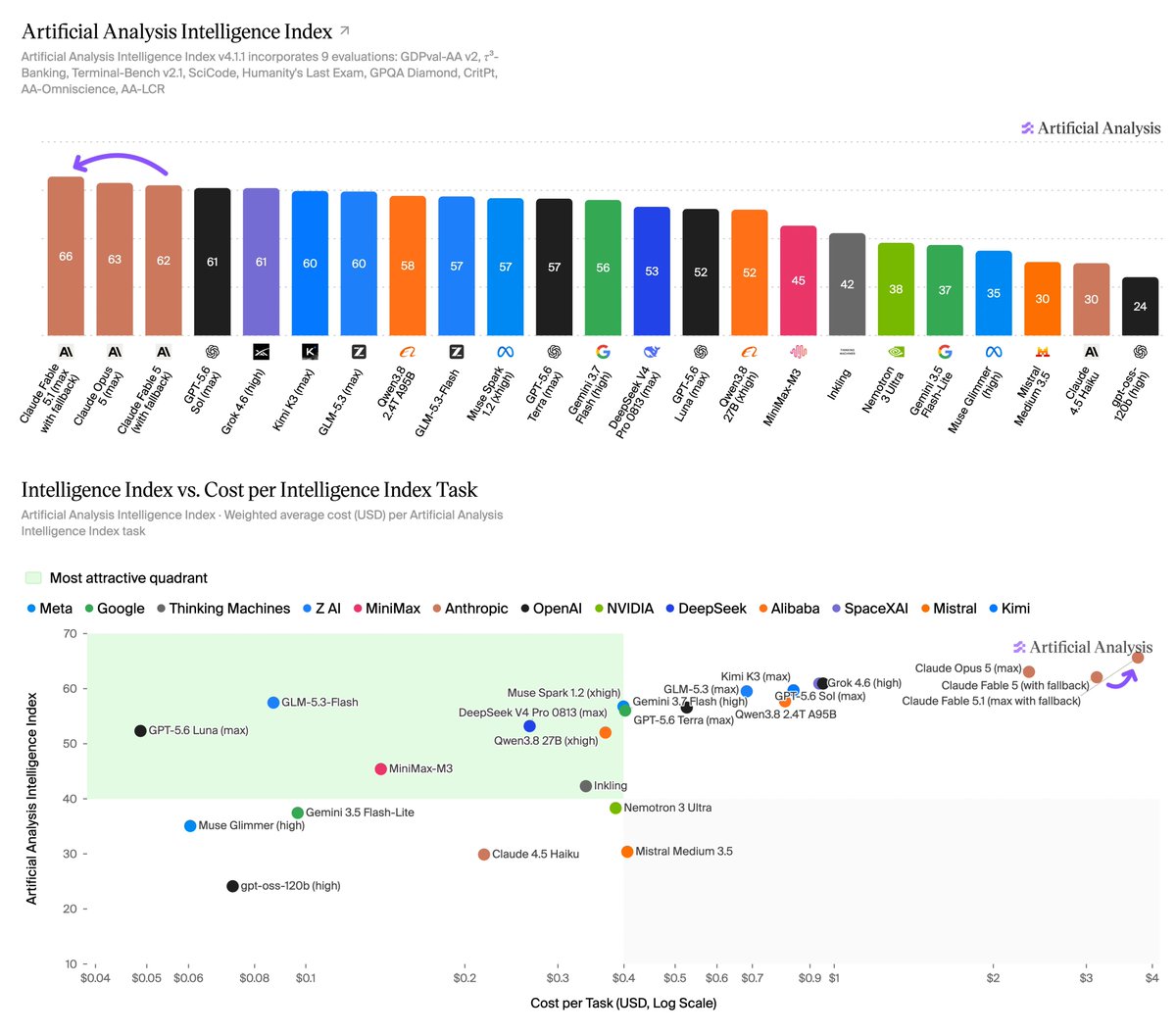
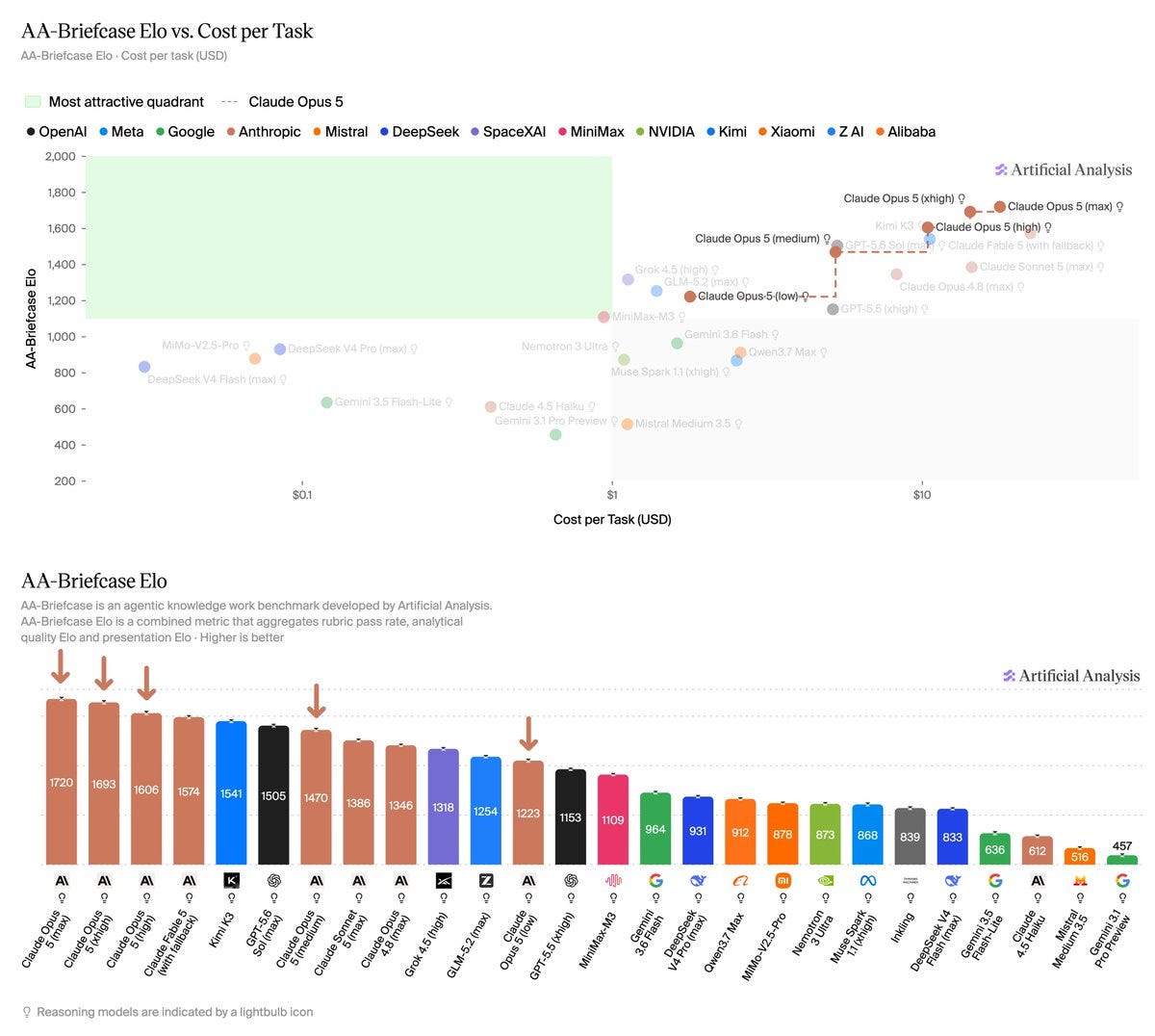
Effort level, the setting that controls how much the model thinks and how many tokens it spends, is therefore the other lever on what a task costs. Artificial Analysis figures quoted in the newsletter put Fable 5.2 at about $26.5 per task on its index at max effort, roughly 2.6 times Opus 5.5 ($10.0) and twice Fable 5.1 ($12.99), while at high and xhigh it scored 62 using about 98k output tokens per task against 173k for Opus 5.5 at max. Anthropic's guide recommends starting at high, the API default, and says most of the capability gain is already present there. The newsletter also reports that several evaluators, Vals among them, saw scores at max or xhigh fall below high, and it relays Anthropic's claim that Fable at high matched Opus 5.5 at max on FrontierCode 2.0 for about half the cost per task.
- SemiAnalysis found Fable 5.2's 20% per-token price cut ($8/$40 vs $10/$50) did not lower task cost: GDPx cost per task rose 31%, from $67.16 to $88.15, because 5.2 wrote hundreds or thousands of test cases where Fable 5.1 and Opus 5.5 tried about 20.
- Several , Vals among them, show Fable 5.2 scoring lower at max or xhigh effort than at high, and one researcher notes only Fable models show this dip, not Opus or Sonnet. Cursor advises starting at the default effort instead of carrying over 5.1 settings.
- Per Artificial Analysis, Fable 5.2 at high and xhigh scores 62 on its index using about 98k output tokens per task, versus 173k for Opus 5.5 at max. At max effort, Fable costs about $26.5 per task, roughly 2.6x Opus 5.5 ($10.0).
- Fable 5.2 does not lead everywhere: on Terminal-Bench 4.0 it scored 60%, level with Opus 5.5 and behind Kimi K3.1 Pro (67%), and a SemiAnalysis domain breakdown found no gain in finance, legal, quant trading or hardware design.
- One developer's analysis of 1.1M logged requests on a $200 Ultra plan found it buys about $15,000 a month of Opus 5.5 usage but only about $3,000 of Fable 5.2, and Fable can use at most 50% of the weekly limit.
- token — The chunk of text a model reads and writes in — roughly three-quarters of a word — and the unit AI usage is billed in.
- benchmark — A standard public test set for comparing AI models — the shared scoreboards behind every "model X beats model Y" claim.
- eval — A repeatable test for AI quality — a set of tasks plus scoring — used the way software teams use test suites, because model output is too variable to judge by eyeballing.
 articleWhat Frontier Labs Buy: A Data Deep Dive with Handshake AI — Garrett Lord & Team
- articleHow Stanford Teaches AI-Native Engineering — Mihail Eric, Monaco
- article[AINews] Inkling 2 Small: 17A-594B trained in 68 hours on 12T tokens, beating Muse Spark
- article[AINews] LLMs can read & write neural network weights: "Weight Space Programming" cuts Autoresearch out of the RSI loop
Checking sign-in…
Loading comments…