Why is Gemini 4 Carbon taking so long?
- Source
- kernel.dev
- Author
- deenadz
- Date
Context
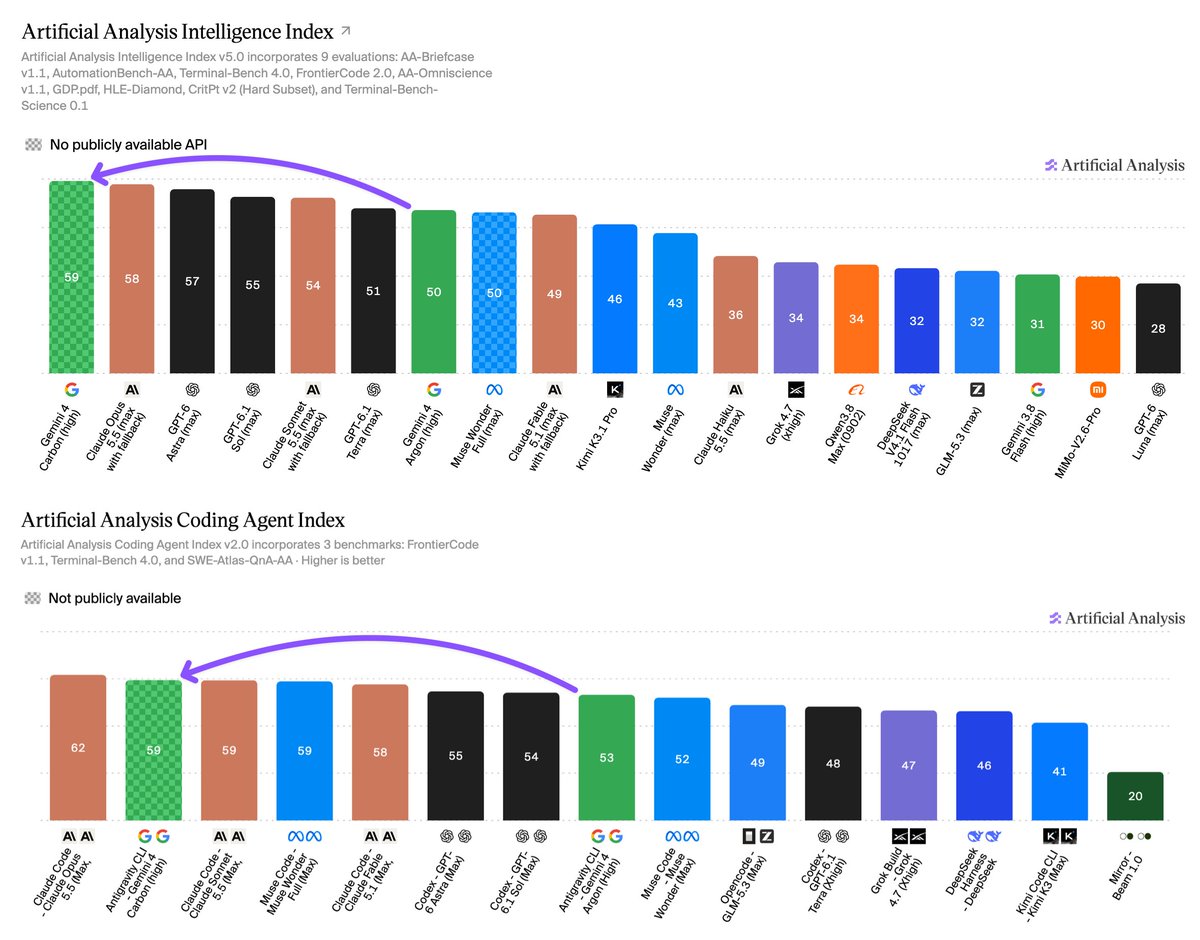
Gemini 4 Carbon, the frontier model from Google DeepMind, is slow on agentic bug fixing mostly because it does far more work per task, not because each response arrives late. That is the finding of a trace analysis by Kernel, which ran Carbon on a private evaluation: the gets a codebase from just before a real bug was fixed, plus a report describing only the symptoms, and must find and fix the bug without unrelated changes. At high effort Carbon averaged 56 minutes per task, while Anthropic's Opus 5.5 and OpenAI's GPT-6 Astra took 2 to 4 minutes at normal effort.
Kernel separated time per step from the number of steps. Slower , which covers provider queueing, network latency and generation speed, explains 16 to 30 percent of Carbon's extra time against Astra and roughly half against Opus. The rest comes from longer runs. Carbon took about seven times as many steps as Astra and eleven times as many actions, such as reading a file or running a command, and because every step resends a growing conversation, it processed more than sixteen times as much input. Running Carbon in two other coding agents, opencode and mini-SWE-agent, made no meaningful difference, and at its low effort setting it often circled without producing a fix.
Labelling every step by purpose showed where the extra work went. About half of Carbon's steps served nothing the bug report asked for: it kept auditing related code after finding the cause and hardened the code against cases the report had already ruled out. In one sample run, Carbon identified the cause in about six minutes but wrote no code for another 25. When Kernel re-ran that task with an automatic question every five turns, asking whether it already had enough to make the fix, the run fell from 37 to 28 minutes and the gap between naming the cause and the first edit shrank from 25 minutes to about 10. Kernel reads this as a behavioural habit rather than missing knowledge. It separately estimates that Carbon's one-file-at-a-time reading and frequent re-reading (39 percent of the lines it read were repeats, against 7 percent for Astra) account for roughly a quarter of the excess runtime.
These are one company's measurements on its own private tasks, and the check-in result rests on a single re-run, so they explain the pattern more firmly than they size it. The pattern matches Every's day-zero review, posted by Dan Shipper, in which a tester gave Carbon a backlog, it marked 6 tasks as ready, and then it did 15. Taken together, the evidence points to a model that keeps working after it has found the answer, so how an prompts it to stop may matter to Carbon's real-world speed.
- AI agent — An AI system that doesn't just answer once but works toward a goal in a loop — taking actions, reading the results, and deciding what to do next.
- inference — Running a trained model to get answers — the phase where AI is actually used, as opposed to trained.
- agent harness — The scaffolding around a model that turns it into a working agent — the loop, the tools it can call, and the rules for when to stop.
- context window — The maximum amount of text a model can consider at once — its working memory for the current conversation or task.

Checking sign-in…
Loading comments…